The $25,000 Day Trading Minimum Is Gone. Here's What It Means for You.
April 24, 2026

The SEC has eliminated the Pattern Day Trader rule. Starting June 4, 2026, the $25,000 minimum equity requirement and the PDT designation itself will no longer exist. TradeZero America will be ready on day one.
What Is the Pattern Day Trader (PDT) Rule?
The Pattern Day Trader rule was a FINRA regulation that classified any retail trader who executed four or more day trades within a five-business-day period — using a margin account at a FINRA member broker-dealer — as a "pattern day trader." Once that designation was applied, the trader was required to maintain a minimum equity balance of $25,000 in their account at all times in order to continue margin day trading.
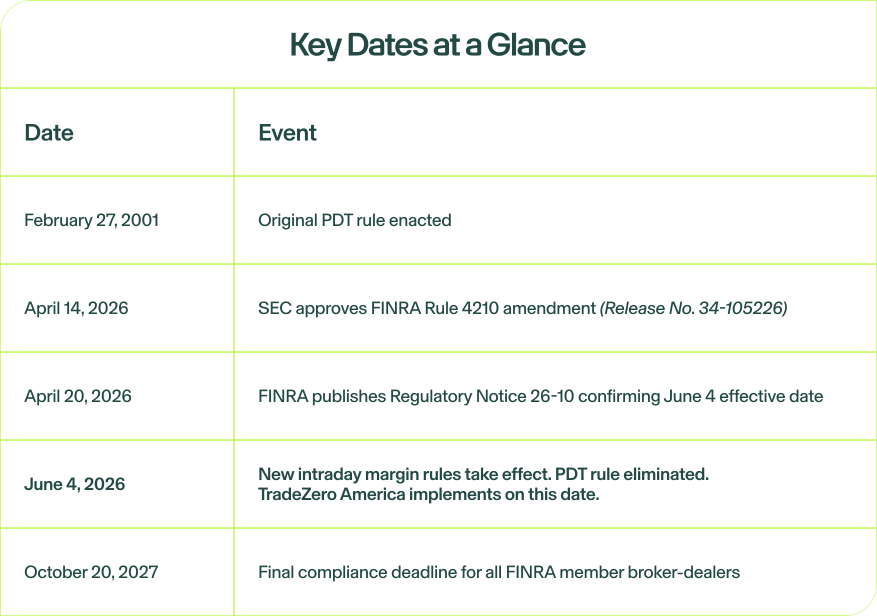
Introduced in February 2001 in the aftermath of the dot-com bust, the rule was designed to protect retail traders from rapid losses during a period of high commissions and limited risk monitoring technology. For 25 years, it stood unchanged — and it effectively locked many retail traders out of active participation in the U.S. equities market.
That changes on June 4, 2026.
What Has Changed? The SEC and FINRA's New Rule
On April 14, 2026, the Securities and Exchange Commission approved FINRA's amendment to Rule 4210. On April 20, 2026, FINRA published Regulatory Notice 26-10 confirming the effective date: June 4, 2026. It is the first change to these margin rules since they were enacted on February 27, 2001.
The amendment replaces the old PDT framework entirely with a modern, risk-based intraday margin standard. Here is precisely what is being removed and what is replacing it:
What is being eliminated:
- The $25,000 minimum equity requirement specific to day trading
- The "pattern day trader" designation
- The four-or-more-day-trades-in-five-business-days classification
What is replacing it:
- A risk-based intraday margin framework tied to your actual market exposure during the trading day
- Intraday buying power determined by real-time account capacity and margin maintenance levels — not trade count
- Broker-level flexibility to monitor margin in real time or via a single end-of-day calculation
The full regulatory basis can be found in SEC Release No. 34-105226 (April 14, 2026) and FINRA Regulatory Notice 26-10 (April 20, 2026).
When Does the PDT Rule Change Take Effect?
The new rules take effect on June 4, 2026.
FINRA has confirmed this date in Regulatory Notice 26-10. Brokers who are ready will implement the new framework on that date. Firms that require additional time have until October 20, 2027 as a final compliance deadline — meaning not all brokers will be ready on June 4.
TradeZero America will be ready on June 4, 2026 — the first possible day.
How Will the New Intraday Margin Rules Work?
Under the new framework, your day trading access is no longer gated by a fixed equity threshold or a trade count. Instead, your available buying power during the trading day is determined by your actual account exposure and margin maintenance requirements.
The key mechanics:
Intraday margin deficit calculation. Brokers will assess your intraday margin position based on the highest deficiency between your maintenance margin requirement and your account equity following any position change during the day. If your account falls short of its margin maintenance requirement at any point, you have an intraday margin deficit.
Two permitted monitoring approaches. Brokers may monitor accounts in real time — with the ability to block trades that would create or increase a margin shortfall — or they may run a single end-of-day calculation to assess intraday exposure. Both approaches are permissible under the new rule.
Standard margin account minimums apply. The $25,000 PDT-specific floor is gone, but a margin account still requires the standard brokerage minimum — typically $2,000 — to open. This is a pre-existing requirement, not a new one.
What Is the 90-Day Restriction and When Does It Apply?
The new framework includes a discipline mechanism traders should understand. If you repeatedly fail to satisfy intraday margin deficits — specifically, if a deficit goes unresolved for more than five business days — your broker will be required to restrict you from creating or increasing short positions or debit balances for 90 calendar days.
There are two important exemptions from this restriction:
- 1.Deficits that do not exceed the lesser of 5% of your account equity or $1,000
- 2.Deficits arising from extraordinary market circumstances
This mechanism is intended to enforce margin discipline in a consistent pattern of shortfalls — not to penalize occasional minor deficits.
What Does This Mean If You've Been Using a Cash Account?
Many retail traders have been using cash accounts specifically to avoid the PDT designation. A cash account has no minimum equity requirement and no day trade restrictions, but it limits you to trading with only settled cash. Once capital is deployed in a trade, those funds are unavailable until the trade closes and the proceeds settle — in practice, this means running out of buying power after one or two trades and waiting.
With the $25,000 barrier removed from margin accounts, the primary reason most traders operated cash accounts as a workaround effectively disappears. A standard margin account will provide intraday buying power without the cash settlement constraint — allowing you to enter and exit positions repeatedly throughout the trading day.
What About Futures, Forex, and Crypto?
It is worth noting that the PDT rule has always applied exclusively to U.S. equities and equity options traded through FINRA member broker-dealers. It has never applied to futures markets, foreign exchange markets, or cryptocurrency markets, which operate under different regulatory frameworks with their own margin structures.
The June 4 change affects margin day trading in U.S. equities and equity options specifically.
What to Expect from TradeZero America
Any funded margin accounts that maintain more than $2,000 will be ready to day trade using overnight margin buying power. The restriction of three round trip trades will be removed on this day. TradeZero America will be ready to remove the PDT restriction on the first possible day, which is June 4, 2026.
We will publish further details on our specific intraday margin implementation ahead of the June 4 effective date.
Frequently Asked Questions
Do I need $25,000 to day trade after June 4, 2026? No. The $25,000 minimum equity requirement specific to day trading will be eliminated on June 4, 2026. Standard margin account minimums — typically $2,000 — will apply, as set by individual brokers.
Will I be flagged as a pattern day trader after June 4, 2026? No. The pattern day trader designation is being eliminated entirely. Day trades will no longer be counted for the purpose of restricting account activity.
What happens if I exceed my intraday margin under the new rules? If you have a margin deficit and it remains unresolved for more than five business days, your broker may restrict your ability to create or increase short positions or debit balances for 90 calendar days. Deficits below 5% of your equity or $1,000 — whichever is lower — are exempt from triggering this restriction.
When will TradeZero America implement the new rules? TradeZero America will implement the new intraday margin framework on June 4, 2026 — the first available date under the new regulations.
Does this affect my cash account? The PDT rule applies only to margin accounts. However, the removal of the $25,000 barrier significantly reduces the practical reason many traders have maintained cash accounts as a workaround. A funded margin account above $2,000 will provide full intraday buying power without the cash settlement delay.
Does this rule change apply to futures or crypto trading? No. The PDT rule and its successor intraday margin framework apply only to U.S. equities and equity options traded through FINRA member broker-dealers. Futures, forex, and cryptocurrency markets are unaffected.
References
- SEC Release No. 34-105226 (April 14, 2026)
- FINRA Regulatory Notice 26-10 (April 20, 2026): finra.org/rules-guidance/notices/26-10
- FINRA Rule 4210 (Margin Requirements)
Disclaimer
TradeZero America, Inc., a United States broker dealer, registered with the Securities and Exchange Commission (SEC) and member of the Financial Industry Regulatory Authority (FINRA) and the Securities Investor Protection Corporation (SIPC); TradeZero, Inc., a Bahamian broker dealer, registered with the Securities Commission of the Bahamas; TradeZero Canada Securities ULC, a Canadian broker dealer, member firm of Canadian Investment Regulatory Organization (CIRO) and member of the Canadian Investor Protection Fund (CIPF); and TradeZero Europe B.V., a Dutch broker dealer, authorized and regulated by the Dutch Authority for the Financial Markets (AFM) (collectively, the “TradeZero Broker Dealers”).
TradeZero Broker Dealers offer self-directed electronic securities trading to their customers. TradeZero Broker Dealers do not provide financial or trading advice and do not make investment recommendations to their customers. This communication does not constitute an offer to sell or a solicitation to buy any security or instrument which it may reference. There is a risk of loss in online trading of securities including equities and options. Trading on margin is for experienced investors whereby the loss can be greater than your initial investment. Likewise, short selling as a securities trading strategy is extremely risky and can lead to potentially unlimited losses. Options trading is not suitable for all investors as it can involve risk that may expose investors to significant losses. Please read the Characteristics and Risks of Standardized Options, also known as the Options Disclosure Document (ODD) at OCC.
If you have any specific questions about TradeZero’s brokerage services, please reach out to the TradeZero Broker Dealer servicing your jurisdiction.