The 3X Profit Protection Rule
October 15, 2026

Trading Strategies with Bob Iaccino
*Bob Iaccino, Chief Market Strategist and Co-Founder of Path Trading Partners, brings over 30 years of hands-on experience across equities, commodities, futures, and FX markets to his role as our Risk Management and Trading Strategies educator.
Key Points at a Glance
- The 3X Profit Protection Rule is about protecting a good day, not squeezing more out of it.
- Daily risk unit = 3 × per-trade risk. At $200 per trade, that is $600.
- The trigger is three times the daily risk unit: 3 × $600 = $1,800 in realized profit.
- At the trigger, either stop trading or cut size to one-half or one-third, trade only your best setups and set a profit floor.
- Only realized profit counts. Open profit is not protected yet.
- Pair the rule with a daily loss limit and decide everything before the market opens.
What Is the 3X Profit Protection Rule?
Most new day traders do not get hurt by one giant losing trade. More often, they make money early, feel good about the day, keep trading, and then give a big chunk of it back before the close.
That is the problem the 3X Profit Protection Rule is designed to solve.
Once your realized profit reaches three times your daily risk unit, you either reduce your trading size or stop trading altogether. The important part is that the number is decided before the market opens, not after you are already up money.
Start With Your Risk
Your per-trade risk is simply how much you are willing to lose if a trade hits your stop. If you are risking $200 per trade, then $200 is your basic risk amount.
How to Calculate Your Daily Risk Unit
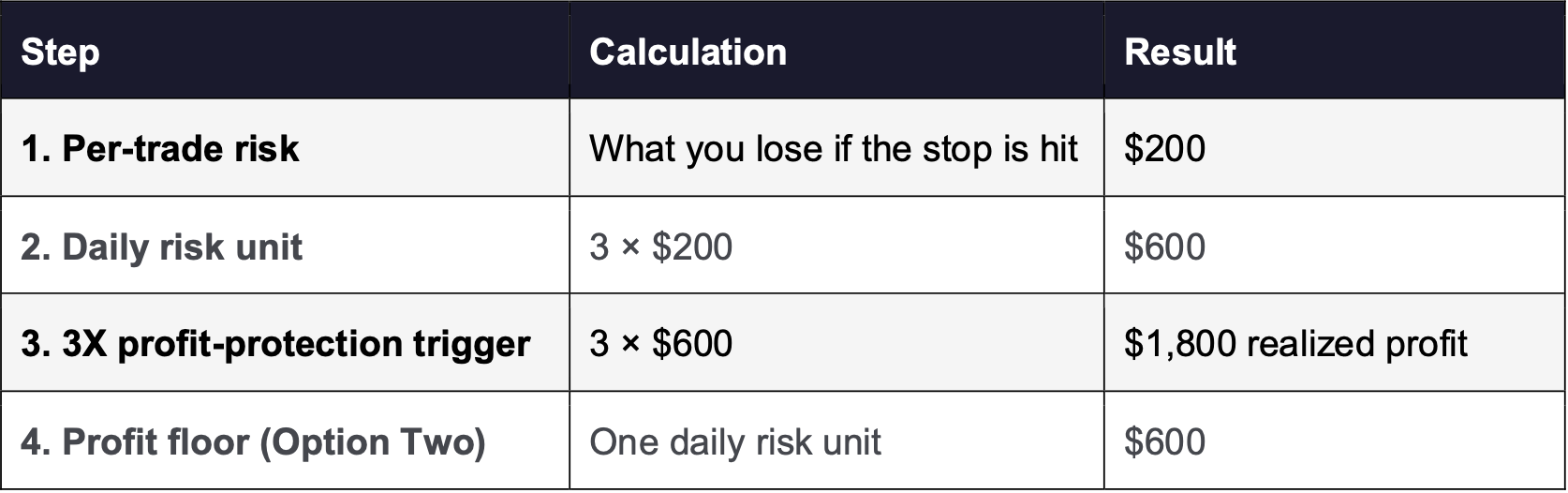
Now define your daily risk unit. A simple approach is three full losing trades:
Daily risk unit = 3 × per-trade risk
So if you risk $200 per trade, your daily risk unit is $600. That $600 becomes the number you use to measure both your daily loss limit and your profit-protection level.
The 3X Rule
Once your realized profit reaches three times your daily risk unit, the goal changes from making more money to protecting what you have already made. Using our example:
3 × $600 = $1,800
Once your closed trades have produced $1,800 in profit, you have reached the 3X level. At that point, you have two choices.
The 3X Rule Step by Step: Worked Example
Hypothetical example for illustration only, based on the figures in the article.
Option One: Stop Trading
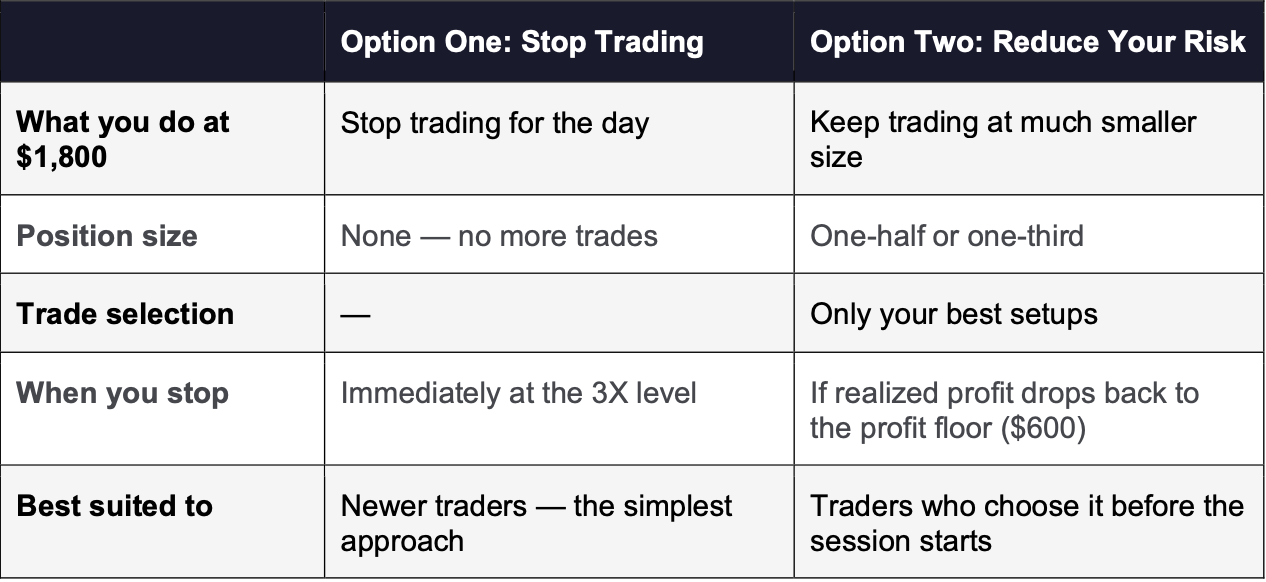
This is the simplest approach, especially for newer traders. Once you hit $1,800 in realized profit, you stop trading for the day.
No “one more trade.” No trying to squeeze another few hundred dollars out of the session. You had a very good day. Keep it.
Option Two: Reduce Your Risk
The second choice is to keep trading, but at much smaller size. Once you hit the 3X level:
- Reduce your position size to one-half or one-third.
- Only take your best setups.
- Establish a profit floor.
What Is a Profit Floor?
Using the same example, that floor might be one daily risk unit, or $600. So if you reach $1,800, continue trading, and your realized profit drops back to $600, you stop.
The key is deciding which option you are using before the session starts.
Stop Trading vs. Reduce Risk: Which Option?
Realized Profit Matters
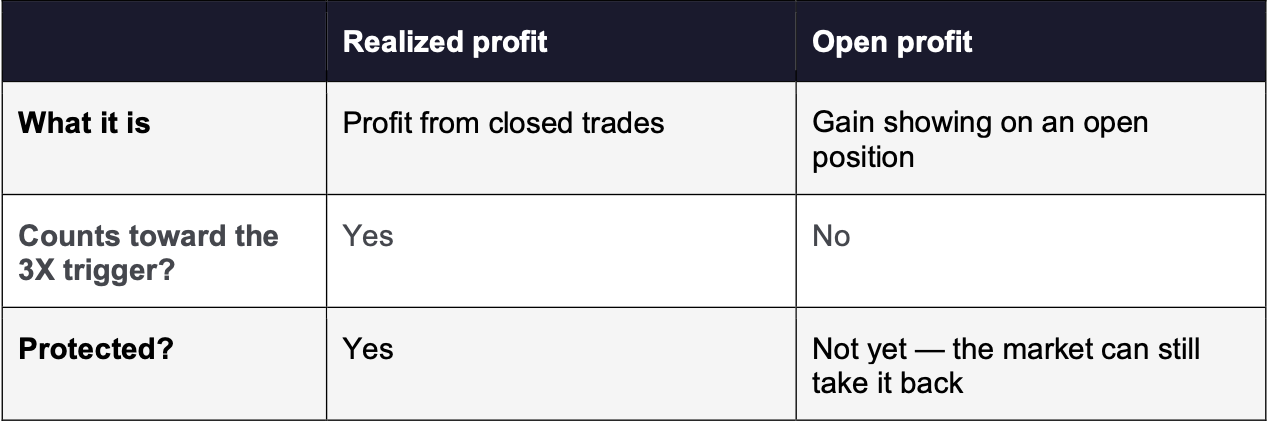
The rule is based on realized profit, not open profit. If you have an open position showing a $2,000 gain, that money is not protected yet. The market can still take it back.
What About Large Open Positions?
The same applies if you have already realized $1,800 but still have a large position open with significant risk. Profit protection is not just what the P&L number says on your screen. It is how much of that money the market can still take away from you.
Realized profit / Open profit
Why Three Times?
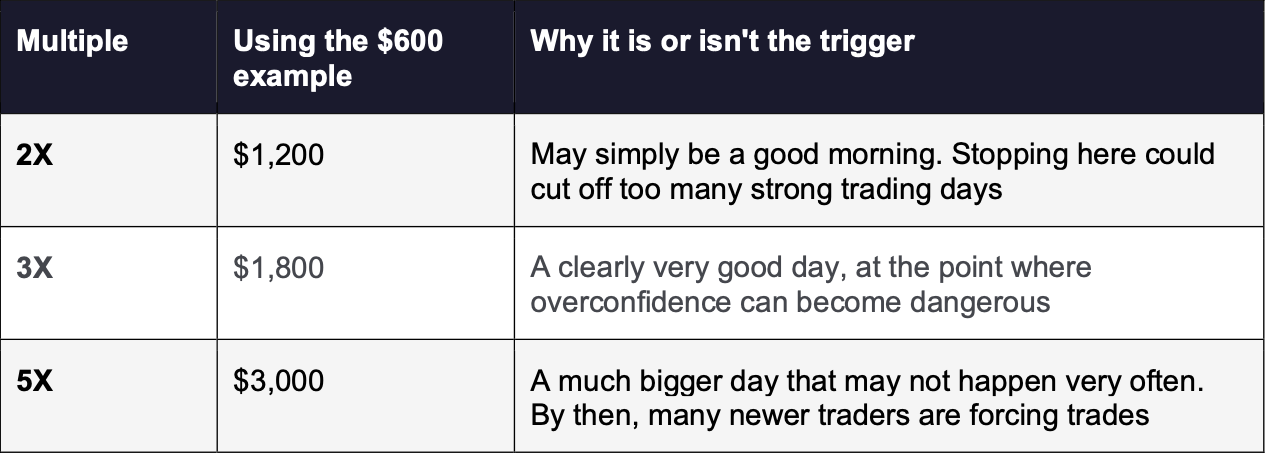
Why not stop at two times your daily risk? Why not wait for five?
Two times may simply be a good morning, and stopping there could cut off too many strong trading days. Five times is a much bigger day and one that may not happen very often. By then, many newer traders have already started forcing trades or taking unnecessary risk.
Three times sits somewhere in the middle. You have clearly had a very good trading day, but you are also reaching the point where overconfidence can become dangerous.
2X, 3X, 5X
You Still Need a Loss Limit
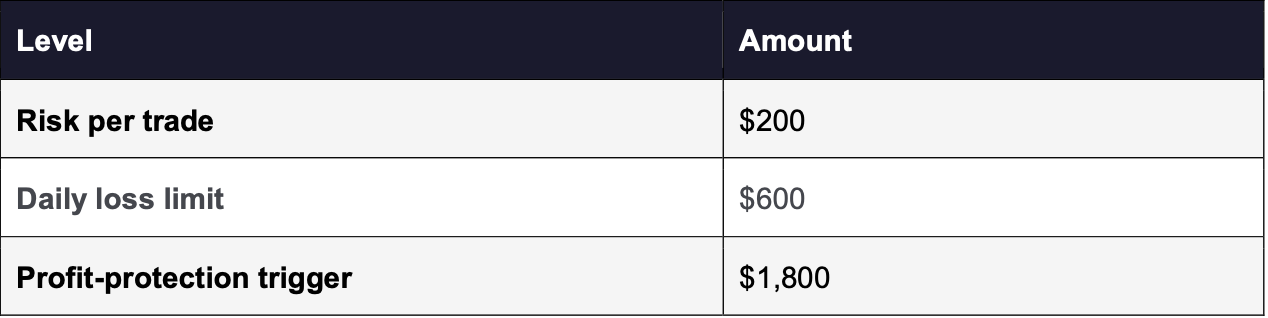
The 3X rule should work alongside a daily loss limit. Using our example:
Level/Amount
So you stop a bad day at minus $600, while you begin protecting a very good day once you reach plus $1,800. That gives you a defined risk structure on both sides.
The Biggest Mistake
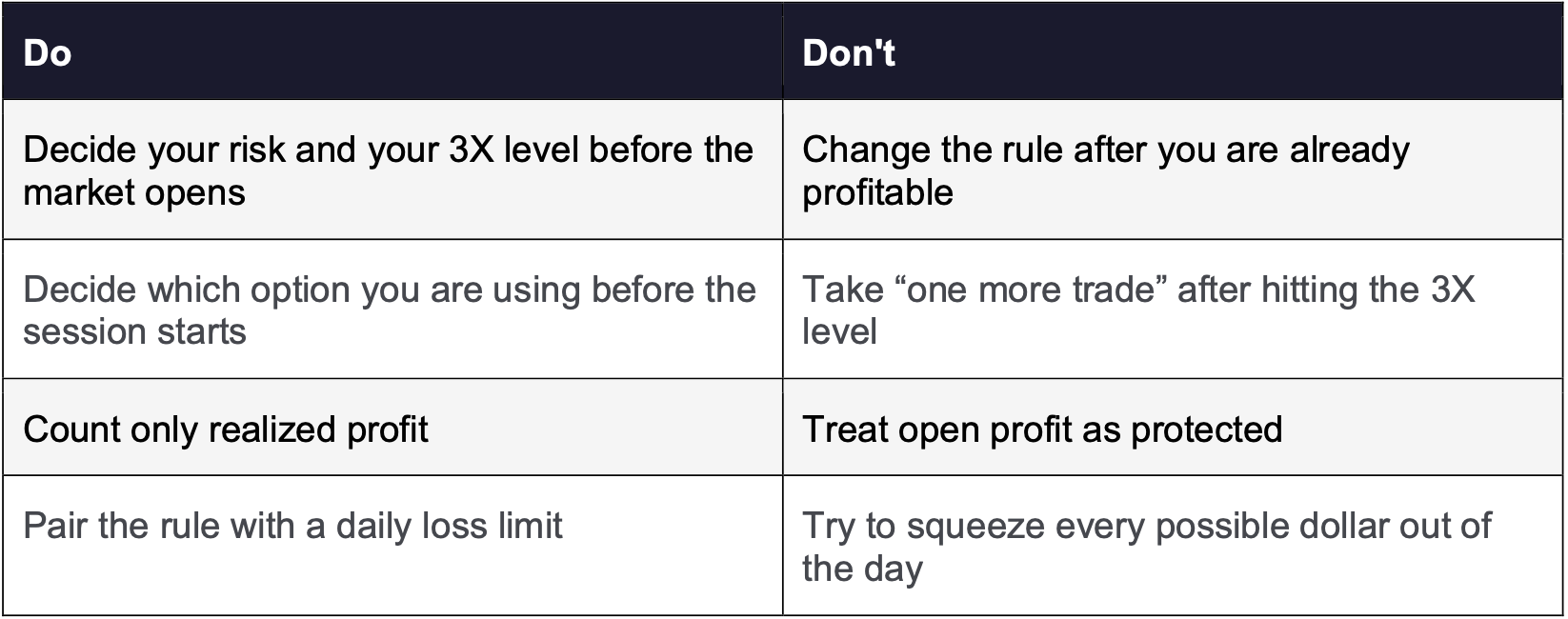
The biggest mistake is changing the rule after you are already profitable. You hit $1,800 and suddenly decide you are going for $2,500.
Then $1,800 becomes $1,200. Then $1,200 becomes $700. Before you know it, a great trading day has turned into an average one. That is exactly what the rule is designed to prevent.
3X Rule Do's and Don'ts
Bottom Line
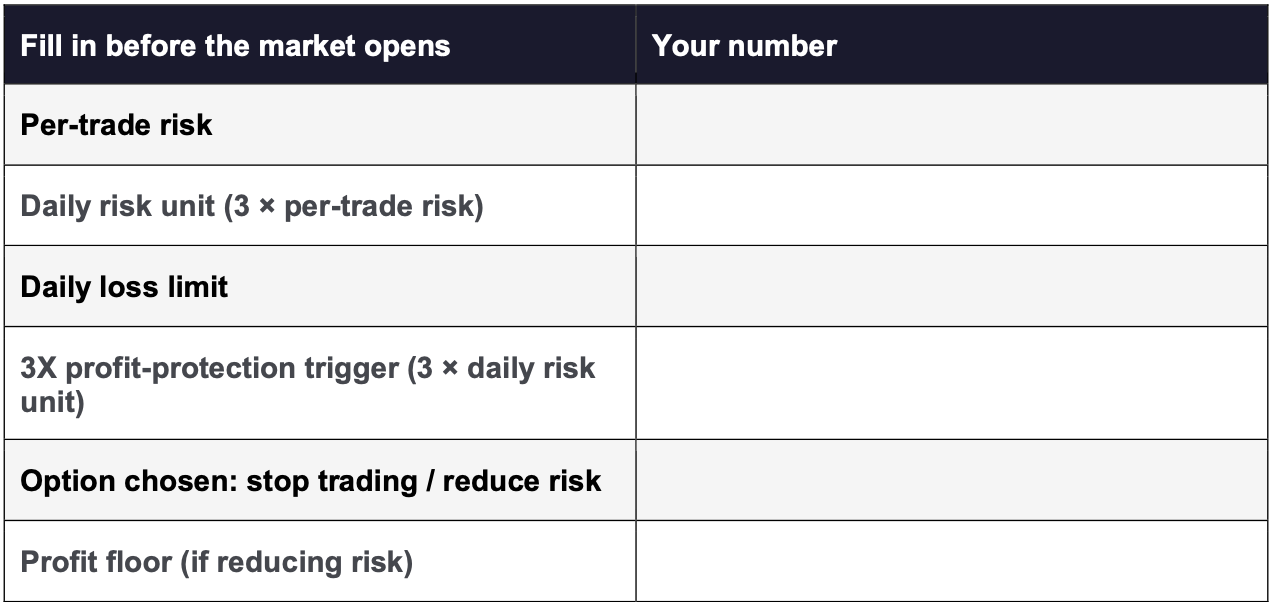
The 3X Profit Protection Rule is simple. Determine your risk before the market opens. Once your realized profit reaches three times your daily risk unit, either stop trading or sharply reduce your exposure.
There will always be another trade. The point is not to squeeze every possible dollar out of every trading day. The point is to make sure that when you have a very good day, you actually keep it.
Your 3X Rule Worksheet
Frequently Asked Questions About the 3X Profit Protection Rule
What is the 3X Profit Protection Rule?
It is a rule for protecting a good trading day. Once your realized profit reaches three times your daily risk unit, you either reduce your trading size or stop trading altogether. The number is decided before the market opens, not after you are already up money.
What problem does the 3X rule solve?
Most new traders do not get hurt by one giant losing trade. More often, they make money early, keep trading, and give a big chunk of it back before the close. In day trading, the rule is designed to stop that pattern by changing the goal from making more money to protecting what has already been made.
How do I calculate my daily risk unit?
Start with your per-trade risk: how much you are willing to lose if a trade hits your stop. A simple approach is to set your daily risk unit at three full losing trades, so daily risk unit = 3 × per-trade risk. At $200 per trade, the daily risk unit is $600.
How do I calculate the 3X profit-protection trigger?
Multiply your daily risk unit by three. With a $600 daily risk unit, the trigger is 3 × $600 = $1,800 in realized profit from closed trades.
What should I do when I hit the 3X level?
You have two choices: stop trading for the day or keep trading at much smaller size. Stopping is the simplest approach, especially for newer traders. Whichever you choose, decide before the session starts.
What does reducing risk after the 3X level involve?
Reduce your position size to one-half or one-third, only take your best setups, and establish a profit floor. If your realized profit drops back to that floor, you stop. Filtering for only the best setups is easier with a stock scanner set up around the criteria you already use, so fewer marginal trades reach your screen.
What is a profit floor?
A profit floor is the level of realized profit at which you stop trading if you have chosen to keep going after the 3X level. In Bob's example, the floor might be one daily risk unit, or $600: reach $1,800, continue trading, and if realized profit drops back to $600, you stop.
Does open profit count toward the 3X rule?
No. The rule is based on realized profit, not open profit. An open position showing a $2,000 gain is not protected yet, because the market can still take it back.
What if I have hit $1,800 but still have a large position open?
That money is not fully protected. Profit protection is not just what the P&L number says on your screen — it is how much of that money the market can still take away from you. A large open position with significant risk still leaves the day's gains exposed.
Why three times and not two or five?
Two times may simply be a good morning, and stopping there could cut off too many strong trading days. Five times is a much bigger day that may not happen very often, and by then many newer traders have already started forcing trades. Three times sits in the middle: a clearly good day, at the point where overconfidence can become dangerous.
Do I still need a daily loss limit?
Yes. The 3X rule works alongside a daily loss limit. In Bob's example, a $200 per-trade risk gives a $600 daily loss limit and an $1,800 profit-protection trigger, so there is a defined risk structure on both sides of the day.
What is the biggest mistake traders make with the 3X rule?
Changing the rule after they are already profitable. A trader hits $1,800 and decides to go for $2,500. Then $1,800 becomes $1,200, then $700, and a great trading day turns into an average one. For a day trader, the fix is to set both the trigger and the chosen option before the market opens and treat them as fixed for the session.
Does the 3X rule apply to short selling?
Yes. The rule is based on realized profit and risk per trade, not on trade direction. If you use short selling, your per-trade risk is still the amount you would lose if the stop is hit, and the same daily risk unit, loss limit and 3X trigger apply. Short positions can carry potentially unlimited losses, so defined stops matter.
Do trading costs affect realized profit?
Realized profit is what your closed trades have actually produced, so commissions and fees reduce it. Measuring the 3X trigger on net figures keeps the rule honest. Using a low cost brokerage means less of each closed trade goes to costs, particularly for traders who make several trades a session.
Should borrow costs count on short trades?
If you short hard-to-borrow stocks, locate fees are part of the cost of the trade. When using hard to borrow locates, factor those fees into your realized profit so the 3X trigger reflects what the day actually produced.
Is the 3X rule suitable for new traders?
Bob describes stopping at the 3X level as the simplest approach, especially for newer traders. The rule gives a defined structure for good days as well as bad ones. As with any risk framework, results will vary and past results do not guarantee future outcomes.
Related Reading From This Series
- How to Always Manage Your Risk Like a Professional Trader
- The ATR Position Sizing Formula: How to Size Every Trade Around Volatility
- When Not to Trade
- Trade Setup Scoring Matrix: How to Grade a Setup
Disclosure
This Blog (hereafter referred to as the "Content") is produced by TradeZero. The Content may include the views and opinions of TradeZero and a third-party participant, Bob Iaccino. Bob Iaccino is compensated by TradeZero for participating in the Content. Mr. Iaccino's trading experiences and accomplishments are unique, and your trading results may vary substantially from his. TradeZero is not responsible for and neither affirms nor endorses any of Mr. Iaccino's views or opinions expressed in the Content. TradeZero makes no representations or warranties with respect to the accuracy of the Content or information available through any referenced or linked third party sites. The Content has been made available for informational and educational purposes only and should not be considered trading or investment advice or a recommendation as to any security. Nothing in this Content constitutes a personalized investment recommendation. Any securities discussed are referenced solely for illustrative and educational purposes.
Trading securities can involve high risk and potential loss of funds. Furthermore, trading on margin is for experienced investors and traders. Margin trading can result in losses that may be greater than your initial investment. Likewise, short selling as a securities trading strategy is extremely risky and can lead to potentially unlimited losses.
Options trading is not suitable for all investors as it can involve risk that may expose investors to significant losses. Please read the Characteristics and Risks of Standardized Options, also known as the options disclosure document (ODD) at OCC before deciding to engage in options trading.
TradeZero provides self-directed brokerage accounts to customers through its operating affiliates: TradeZero America, Inc. a United States broker dealer, registered with the Securities and Exchange Commission (SEC) and member of the Financial Industry Regulatory Authority (FINRA) and the Securities Investor Protection Corporation (SIPC); TradeZero, Inc., a Bahamian broker dealer, registered with the Securities Commission of the Bahamas; and TradeZero Canada Securities ULC, a Canadian broker dealer, member firm of the Canadian Investment Regulatory Organization (CIRO) and member of the Canadian Investor Protection Fund (CIPF); and TradeZero Europe B.V., a Dutch broker dealer, authorized and regulated by the Netherlands Authority for the Financial Markets (AFM) and subject to the regulatory framework of the European Securities and Markets Authority (ESMA) under MiFID II (collectively, the "TradeZero Broker Dealers").