Iron Condor: How Traders Use This Options Strategy to Seek Range-Bound Profits with Limited Risk
May 27, 2026

By Shane Neagle
The Iron Condor enjoys a vaunted position as one of the most recognized strategies in the advanced options trader’s playbook. The strategy consists of four legs and offers a setup with clearly defined potential losses that may be appropriate for traders seeking to collect premiums in rangebound or sideways markets.
There’s a lot to like about the Iron Condor, and experienced retail traders often favor this approach since it relies on a structured, rules-based setup rather than pure speculation. Through the act of pairing a bear call spread with a bull put spread, traders can use this position in low-volatility environments, where time decay can work in favor of the short option legs.
While strategies like these have long been relatively complex to put into play, TradeZero’s new advanced multi-leg options execution tools are designed to help traders more efficiently implement strategies such as the Iron Condor, potentially providing enhanced visibility and convenience when managing positions.
What Is an Iron Condor?
Let’s begin with structure. An Iron Condor is a defined-risk options trading strategy that consists of two vertical spreads combined into one position. In essence, think of the Iron Condor as a trade that consists of a bear call spread and a bull put spread at the same time.
So, to get an Iron Condor, we use four option contracts in total, all of which have the same expiration date. The difference between the four legs lies in the strike prices.
On the call side, the Iron Condor consists of a sold out-of-the-money (OTM) call and a purchased OTM call that has a strike price that is deeper out-of-the-money. When it comes to the put side, we have a sold OTM put and a purchased OTM put with a deeper out-of-the-money strike.
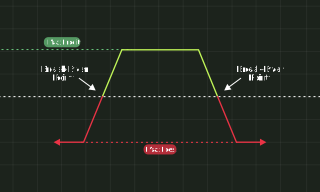
The result is a net credit and a position with a high degree of visibility, as there’s a clearly defined range where the trade can become profitable. That credit that we just mentioned also doubles as the position’s maximum potential gain, which is reached if the underlying asset’s price stays between the two short strikes until the time of expiration.
With the Iron Condor, the basic idea is to have both of the spreads expire worthless, with the goal of leaving the trader to collect the full premium received from the sold contracts.
How the Iron Condor Works
As a four-leg position, the Iron Condor can appear daunting at first. Let’s reiterate the setup’s structure and then try to clear it up:
- A trader sells an out-of-the-money call
- Followed by purchasing a further out-of-the-money call
- Then, the trader sells an out-of-the-money put
- Followed by purchasing a further out-of-the-money put
The short call and short put are at the center of this trade, and form the “body” of the Condor, while the long call and long put form the “wings” of the setup. Whereas the wings can help cap losses, the body defines the range in which the trade can be profitable.
If the underlying asset’s price at the time of expiration is within the range of the “body”, then all the options contracts may expire worthless, and the trader could retain the full premium collected, representing the maximum potential gain.
If, however, the asset's price moves beyond either of the long legs’ strike prices, we end up in a situation where one spread can be fully in the money, while the other can expire worthless, leading to maximum potential loss. However, a key component of the strategy is the fact that maximum theoretical losses are known ahead of time, since the purchased contracts help protect from unlimited risk, and can thus make the overall strategy comparatively less risky than outright purchasing either calls or puts.
There’s one final element that should be touched upon, and that is Theta, or time decay. All four legs of the trade lose value as the expiration date approaches, so the position may benefit from the passing of time. Traders who put the Iron Condor into play generally seek to run out the clock, or, to be more literal, have prices remain within the desired range as the expiration date approaches.
Risk, Reward, and Breakeven Points
In order to gain a solid, practical understanding of the Iron Condor, traders have to hone in on three key elements: maximum potential gain, maximum potential loss, and specific setup’s breakeven levels. An understanding of the aforementioned may help traders determine whether or not the strategy fits their broader outlook in given circumstances.
To help tie everything together (and make it a bit more grounded), we’ll use a simple, hypothetical example to illustrate.
Let’s begin with the assumption that we’re dealing with a stock trading close to the $200 mark. Here, our hypothetical trader would:
- Sell a $210 call and receive a $1.50 premium
- Buy a $215 call for $0.50
- Sell a $190 put and receive a $1.50 premium
- Buy a $185 put for $0.50
So, we have $3 collected in premiums, with $1 paid in premiums, leaving us with a net credit of $2. This also defines the maximum possible gain, which is capped at $2, and may occur if the underlying asset’s price at the time of expiration is between the two short strikes; in this instance, $210 and $190.
What about maximum theoretical losses? They can occur if the underlying asset’s price crosses over or under either wing of the Condor; in this instance, that means above $215 or below $185. To calculate maximum potential loss, we take the spread width, which is $5 in this example, and subtract the $2 net premium received, giving us a $3 maximum possible loss. This capped downside is what makes the Iron Condor a defined-risk strategy.
The last order of business we have to take into account is the breakeven points. At the call wing, the breakeven point is calculated by taking the short strike and adding the credit. In this case, since those figures are $2 and $210, we have a breakeven point at $212. On the put wing, we subtract the credit from the short strike; and since we have a $2 credit and a $185 strike, the breakeven point would be $188.
Before we move on to a set of practical advice, we have to single out one overarching point. Success with the Iron Condor hinges on selecting spread widths (which is to say, strike prices) that are balanced with the premium received and in accordance with your risk tolerance. While tighter spreads lead to smaller loss potential, they also cut into premiums and reduce the maximum possible gain.
Using an Iron Condor
Now that we’ve covered how an Iron Condor works, it’s time to focus on the conditions and scenarios for which the strategy might present a suitable approach.
In general, Iron Condors can function most effectively when markets are on the calmer side, and price action is not expected to break out of a clearly defined range.
Since the strategy offers the maximum potential benefit when the underlying asset’s price remains between the two short strike prices, low-volatility scenarios in which sideways movement is expected may provide the most opportunity for putting the Iron Condor into play.
Periods where market catalysts are rare or immediately following a volatility spike, for example, once earnings announcements, central bank meetings, or major data releases are behind the market, may offer conditions under which this approach could be considered.
Traders should also be mindful of implied volatility or IV. High IV increases options premiums, and the ideal conditions for Iron Condors are typically those in which IV starts high but is expected to contract, allowing traders to seek to collect premium income as volatility declines.
Successful Iron Condor Trading
Like all structured approaches to options trading, the Iron Condor is a strategy that relies on discipline, consistent risk management, and carefully monitoring market changes for long-term consistency.
Traders may want to avoid holding the position too close to the expiration date in the event that the price of the underlying asset begins to approach either of the short strikes. In those instances, exiting the trade early or making an adjustment before the situation becomes critical may be prudent depending on individual risk tolerance.
Volatility is a key factor that should be closely monitored. Unexpected spikes can quickly erode the trade’s value, so monitoring volatility closely can help traders assess whether holding steady, adjusting, or exiting a setup aligns with their individual strategy and risk tolerance.
Position sizing plays a crucial role in the wider scheme of risk management. While the Iron Condor is a strategy that maintains a high degree of visibility when it comes to potential losses, allocating too much of your account’s capital to any one single trade can still create significant exposure. Ensuring that each position is appropriately sized may help ensure that no single trade outcome can materially affect long-term portfolio performance.
We already briefly touched on strike price selection. Selecting wider spreads can leave more room for natural price movements,but it might also increase potential losses if the trade ends up going against you. Conversely, narrower spreads put a tighter cap on theoretical losses,but the smaller credit they might provide can reduce the setup’s appeal. While it might sound trite, finding a balance between the two is key.
Last but not least, traders intent on using the Iron Condor should consider making use of advanced order types, particularly stop-loss orders or automated exits, for an additional layer of protection against large, sudden moves that could lead to potential losses.
What are the risks associated with Iron Condors?
An iron condor carries several risks that traders should understand before using the strategy.
- Although the iron condor is a defined-risk position, its maximum profit is limited, while the maximum loss can be significant if the underlying asset breaks out sharply above the call spread or below the put spread.
- Because iron condors rely on range-bound price action, sudden volatility spikes, news events, or earnings announcements can quickly push the position toward its loss zones.
- Time decay typically benefits the strategy, but adverse moves early in the trade can lead to rapid unrealized losses, and wide bid-ask spreads may increase adjustment or exit costs.
- Traders also face potential early-assignment risk when American-style short options are part of the structure.
In volatile markets or low-liquidity underlyings, managing and adjusting an iron condor can become challenging, making risk control, position sizing, and awareness of key price levels essential.
Conclusion
The appeal of the Iron Condor for options traders is rather straightforward, as the strategy can provide defined potential risk, defined potential rewards, and might help turn range-bound markets and periods of sideways trading into possible sources of opportunity.
With that being said, there’s an art and a science to successfully deploying this strategy in the long run. Careful analysis of the underlying asset, keeping your eye on important metrics, and proper position sizing and risk management may help improve the likelihood of more consistent outcomes, but success is not guaranteed.
Disclaimer
This content (“Content”) is produced by Tokenist Media LLC. The Content represents only the views and opinions of Tokenist Media LLC.Tokenist Media LLC’s trading experiences and accomplishments are unique, and your trading results may vary substantially. Tokenist Media LLC is a paid marketing partner of TradeZero that receives compensation from TradeZero for broadcasting, displaying, and/or presenting marketing and sponsorship materials that promote TradeZero. TradeZero does not endorse the Content and makes no representations or warranties with respect to the accuracy of the Content or information available through any referenced or linked third party sites. The Content has been made available for informational and educational purposes only and should not be considered trading or investment advice or a recommendation as to any security.
Trading securities can involve high risk and potential loss of funds. Furthermore, trading on margin is for experienced investors and traders only as the amount you may lose can be greater than your initial investment. Likewise, short selling as a securities trading strategy is extremely risky and can lead to potentially unlimited losses.
Options trading is not suitable for all investors as it can involve risk that may expose investors to significant losses. Please read the Characteristics and Risk of Standardized Options, also known as the options disclosure document (ODD) at https://www.theocc.com/Company-Information/Documents-and-Archives/Options-Disclosure-Document before deciding to engage in options trading. Please also see the Options Trading Disclosure. You must be approved to trade multi-leg options strategies. You may lose all of your principal. Executing multi-leg options orders may result in increased transaction fees compared to single-leg options orders. Multi-leg strategies may exhibit risks such as illiquidity and increased sensitivity to market unpredictability.
TradeZero provides self-directed brokerage accounts to customers through its operating affiliates: TradeZero America, Inc., a United States broker dealer, registered with the Securities and Exchange Commission (SEC) and member of the Financial Industry Regulatory Authority (FINRA) and the Securities Investor Protection Corporation (SIPC); TradeZero, Inc., a Bahamian broker dealer, registered with the Securities Commission of the Bahamas;TradeZero Canada Securities ULC, a Canadian broker dealer, member firm of the Canadian Industry Regulatory Organization (CIRO) and member of the Canadian Investor Protection Fund (CIPF) and TradeZero Europe B.V., a Dutch broker dealer, authorized and regulated by the Dutch Authority for the Financial Markets (AFM) (collectively, the “TradeZero Broker Dealers”).