Credit Spread vs Debit Spread: How Traders Choose Between Income and Directional Strategies
May 27, 2026

By Shane Neagle
Options traders who’ve mastered and moved beyond rudimentary single contract strategies toward more advanced strategies often opt for multi-leg trades, which may provide more control over both the risk and reward of setups
Among these multi-leg strategies, credit spreads and debit spreads are foundational, commonly used approaches. Both use two option contracts in order to create defined potential gain and potential loss parameters, which can offer options traders more clarity into the possible outcomes of a trade before a position is even opened.
The chief similarity of the two is their structure, as both combine two options contracts of the same type and expiration date that have differing strike prices. Execution and purpose are where the two strategies diverge. While one generates a credit upfront and may allow traders to potentially benefit from time decay and stable prices, the other generates a debit, can limit downside risk, and might offer traders a cost-efficient method of capturing directional moves.
Having a solid grasp of the similarities and differences of credit spreads and debit spreads helps traders determine when which approach is appropriate. We’ll compare and contrast the two, with the goal of helping intermediate traders elevate their options trading execution, while also touching on how TradeZero’s new multi-leg options tools can make building and managing these setups more efficient.
What is a Credit Spread?
To tackle the topic of credit spreads, let’s begin with the strategy’s purpose. The approach aims to collect premium income while simultaneously defining the position’s potential risk from the get-go.
In a credit spread, traders sell an option while simultaneously buying another option of the same type. These can either be calls or puts. The two contracts have the same expiration date, but a different strike price. With this approach, the option that is short (the sold contract) typically generates a higher premium than what is paid for the long (or purchased) contract.
This results in a net credit, which represents the setup’s maximum potential theoretical gain. Through pairing a short leg with a cheaper long leg, options traders can cap their downside exposure, while also leaving room for potential gains should the underlying asset perform as expected.
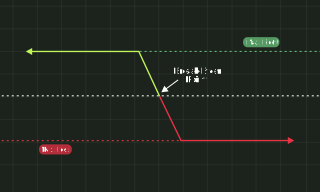
Credit spreads are generally used in rangebound, neutral, or slightly directional markets - environments in which time decay or Theta may erode the short leg’s value more quickly than the long leg’s value.
That might seem a bit daunting and complex, but don’t worry, we’ll use a simple, hypothetical example to illustrate.
In this scenario of ours, a stock is trading above $175. Our hypothetical trader sells a $175 put option for which they receive a $3.50 premium. At the same time, the trader buys a $170 put for $1.50. The difference between the two, the net premium, is $2, and this represents the trade’s maximum potential gain.
The maximum potential gain of the trade will be reached if the underlying asset’s price stays above the $175 mark at the time of expiration. In contrast, the maximum loss is defined by the difference between the strikes (in this case, $5) and the credit received ($2), for a total of $3. In this setup, the breakeven point comes at $173, calculated by subtracting the $2.00 credit received from the short strike price of $175.
Variations include the bull put spread, selling a higher-strike put and buying a lower-strike put to potentially benefit from stable or rising prices, and the bear call spread, which mirrors the logic using calls to potentially benefit when prices stay flat or drift lower. Both approaches allow traders to attempt to pursue premium income with clearly outlined potential risk and potential reward.
What is a Debit Spread?
This time around, we’ll start with the position’s cash flow. While a credit spread leads to receiving a net credit, a debit spread leads to…well, debit. In other words, a trader has to pay to set up the position.
Debit spreads consist of a purchased option and a sold option, but with this approach, the long leg typically costs more than the premium received for selling the short leg. Once again, both options are of the same type, have the same expiration date, and have different strike prices.
So, since we’re not receiving a credit, what’s the appeal of a debit spread? It’s simple; the strategy is structured to help traders potentially capture directional moves, and it usually comes with a lower upfront cost compared to simply buying a single option. Selling a cheaper option against the long position can offset a part of the cost of setting up the trade, while still keeping potential risk a clearly defined factor.
With a debit spread, the net debit paid at the beginning of a trade represents the maximum possible loss, whereas the maximum possible gain is capped at the difference between the strike prices minus the debit.
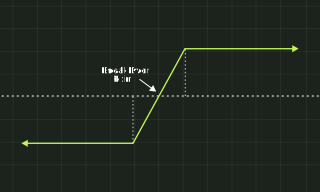
Let’s turn to an example once more to help you get a better understanding of how everything plays out.
In this instance, our hypothetical stock is trading near $340. Our trader buys a $340 call that costs $6, while simultaneously selling a $350 call for $2. In this case, the net debit is $4, and this is also the maximum potential loss, which occurs if the underlying stock finishes at $340 or below at the time of expiration.
The maximum potential gain in this setup would be $6, since we have a $10 difference in strike prices and subtract the $4 debit, and it occurs if the stock closes at or above $350. The breakeven point in this case is $344, and is calculated by adding the $4.00 debit paid to the long strike price of $340.
Common variations include the bull call spread, which can potentially benefit from moderate upside gains by buying a call at a lower strike and selling another at a higher strike, and the bear put spread, which takes the opposite approach by buying a higher-strike put and selling a lower-strike put to potentially capture downward movement. In both cases, the trade structure aims to limit cost while maintaining a defined profit target if the underlying moves in the anticipated direction.
Key Differences Between Credit and Debit Spreads
Both of these strategies, credit spreads and debit spreads, share the same vertical structure consisting of two options of the same type, same expiration date, but different strike prices. However, their mechanics and applications diverge in a couple of significant ways.
Key Differences Between Credit and Debit Spreads
| Feature: | Credit spread: | Debit spread: |
| Entry cost | Net credit (receive premium) | Net debit (pay premium) |
| Outlook | Neutral to slightly directional | More directional bias |
| Maximum potential profit | Limited to the credit received | Limited to the difference in strike prices minus the premium paid |
| Maximum potential loss | Difference in strikes minus credit | Limited to net premium paid |
| Time decay | May work in the trader’s favor | May work against the trader |
Credit spreads put money in a trader’s account upfront, seeing as the sold options contract typically earns a larger premium than what is paid for the purchased leg of the trade. In contrast, debit spreads require an outlay, as the sold leg’s value is smaller compared to the purchased leg’s value.
Profit profiles are another important distinction. With a credit spread, the goal is to retain the net credit that you acquired, which requires the underlying asset to stay in a specific price range.On the other hand, the purpose of a debit spread is to seek to capture a more decisive move in price. In the former, the maximum possible gain is equal to the net credit; in the latter, the maximum theoretical gain is equal to the difference between strike prices minus the debit.
We can’t mention potential gains without mentioning potential losses, which adds another layer of differentiation. With credit spreads, the maximum theoretical loss is equal to the strike price difference minus the credit received. In the case of a debit spread, the maximum possible loss is equal to the net premium paid at the start of the trade.
Time decay introduces another point of separation. Credit spreads can benefit from the erosion of option premiums over time, as Theta can work in the trader’s favor as the short leg loses value faster than the long leg. Debit spreads face the opposite dynamic: they require the underlying to move in the right direction before time decay eats into the value of the long leg.
Lastly, it’s important to note that ultimately, market conditions can play a large role in determining which of these strategies is more suitable. This hinges chiefly on the level of implied volatility in a given scenario. If IV is high, premiums rise, so credit spreads may benefit; conversely, low IV can make debit spreads less appealing.
Choosing the Right Spread for Your Strategy
The most pronounced factor when it comes to deciding between these two approaches will likely be your market outlook.
Credit spreads can be used in environments in which an asset’s price is anticipated to be stable or to experience only muted price action. Traders who anticipate that an asset’s price may remain rangebound or that time decay could work in their favor often lean toward this approach. Conditions of elevated implied volatility can make credit spreads more attractive to traders who seek to collect premiums, as inflated premiums allow for potentially larger credits to be collected upfront.
Conversely, debit spreads can be used in environments where traders anticipate a more defined directional move in an asset’s price. By using a debit spread, traders may reduce the cost of the position by selling another options contract, while still providing room for possible upside. As debit spreads rely less on time decay and more on price movement, they can benefit from periods of low IV.
Whichever route you end up choosing, there is one essential, non-negotiable point, and that is risk management. Before placing any trade, the key is to define acceptable potential risk. Lastly, it’s important to make the most of the tools at your disposal. Platforms like TradeZero allow users to place both legs of the trade within a single ticket, preview strike selection, see net credit or debit, and check breakeven points upfront, providing a level of spread visibility that can make position management a more efficient process.
Using Multi-Leg Options Tools to Execute Spreads Efficiently
Building and managing spread strategies the old-fashioned way, by hand, could often be a cumbersome task, as placing separate orders for each leg increased the chance of execution errors or mismatched fills occurring.
Thankfully, nowadays multi-leg options trading tools go a long way in streamlining the process, as they can allow the entire spread to be constructed within a single order ticket, which may help ensure both sides of the trade execute more efficiently and as intended.
Moreover, these tools make it easier to visualize the payoff profile of the trade, as traders get access to simple, intuitive overviews of maximum potential gains, maximum potential losses, and breakeven points, which can help traders assess whether the structure aligns with their market view and personal risk tolerance.
Last but not least, we have the question of cost efficiency. Commission-free structures can afford options traders a level of flexibility, as experimenting with different combinations of strikes and expirations becomes a viable option when it no longer incurs additional expenses. Traders can also scale out of positions, adjust legs, or close early to realize profits or limit losses, without commissions eroding overall outcomes.
Options chain management and real-time quotes can further reduce the chance of slippage, since prices update instantly as conditions shift.
What are the risks associated with Credit Spread and Debit Spreads?
A credit spread and a debit spread each carry distinct risks that traders should understand before choosing between them.
- With credit spreads, the main risk is that the underlying asset moves against the trader and pushes the position toward its maximum loss, which is typically larger than the maximum potential gain.
- Because credit spreads benefit from time decay, adverse moves earlier in the trade can cause losses to escalate quickly, and traders may also face early-assignment risk when using American-style short options.
- In contrast, debit spreads risk losing the entire premium paid if the underlying asset fails to move in the anticipated direction before expiration.
- Debit spreads are also vulnerable to time decay and implied-volatility contraction, both of which can reduce the spread’s value even if the price does move favorably.
In both strategies, traders must account for liquidity, bid-ask spreads, volatility shifts, and the need to manage defined yet meaningful maximum-loss levels.
Conclusion
Credit and debit spreads can help traders apply a defined-risk framework to various market conditions.
If an asset appears range-bound or shows modest directional movement, a credit spread may represent a simple multi-leg strategy that is structured to help traders make the most of such situations by seeking to collect premium income. On the other hand, debit spreads can provide traders with cost-efficient exposure to stronger directional moves without taking on the risk of potentially unlimited losses.
Disclaimer
This content (“Content”) is produced by Tokenist Media LLC. The Content represents only the views and opinions of Tokenist Media LLC.Tokenist Media LLC’s trading experiences and accomplishments are unique, and your trading results may vary substantially. Tokenist Media LLC is a paid marketing partner of TradeZero that receives compensation from TradeZero for broadcasting, displaying, and/or presenting marketing and sponsorship materials that promote TradeZero. TradeZero does not endorse the Content and makes no representations or warranties with respect to the accuracy of the Content or information available through any referenced or linked third party sites. The Content has been made available for informational and educational purposes only and should not be considered trading or investment advice or a recommendation as to any security.
Trading securities can involve high risk and potential loss of funds. Furthermore, trading on margin is for experienced investors and traders only as the amount you may lose can be greater than your initial investment. Likewise, short selling as a securities trading strategy is extremely risky and can lead to potentially unlimited losses.
Options trading is not suitable for all investors as it can involve risk that may expose investors to significant losses. Please read the Characteristics and Risk of Standardized Options, also known as the options disclosure document (ODD) at https://www.theocc.com/Company-Information/Documents-and-Archives/Options-Disclosure-Document before deciding to engage in options trading. Please also see the Options Trading Disclosure. You must be approved to trade multi-leg options strategies. You may lose all of your principal. Executing multi-leg options orders may result in increased transaction fees compared to single-leg options orders. Multi-leg strategies may exhibit risks such as illiquidity and increased sensitivity to market unpredictability.
TradeZero provides self-directed brokerage accounts to customers through its operating affiliates: TradeZero America, Inc., a United States broker dealer, registered with the Securities and Exchange Commission (SEC) and member of the Financial Industry Regulatory Authority (FINRA) and the Securities Investor Protection Corporation (SIPC); TradeZero, Inc., a Bahamian broker dealer, registered with the Securities Commission of the Bahamas;TradeZero Canada Securities ULC, a Canadian broker dealer, member firm of the Canadian Industry Regulatory Organization (CIRO) and member of the Canadian Investor Protection Fund (CIPF) and TradeZero Europe B.V., a Dutch broker dealer, authorized and regulated by the Dutch Authority for the Financial Markets (AFM) (collectively, the “TradeZero Broker Dealers”).