November Begins: Cautious Optimism, but the Burden of Proof Is on the Bulls
November 2, 2026

Market Recap
Analyzing the markets with Richie Naso, a Wall Street veteran of over 40 years and former member of the NYSE.
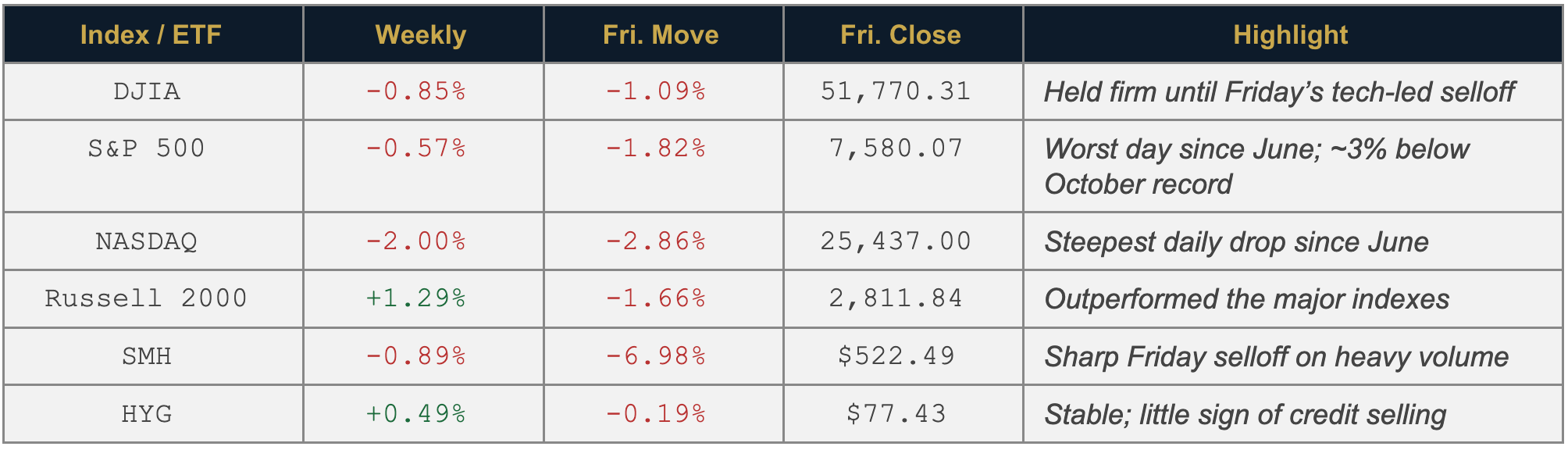
Last Week’s Main Indexes — Let’s Try to Figure This Action Out
Dow Jones Industrial Average
The Dow finished the week lower, closing Friday at 51,770.31, down 444.85 points, or approximately 0.9%, for the week. After holding relatively firm through the first four sessions, the index sold off sharply on Friday as concerns surrounding technology earnings and the enormous spending commitments tied to artificial intelligence weighed on market sentiment.
The Dow demonstrated relative resilience compared with the Nasdaq, which suffered a substantially steeper decline. That divergence suggests the selling pressure remains concentrated in technology and growth stocks rather than affecting every sector equally. However, Friday’s decline is a reminder that weakness in technology can spill over into the broader market, particularly when investors begin questioning whether expected returns will justify the level of AI investment.
Richie’s take: The Dow’s relative strength is encouraging, but I would not interpret it as confirmation that the market has avoided a deeper correction. I will be watching market breadth, sector rotation, and whether selling pressure spreads beyond technology. If the Dow can maintain its relative strength while participation broadens, the longer-term outlook remains more constructive. If weakness becomes widespread, a more defensive posture may be warranted.
S&P 500
The S&P 500 finished the week at 7,580.07, down 43.61 points, or approximately 0.6%. The index had advanced during the first part of the week before Thursday’s weakness accelerated into a sharp Friday selloff. Friday alone saw the S&P fall 140.32 points, or 1.82%, marking its worst daily performance since June. The decline left the index approximately 3% below its October record high.
Technology stocks were a major source of pressure as disappointing earnings and renewed concerns over the enormous capital expenditures required to support artificial intelligence weighed on investor sentiment. Intel suffered a particularly severe decline after issuing a disappointing profit outlook, while concerns about the returns on AI spending affected the broader technology sector.
Richie’s take: The S&P’s weekly decline was relatively modest, but Friday’s sharp reversal deserves attention. The market had shown resilience earlier in the week, yet the late selling demonstrates how quickly sentiment can change when investors question valuations and future earnings growth. I would remain cautious without abandoning the longer-term constructive outlook. The key question is whether this weakness remains concentrated in technology or spreads across sectors. Market breadth, the ability of other sectors to absorb selling pressure, and the behavior of credit markets will be important indicators of whether we are seeing a normal correction or the beginning of a more significant deterioration.
Nasdaq Composite
The Nasdaq Composite had a difficult week, falling 2.0% to close Friday at 25,437.00. The damage was concentrated in the final two sessions, with Friday’s 2.86% decline marking the index’s steepest daily drop since June. For October, the Nasdaq lost approximately 5.3%, its worst monthly performance since March 2025.
Technology stocks came under renewed pressure as investors questioned whether the enormous capital expenditures devoted to artificial intelligence will ultimately generate sufficient returns. Disappointing earnings and outlooks from major technology companies added to those concerns. Intel fell nearly 29% on Friday following a weaker-than-expected profit forecast, while semiconductor stocks broadly retreated. The selling reflects a growing willingness among investors to challenge elevated valuations and scrutinize the profitability of the AI investment cycle.
Richie’s take: The Nasdaq remains a key source of concern for the broader market. The combination of disappointing earnings reactions, heavy AI spending, and renewed selling in semiconductor stocks suggests that investors are becoming more selective. While this could represent a correction within a longer-term advance, the magnitude of Friday’s decline should not be dismissed. I will be watching whether technology can stabilize, whether market breadth improves, and whether weakness begins to spread into other sectors. Until those signs emerge, I would maintain a cautious near-term outlook rather than assume the latest selloff is simply another buying opportunity.
SMH — Semiconductors
SMH had a volatile and ultimately disappointing week, closing Friday at $522.49, down 0.89% from the previous Friday’s close of $527.20. The ETF initially showed strength, advancing Monday through Wednesday before reversing course. Thursday’s decline accelerated dramatically on Friday, when SMH fell 6.98% on heavy volume of approximately 17.6 million shares. (Source: StockAnalysis.com)
SMH daily moves, October 26–30, 2026.
| Mon | Tue | Wed | Thu | Fri |
| +2.74% | +3.02% | +1.74% | -1.06% | -6.98% |
The sharp Friday selloff is particularly significant given the semiconductor sector’s leadership role in the broader market. Concerns surrounding elevated technology valuations, the enormous capital commitments associated with artificial intelligence, and questions about future returns on that investment weighed heavily on semiconductor shares.
Richie’s take: SMH remains one of the more important areas to watch. Semiconductors have been a major engine of this bull market, and a sustained deterioration in the group would represent a meaningful threat to the broader indexes. Friday’s heavy-volume decline raises a warning flag. I would like to see stabilization and evidence that buyers are willing to step back in before becoming more constructive. For now, the semiconductor weakness reinforces my cautious near-term outlook.
Russell 2000
The Russell 2000 demonstrated relative resilience for much of the week, advancing during the first four trading sessions before Friday’s broad market selloff. Despite Friday’s 1.66% decline, the index finished the week up approximately 1.3%, closing at 2,811.84. This was a notably better weekly performance than the Nasdaq, S&P 500, and Dow.
The small-cap index benefited from earlier strength, suggesting that investor participation had been extending beyond the large-cap technology stocks that have dominated market leadership. However, Friday’s decline indicates that small caps were not immune to the deterioration in sentiment, particularly as concerns about technology valuations and AI spending intensified.
Richie’s take: The Russell’s relative strength is an encouraging development and supports the possibility that market participation is broader than the weakness in technology might suggest. However, I would like to see that strength continue rather than rely on a single week’s performance. Small caps will be an important indicator of market breadth and investor confidence. If the Russellcan hold its gains and continue to outperform the Nasdaq, it would provide some support for the broader market. If it begins to roll over alongside technology, that will raise a more significant concern about the market’s underlying condition.
HYG — High-Yield Credit
HYG remained relatively stable throughout the week, closing Friday at $77.43, up 0.49% from the previous Friday’s close of $77.05 and down 0.19% on Friday. Despite the sharp deterioration in equities, particularly technology and semiconductor stocks, high-yield credit showed little evidence of meaningful selling pressure.
This relative stability is worth noting. While investors were reassessing technology valuations and the enormous capital commitments associated with artificial intelligence, the high-yield bond market remained comparatively calm. HYG’s ability to hold its ground suggests that credit investors are not yet signaling a significant deterioration in risk appetite.
Richie’s take: HYG continues to be an important indicator in evaluating the broader market’s health. The divergence between relatively stable high-yield credit and weakness in the Nasdaq and semiconductor stocks suggests that the current selling pressure may still be concentrated in equities rather than reflecting a broader credit concern. However, I would not become complacent. A meaningful decline in HYG alongside continued equity weakness would be a more serious warning sign. For now, credit-market stability offers some reassurance, but it remains an area I will be watching closely.
Friday's Market Action — Third-Party Recap: Tech Selloff Wipes Out $1 Trillion in Value
The summary below is drawn from a third-party market commentary. It reflects the views of its author, not TradeZero or Richard Naso, and is included for informational and educational purposes only. It does not constitute investment advice or a recommendation to buy or sell any security. (Source: Seeking Alpha)
- AI spending is under scrutiny. Markets have spent months weighing the potential productivity gains from artificial intelligence against the billions of dollars being invested to get there. This week’s heavy run of technology and semiconductor earnings disappointed investors, suggesting the demand for accountability on that spending may be growing.
- All three major indexes lost ground on Friday but finished off their intraday lows. The Nasdaq Composite fell 2.86%, the S&P 500 fell 1.82% and the Dow fell 1.09%. The selloff erased more than $1 trillion in market value.
- Volatility rose. The Cboe Volatility Index (VIX) neared 24 intraday and closed 12.91% higher, just below 20. Readings above 20 are generally viewed as a sign of caution.
- Biggest decliners: Intel (INTC) fell 28.5%, its worst intraday decline since 1974, according to CNBC. SanDisk (SNDK) lost 13.8%, Marvell (MRVL) fell 10%, Micron (MU) dropped 5.3%, and Nvidia (NVDA) fell 4.2%, slipping below a $5 trillion market capitalization.
- Not necessarily the end of the AI boom. The article (see here) notes the selloff does not mean the AI boom is ending or that demand is fading; it appears to reflect Wall Street rethinking how it balances spending against still-uncertain returns.
- It was not an across-the-board slump. Financials, healthcare and energy ended solidly higher on the S&P 500 as investors turned to more defensive areas. Healthcare climbed to a 52-week high after pharmaceutical and biotech companies reported strong earnings.
- Investors also moved into Treasury bonds. Yields fell as prices rose, with the 10-year yield at 4.92% and the 30-year at 5.31%.
- Oil moved higher. WTI crude rose 2.2% to above $104 a barrel and Brent rose 2.45% to just below $118, as security risks escalated in the Middle East and reports surfaced of threats of more conflict after Tuesday’s midterm elections.
This Weeks Interesting Sector Piece: Market Breadth
Last week was better than the headline index performance suggested — but Friday’s selloff was a significant setback. There was evidence of broadening participation earlier in the week, even as technology stocks weakened. However, Friday brought a noticeable deterioration.
S&P 500 Breadth: October 26–30
| Indicator | October 30 Reading |
| Advancing stocks | 226 |
| Declining stocks | 277 |
| Advance/decline ratio | 0.82 |
| Stocks above 50-day MA | 59% |
| Stocks above 200-day MA | 56% |
| Advancing volume | 32.4% |
MA = moving average. Readings as of October 30. For informational purposes only. (Source: Dean Financials)
One particularly interesting comparison: on Thursday, October 29, there were 406 advancing stocks versus only 97 declining stocks. Friday reversed much of that positive breadth picture. (Source: Dean Financials)
What I find most interesting: a constructive longer-term signal
The October breadth recovery. As of October 29:
- Approximately 77% of S&P 500 constituents were higher for the month.
- 65% were above their 50-day moving average.
- 63% were above their 200-day moving average.
- Nine of the eleven S&P sectors were positive for October.
This suggests the market’s weakness was disproportionately concentrated in several large technology companies rather than reflecting uniform weakness across the market. (Source: IG)
On My Radar This Week: What I’ll Be Focused On This Week
The items below reflect Richard Naso’s personal areas of focus for the coming week and are provided for informational and educational purposes only. They do not constitute investment advice or a recommendation to trade any security.
WATCH LIST — WEEK OF NOVEMBER 2, 2026
Earnings on the calendar this week should give more insight into the tech selloff, as well as the strength in healthcare, energy and consumer spending. The lineup:
- Monday: Apple (AAPL)
- Tuesday: Advanced Micro Devices (AMD), Amgen (AMGN) and Pfizer (PFE)
- Wednesday: McDonald’s (MCD) and Qualcomm (QCOM)
- Thursday: ConocoPhillips (COP)
- ISM Manufacturing and ISM Services — Fresh readings on business activity.
- Friday — October Employment Report — If released as scheduled.
Final Thoughts: Richie’s Take
With September and October, historically two of the more challenging months for equities, now behind us, the market enters November facing a different set of challenges and opportunities. While the calendar may become more favorable seasonally, I would be reluctant to interpret that alone as a reason for renewed optimism.
We have plenty of corporate earnings ahead, and the market’s reaction to those reports will be just as important as the numbers themselves. Investors are increasingly scrutinizing valuations, forward guidance, profit margins, and particularly the enormous capital expenditures associated with artificial intelligence. Strong earnings are no longer necessarily enough; companies must demonstrate that their growth expectations and spending commitments can translate into meaningful returns.
Last week’s action also reinforced my concerns about technology leadership. The sharp declines in the Nasdaq and semiconductor stocks, particularly SMH, deserve attention. At the same time, the Russell 2000 demonstrated relative strength, while HYG remained comparatively stable. That divergence suggests that selling pressure has not yet become uniform across the market.
Market breadth will remain one of my most important indicators. Although participation improved during much of October, Friday’s reversal was a reminder of how quickly conditions can change. I want to see broader participation continue, rather than having the major averages depend on a relatively narrow group of large-cap technology stocks to sustain their advances.
I also believe the relationship between equities and credit deserves close attention. As long as HYG remains relatively stable, there is some reassurance that credit investors are not confirming the weakness we are seeing in technology. However, a deterioration in high-yield credit alongside continued equity weakness would be a considerably more concerning development.
My overall view remains cautiously constructive longer term, but I am not prepared to dismiss the possibility of additional near-term volatility or a deeper correction. The market needs to demonstrate that it can absorb the recent technology selling, maintain breadth, and establish more sustainable leadership across sectors.
With the seasonal headwinds of September and October now behind us, November offers an opportunity for the market to regain its footing. But ultimately, price action, earnings quality, credit conditions, and market participation — not the calendar — will determine the next direction.
For now, I believe patience and discipline are warranted. I remain constructive on the longer-term market, but the burden of proof is on the bulls.
— Richie
Disclaimer
This content (“Content”) is produced by Richard Naso. The Content represents only the views and opinions of Mr. Naso who is compensated by TradeZero for producing it. Mr. Naso’s trading experiences and accomplishments are unique, and your trading results may vary substantially from his. TradeZero does not endorse the Content and makes no representations or warranties with respect to the accuracy of the Content or information available through any referenced or linked third party sites. The Content has been made available for informational and educational purposes only and should not be considered trading or investment advice or a recommendation as to any security. Trading securities can involve high risk and potential loss of funds. Furthermore, trading on margin is for experienced investors and traders only as the amount you may lose can be greater than your initial investment. Likewise, short selling as a securities trading strategy is extremely risky and can lead to potentially unlimited losses. Options trading is not suitable for all investors as it can involve risk that may expose investors to significant losses. Please read the Characteristics and Risks of Standardized Options, also known as the options disclosure document (ODD) at https://www.theocc.com/Company-Information/Documents-and-Archives/Options-Disclosure-Document before deciding to engage in options trading.
TradeZero provides self-directed brokerage accounts to customers through its operating affiliates: TradeZero America, Inc., a United States broker dealer, registered with the SEC and member of the Financial Industry Regulatory Authority (FINRA) and the Securities Investor Protection Corporation (SIPC); TradeZero, Inc., a Bahamian broker dealer, registered with the Securities Commission of the Bahamas; TradeZero Canada Securities ULC, a Canadian broker dealer, member firm of Canadian Investment Regulatory Organization (CIRO) and member of the Canadian Investor Protection Fund (CIPF); and TradeZero Europe B.V., a Dutch broker dealer, authorized and regulated by the Netherlands Authority for the Financial Markets (AFM) and subject to the regulatory framework of the European Securities and Markets Authority (ESMA) under MiFID II (collectively, the “TradeZero Broker Dealers”).