Can the Rally Broaden?
October 5, 2026

Market Recap
Analyzing the markets with Richie Naso, a Wall Street veteran of over 40 years and former member of the NYSE.
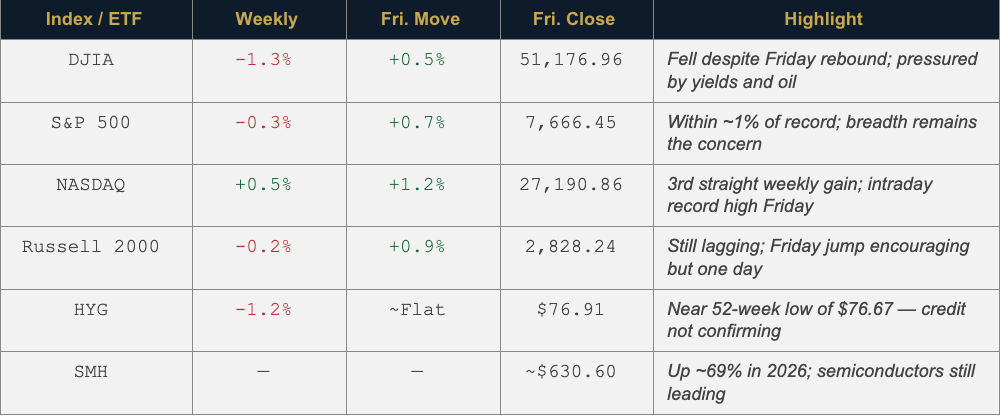
Last Week’s Main Indexes — Let’s Figure This Action Out
Dow Jones Industrial Average
The Dow had a difficult week, falling 651.66 points, or 1.3%, to 51,176.96 for the week ended October 2. The decline came despite a strong Friday rebound of 250 points, or 0.5%. (Source: AP News)
The primary pressure on the Dow came from higher Treasury yields and oil-price volatility. On Monday, the 10-year Treasury yield reached 5.23%, its highest level since 2007, putting pressure on equities. The Dow fell 0.7% that day. (Source: AP News)
Friday was the key session. The September employment report showed only 29,000 jobs added, while unemployment rose to 4.2%. The weaker labor-market data reduced concerns about another immediate rate hike and helped stocks recover. (Source: AP News)
S&P 500
The S&P 500 finished the week lower by 0.3%, closing Friday at 7,666.45, despite a strong 0.7% rebound on Friday. The index remains within roughly 1% of its record high, but the weekly decline highlights some underlying hesitation after the recent advance. (Source: AP News)
What concerns me
The bigger story continues to be market breadth and participation. The cap-weighted S&P is holding up considerably better than the equal-weighted index, while small caps have continued to struggle. MarketWatch noted that the divergence between the two S&P measures has become unusually wide, accompanied by deterioration in the advance/decline line and a large number of stocks trading below their moving averages. (Source: MarketWatch)
That tells me the headline index is still being supported heavily by large-cap technology and AI-related stocks, rather than by broad-based participation across the market.
Richie’s bottom line: The S&P’s trend remains constructive, but I would not interpret this week’s action as a confirmed breakout yet. Friday’s rally was encouraging, but I want to see follow-through, improving breadth, stronger small-cap participation, and confirmation from credit markets.
Nasdaq
The Nasdaq Composite continued to show relative strength this week, gaining 0.5% and closing Friday at 27,190.86. That marked its third consecutive weekly gain, and Friday’s 1.2% advance pushed the index to an intraday record high. (Source: AP News)
Technology remains the leader.
The Nasdaq continues to benefit from strong AI and semiconductor momentum. Recent strength in companies such as Nvidia and Micron has reinforced the market’s enthusiasm for AI-related spending and demand, and the Nasdaq’s record levels have been supported by continued optimism surrounding AI. (Source: Reuters)
However, there is an important distinction between index strength and market breadth. Nasdaq Dorsey Wright reported that the S&P 500’s Positive Trend Percent fell below 50% for the first time in more than a year, even as technology continued to strengthen as a sector leader. (Source: Nasdaq Dorsey Wright)
Russell 2000
The Russell 2000 remained a laggard this week, falling 0.2% to 2,828.24 for the week ended October 2. That compares with a 0.5% gain for the Nasdaq, while the S&P 500 fell 0.3% and the Dow dropped 1.3%. (Source: AP News)
Friday was encouraging, however. The Russell jumped 0.9%, gaining 26.27 points, as the weaker-than-expected September employment report reduced expectations for an imminent Fed rate hike. Small caps, which are particularly sensitive to interest rates and financing conditions, responded positively. (Source: Reuters)
Richie’s bottom line: Friday’s 0.9% gain was a positive development, but one day does not establish a trend. I’d like to see the Russell 2000 begin to outperform and participate more consistently if we’re going to get a broad-based breakout.
HYG — Junk Bond Watch
HYG remained under pressure this week, continuing to signal caution in the high-yield credit market. The iShares iBoxx $ High Yield Corporate Bond ETF finished Friday at $76.91, essentially unchanged on the day. For the week, it declined from $77.86 to $76.91, a drop of roughly 1.2%. (Source: BlackRock)
The important point is that HYG remains very close to its 52-week low of $76.67. That weakness is notable because high-yield credit is an important gauge of investor risk appetite.
SMH — Semiconductors
SMH continued to be one of the strongest areas of the market this week, reinforcing the leadership of semiconductors and AI-related stocks. The VanEck Semiconductor ETF was around $630.60 Friday, and chip stocks were again among the strongest performers as the weaker-than-expected employment report reduced expectations for an October Fed rate hike. Nvidia reached a new all-time high, helping lead the group higher. (Source: Motley Fool)
The bigger picture is even more impressive. SMH is up roughly 69% in 2026, dramatically outperforming the S&P 500. Its strength has also been broader than Nvidia alone, with stocks such as Micron, AMD, and Intel contributing substantially to the ETF’s advance. Past performance is not indicative of future results. (Source: Motley Fool)
Economic Data: September Jobs Report — Analyst Reactions
The September employment report was considerably weaker than expected: payrolls increased only 29,000, versus roughly 84,000–90,000 expected; unemployment rose to 4.2%; and July and August were revised down by a combined 60,000 jobs. Wage growth also cooled to 3.0% year over year. (Source: Bureau of Labor Statistics)
Analysts generally viewed the report as reducing the likelihood of another Fed rate hike in October, although they differed on whether the weakness represents a meaningful deterioration in the economy or simply a continuation of the “low-hire, low-fire” environment. (Source: Reuters)
- Thomas Simons, Jefferies: characterized the report as effectively eliminating the case for an October hike. (Source: NewsCord)
- Luke Tilley, Wilmington Trust, said there was no indication in the report that the labor market was generating inflationary pressure. (Source: NewsCord)
- Reuters economist commentary: emphasized that the weak payroll number does not necessarily signal a sudden deterioration, noting the absence of a broad increase in layoffs. (Source: Reuters)
- InvestmentNews analyst roundup: similarly said the report gives the Fed more room to hold rather than hike at its October meeting. (Source: InvestmentNews)
This Week's Interesting Sector Piece: Quantum Computing Is Having a Moment. What to Know About the Hottest Sector After AI.
Source: Barron’s, print edition, p. 10 — Mackenzie Tatananni, October 5, 2026. The companies and analyst views referenced below are drawn from that article and are included for informational and educational purposes only. They do not constitute investment advice or a recommendation to buy or sell any security. Past performance is not indicative of future results.
Just a decade ago, quantum computing was nothing more than a dream of scientists in the lab. Recent advances by IBM, IonQ, Nvidia, and others illustrate the new promise of the complex technology — and investors are taking notice.
As artificial intelligence dominates the headlines, quantum computing is gaining steam. Nowhere is that clearer than in public markets, where Quantinuum’s landmark initial public offering and a wave of listings this year signal a shift: quantum is moving from speculative sci-fi to an early commercial market. (Source: Barron’s)
Late last month, Microsoft unveiled a new research center in Maryland, bringing its technology closer to independent evaluators from the government’s Defense Advanced Research Projects Agency (DARPA). IonQ announced that its latest system would be deployed at Nvidia’s quantum research center, bridging classical hardware with quantum processors. And a technical paper claimed that IBM’s Nighthawk processor took 19 seconds to complete a task estimated to take a supercomputer 110 years.
“A lot of the industry is still doing ‘toy problems.’ But the people on the leading edge are no longer doing that.” — Scott Crowder, Vice President of Quantum Adoption, IBM
Nowhere is that leading edge more apparent than in drug discovery, where quantum systems mirror the complex behavior of electrons and molecules. Amgen, one of the world’s largest pharmaceutical companies, has embraced the technology to potentially shorten the drug development timeline. A lead investor in Quantinuum’s first major funding round, Amgen also collaborates with players such as QuEra.
“I look at quantum the same way I look at other emerging technologies. What does it allow us to do that we couldn’t do before, and where can it meaningfully complement the tools we already have?” — Alan Russell, Vice President of Research and Head of R&D Technology, Amgen
Amgen, like others, is looking for “quantum advantage” — the point where quantum systems can complete a useful task more efficiently than the best available classical supercomputers. That milestone remains elusive, as scaling quantum systems makes them increasingly vulnerable to environmental noise. For now, today’s investments are about exploring capabilities and finding practical applications rather than unlocking immediate efficiencies.
Enthusiasm is spreading across the healthcare landscape. Cleveland Clinic’s quantum program, launched five years ago, centers on the Discovery Accelerator — a partnership with IBM spanning more than 60 projects in AI, high-performance computing, and quantum. Researchers from Cleveland Clinic, IBM, and Japanese research institute Riken were nominated for the prestigious ACM Gordon Bell Prize for their work in protein modeling.
“We had that long-term view, which is what every organization looking at quantum needs to have. Otherwise it will never make sense as an investment.” — Dr. Lara Jehi, Chief Research Information Officer, Cleveland Clinic
While an early attempt to predict post-surgery cardiac risks proved too complex for current hardware, Jehi sees significant potential in areas such as clinical trial logistics, supply chains, and staff scheduling across sprawling hospital networks.
Enthusiasm extends to the federal level, where the Commerce Department unveiled a $2 billion package in May to accelerate quantum technology. Washington is targeting a 2028 deadline to deploy a “scientifically relevant quantum computer” at a national laboratory. The push partly stems from security concerns centered on Shor’s algorithm, which can factor large numbers at speeds no classical computer can match. The algorithm has never been used to break real-world encryption, but government partners emphasize that preparation can’t wait.
“The quantum threat to our public infrastructure is very severe, very real, and certainly coming.” — JD Dulny, Quantum Lead, Booz Allen Hamilton
For investors following the sector, pure-play IonQ continues to draw strong interest, with BofA Securities recently initiating coverage with a Buy rating, citing strategic technical acquisitions such as its recent purchase of chip maker SkyWater Technology. Government backing highlights other contenders: Infleqtion leads in defense applications such as sensors and atomic clocks, while federal stakes in publicly traded Rigetti Computing, D-Wave Quantum, and Quantinuum validate their respective hardware approaches. IBM remains a central player, though analysts debate how much quantum growth is already priced into the stock. Analyst ratings are third-party opinions and are not a guarantee of future performance. (Source: Barron’s)
On my Radar This Week: What I’ll Be Focused On This Week
The items below reflect Richard Naso’s personal areas of focus for the coming week and are provided for informational and educational purposes only. They do not constitute investment advice or a recommendation to trade any security.
WATCH LIST — WEEK OF OCTOBER 5, 2026
- Monday — September ISM Services PMI — Particularly important because services represent a much larger portion of the U.S. economy.
- Interest Rates — The 10-year Treasury yield remains the biggest potential headwind after reaching its highest level since 2007. A meaningful decline in yields would give equities more room to move higher.
- Wednesday — Fed Minutes — The September FOMC minutes. I will be looking for clues about how divided the Fed is on future rate moves and whether the weak employment data changes the thinking for October.
- Breadth and Participation — Probably the most important factor for me. The Nasdaq and semiconductors continue to lead, but I want to see the Russell 2000, financials, and the broader market participate. If that happens, the breakout argument becomes much stronger.
- Credit (HYG) — If HYG stabilizes after its recent weakness, it would provide additional confirmation that risk appetite is improving. If equities move higher while HYG keeps making new lows, I would remain cautious.
Final Thoughts: Richie's Take
As we move into October, I remain constructive on the market, but I think this is a time to be more selective and cautious. The Nasdaq continues to lead, and the latest jobs data has given the market some relief on the interest-rate front. But leadership remains unusually concentrated, and the broader market has yet to provide the confirmation I would like to see.
One divergence that particularly catches my attention is the Nasdaq versus HYG. The Nasdaq is trading near record highs, while high-yield credit has been under pressure. That is an important disconnect because HYG is a good gauge of risk appetite and credit conditions. When equities are pushing higher, but credit is not confirming the move, I don’t want to ignore that signal.
The same issue exists with market breadth. The headline indexes can continue higher because of the tremendous influence of a relatively small number of technology and AI-related stocks. But for a breakout to become sustainable, I want to see broader participation — particularly from the Russell 2000, financials, the advance/decline line, and a larger percentage of stocks participating. Recent data continues to show how narrow the leadership has become.
The upcoming week will therefore be important. I’ll be watching the ISM Services PMI, the FOMC minutes, Treasury yields, HYG, and overall breadth. The jobs report has reduced expectations for an immediate Fed rate hike, but long-term Treasury yields remain elevated, which continues to put pressure on the broader market.
So, is there a breakout coming? Possibly. The Nasdaq and semiconductors are certainly making the bullish case. But I want to see the rest of the market confirm it.
For now, I remain constructive — but not complacent. If HYG stabilizes, yields begin to ease, small caps participate, and breadth improves, I would become much more confident that we’re seeing the beginning of a genuine broad-based breakout rather than simply another leg higher led by technology.
Until then, I believe the best approach is to respect the strength of the market while also respecting the divergences underneath it.
— Richie
Disclaimer
This content (“Content”) is produced by Richard Naso. The Content represents only the views and opinions of Mr. Naso who is compensated by TradeZero for producing it. Mr. Naso’s trading experiences and accomplishments are unique, and your trading results may vary substantially from his. TradeZero does not endorse the Content and makes no representations or warranties with respect to the accuracy of the Content or information available through any referenced or linked third party sites. The Content has been made available for informational and educational purposes only and should not be considered trading or investment advice or a recommendation as to any security. Trading securities can involve high risk and potential loss of funds. Furthermore, trading on margin is for experienced investors and traders only as the amount you may lose can be greater than your initial investment. Likewise, short selling as a securities trading strategy is extremely risky and can lead to potentially unlimited losses. Options trading is not suitable for all investors as it can involve risk that may expose investors to significant losses. Please read the Characteristics and Risk of Standardized Options, also known as the options disclosure document (ODD) at
https://www.theocc.com/Company-Information/Documents-and-Archives/Options-Disclosure-Document before deciding to engage in options trading.
TradeZero provides self-directed brokerage accounts to customers through its operating affiliates: TradeZero America, Inc., a United States broker dealer, registered with the SEC and member of the Financial Industry Regulatory Authority (FINRA) and the Securities Investor Protection Corporation (SIPC); TradeZero, Inc., a Bahamian broker dealer, registered with the Securities Commission of the Bahamas; TradeZero Canada Securities ULC, a Canadian broker dealer, member firm of Canadian Investment Regulatory Organization (CIRO) and member of the Canadian Investor Protection Fund (CIPF); and TradeZero Europe B.V., a Dutch broker dealer, authorized and regulated by the Netherlands Authority for the Financial Markets (AFM) and subject to the regulatory framework of the European Securities and Markets Authority (ESMA) under MiFID II (collectively, the “TradeZero Broker Dealers”).