The Trade Setup Evaluation Matrix: Scoring Trade Setups
November 5, 2026

Trading Strategies with Bob Iaccino
*Bob Iaccino, Chief Market Strategist and Co-Founder of Path Trading Partners, brings over 30 years of hands-on experience across equities, commodities, futures, and FX markets to his role as our Risk Management and Trading Strategies educator.
Key Points at a Glance
- The matrix scores three categories from one to ten; chart alignment, confirmation and available catalyst - and averages them.
- The grade is not a probability: an eight out of ten does not mean an 80% chance of success.
- Scores of eight to ten mean take the trade if reward-to-risk requirements are met; lower averages mean wait, watchlist or pass.
- Reward-to-risk is the final criterion. Poor reward-to-risk disqualifies a trade regardless of the score.
- Position size comes after the evaluation, and a high grade does not justify a larger position.
- Record every score before entry and never change old scores to make the results look better.
A chart can look good and still be a trade you should pass on. When evaluating a setup, you need to know what triggers the entry and what invalidates the trade under your system. You need to know whether the potential return justifies the risk. And you should have those answers before entering a trade.
What Is a Trade Setup Scoring Matrix?
Professional traders all have their own methods for filtering opportunities. A “scoring matrix” is a practical way to keep the process consistent. It gives you specific conditions to evaluate and a record you can compare with the results.
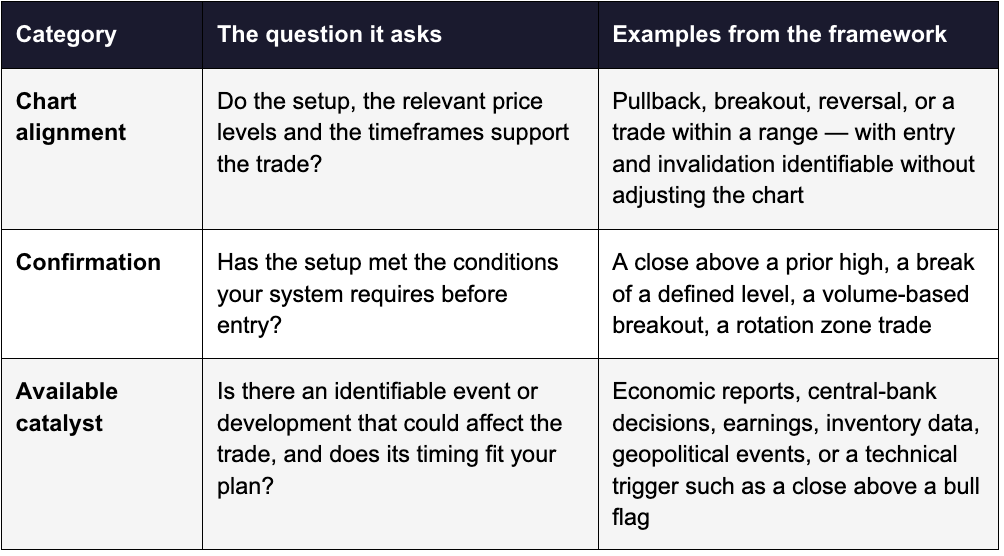
The framework below scores three categories from one to ten: chart alignment, confirmation, and available catalyst. Add the scores and divide by three to get the overall grade.
These are proposed grading rules to test within your strategy. An eight out of ten does not mean an 80% probability of success.
The Three Categories at a Glance
What Is Chart Alignment?
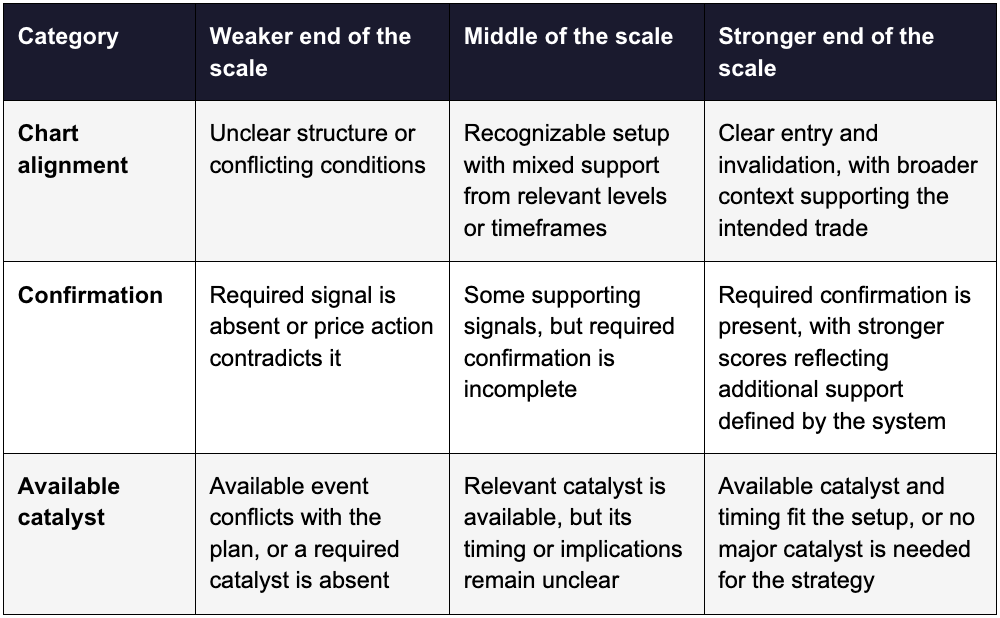
Chart alignment asks whether the setup, the relevant price levels, and the timeframes support the trade.
Start With the Structure
Start with the structure. Is it a pullback, a breakout, a reversal, or a trade within a range? Can you identify the entry and invalidation without adjusting the chart or inventing subpar support or resistance until it tells you what you want to hear?
Higher Timeframes and Countertrend Trades
A higher timeframe can provide useful context, but the same pattern doesn’t need to appear on every chart. Buying a five-minute bounce during a daily downtrend is a countertrend trade, and it’s a legitimate style of trading. However, your target and expectations should reflect that. You can’t expect a bounce on a 5-minute chart to carry far enough to reverse a daily downtrend.
What Counts as Confirmation?
Confirmation asks whether the setup has met the conditions your system requires before entry. That might mean a close above a prior high, a break of a defined level, or another tested signal, like volume-based breakouts or my rotation zone trades.
Match the Confirmation to the Timeframe
Be specific about what counts as confirmation and which timeframe applies. If your system requires a daily close above a level, an intraday move through it does not meet that requirement. Volume or other indicators can support the evaluation if they are part of your system, but they do not replace the required signal.
What Is an Available Catalyst?
Available catalyst asks whether there is an identifiable event or development that could affect the trade and whether its timing fits your plan.
When a Major Announcement Hurts a Setup
Economic reports, central-bank decisions, earnings, inventory data, and geopolitical events are all potential catalysts. A major announcement isn’t automatically a positive. If it quickly moves the market beyond your planned entry before you can respond, it may skew the reward-to-risk ratio (R/R) and make the setup less attractive. Technical patterns can provide catalysts. Maybe a close above a bull flag gives you a reason to buy. Your system dictates what kind of catalyst you need, but you need one.
Range Strategies and Event Strategies
For a strategy built around trading a range, having no major catalyst on the calendar may be the catalyst. For a strategy built around an economic release, the report may be essential. Score the available catalyst, or its absence, against what your strategy needs.
How to Score Each Category From One to Ten
Use the following descriptions as anchors, with intermediate scores reflecting how closely the setup meets the stronger criteria. Let’s look at the example table below.
Write Down What Separates a Seven From a Nine
Be specific about what separates a seven from a nine. Write those conditions down before grading live opportunities. Otherwise, the score can become another way to justify a trade you already want.
How to Turn the Score Into a Decision
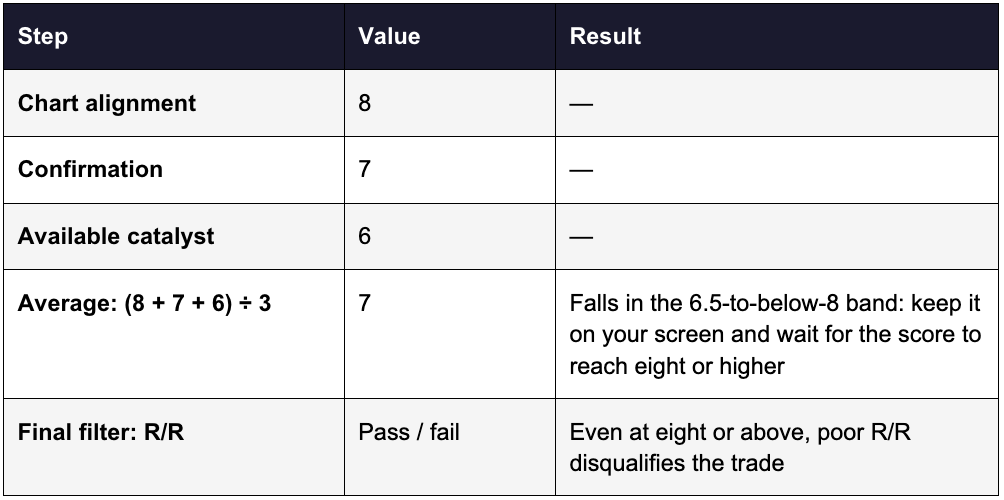
For example, chart alignment at eight, confirmation at seven, and available catalyst at six produce an average of seven.
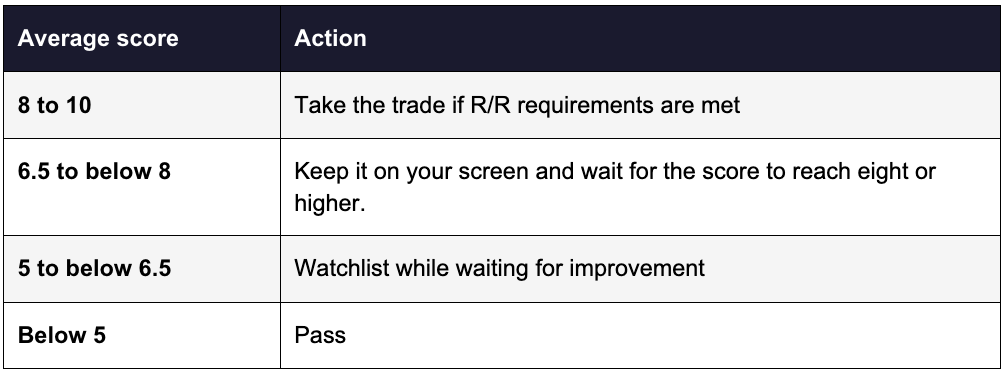
Here’s one possible way to organize the resulting grades:
The Worked Example, Step by Step
Why Reward-to-Risk Overrides the Score
The average does not override your risk rules. R/R is always the final criterion based on your system’s win rate (see my previous article), and poor R/R should disqualify the trade regardless of the total. Sticking to the risk-to-reward requirements of your initial setup, even when you really want to take the trade, is one of the hardest things for a trader to do.
Why a High Score Doesn't Justify a Bigger Position
Position Size Comes After the Evaluation
Position size comes after that evaluation. Base it on the planned exit, dollar risk, and existing exposure. Keep in mind that a high grade doesn’t justify a larger position. No matter what your win rate is, even when you trade your system correctly, you can’t know in advance which trades will win and which will lose. Also, the actual loss can exceed the planned amount if execution is worse than expected. If you took a larger position just because the trade had a high score, that outsized loss could hurt your long-term performance.
Risk/Reward Has to Fit the Strategy
Risk/reward also needs to fit the strategy. Requiring two dollars of potential profit for every dollar risked is one possible rule. As I’ve written about, profitability ultimately depends on win rate, average wins, average losses, and of course, costs.
How to Test Whether Your Scores Actually Work
Record Each Score Before Entry
Record each score before entry. Then compare the results. Track whether the higher grades actually perform better across different market conditions and on new trades.
Review the Criteria, Not the Old Scores
If they don’t, review the criteria. Don’t change the old scores to make the results look better.
Why the Matrix Works: Explain the Trade Before You Take It
The value of the matrix is that it makes you explain the trade before taking it. And as I always say, the only time you’re thinking clearly about a trade is before you’re in it. Whether a strict matrix identifies better opportunities within your system is something your research and trading results have toestablish.
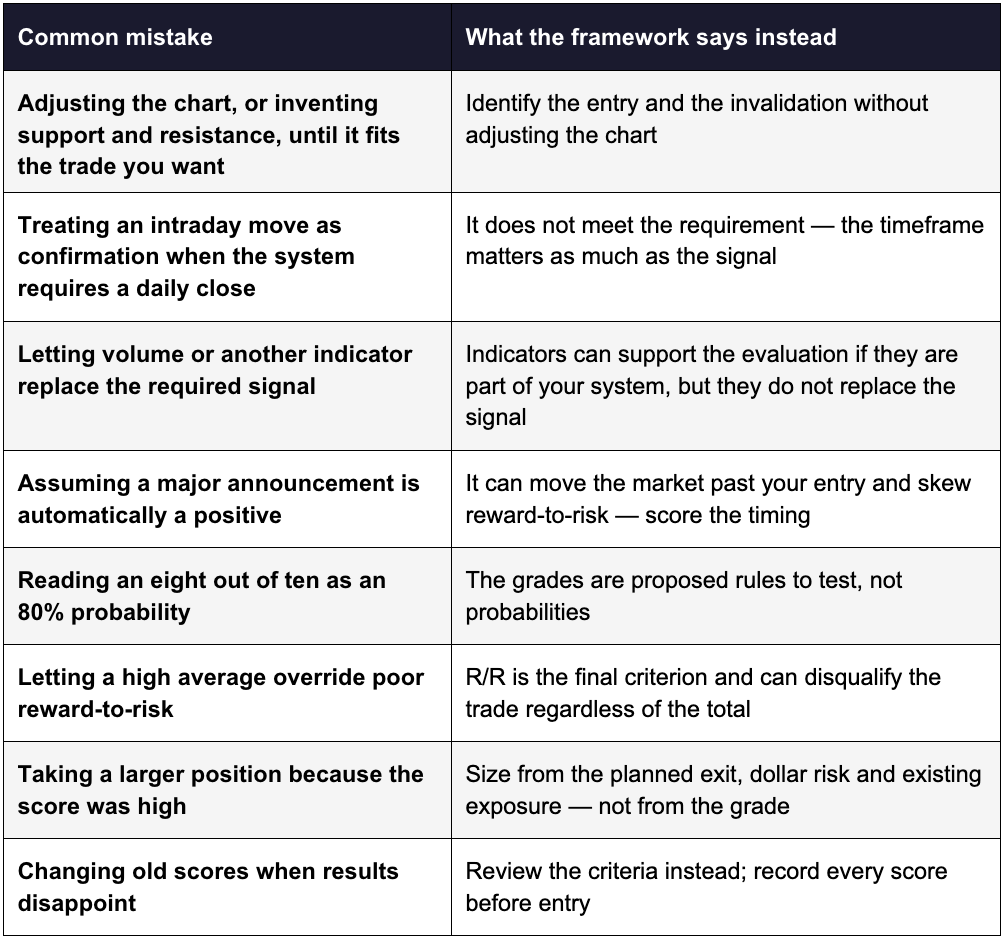
Scoring Do's and Don'ts From the Framework
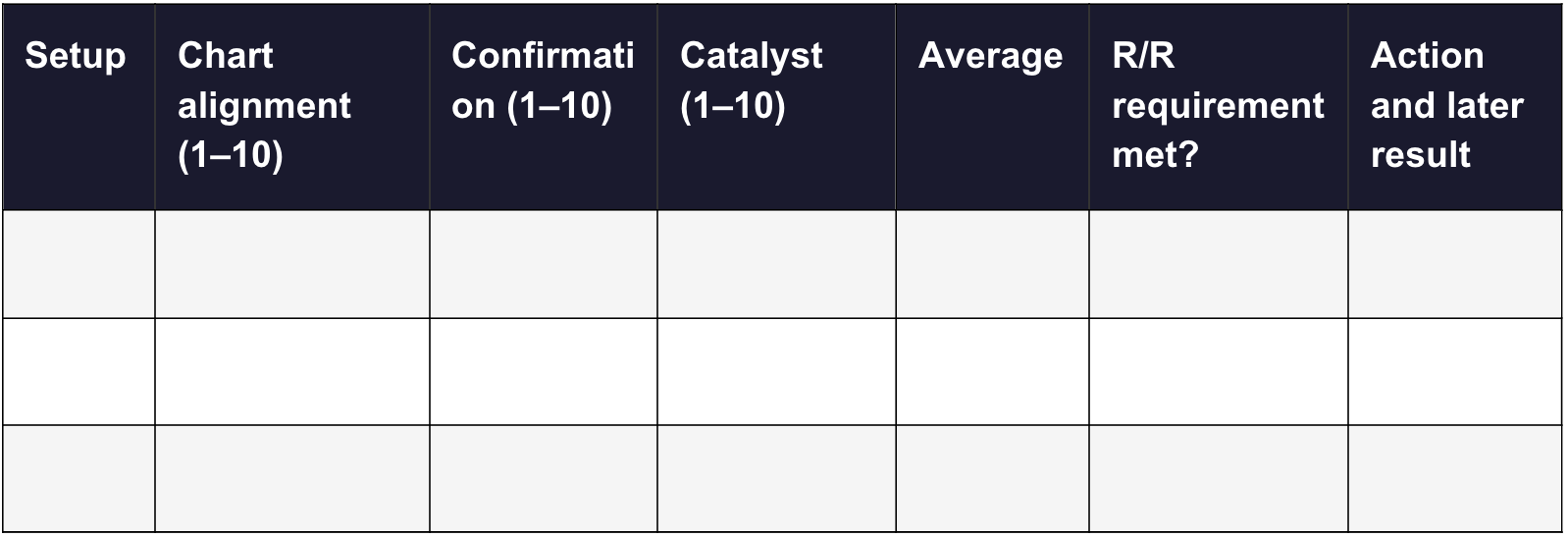
Trade Setup Scorecard Template
Use this layout to record each grade before entry, so that the scores can later be compared with the results.
Frequently Asked Questions About Scoring Trade Setups
What is a trade setup evaluation matrix?
It is a scoring framework that grades a potential trade on three categories; chart alignment, confirmation and available catalyst - each from one to ten. The three scores are averaged into an overall grade, which maps to an action: take the trade if reward-to-risk requirements are met, keep it on screen, put it on the watchlist, or pass. The value of the matrix is that it makes you explain the trade before you take it.
How do you calculate the overall score?
Add the three category scores and divide by three. In the worked example, chart alignment at eight, confirmation at seven and available catalyst at six average to seven, which falls in the 6.5-to-below-8 band. That means the setup stays on screen until its score reaches eight or higher.
Does a score of 8 out of 10 mean an 80% chance of winning?
No. The grades are proposed rules to test within your own strategy, not probabilities. An eight out of ten does not mean an 80% probability of success. Whether higher grades actually perform better is something your own records and results have to establish.
What score do you need before taking a trade?
In the example grading bands, eight to ten means take the trade if reward-to-risk requirements are met. From 6.5 to below eight, keep it on your screen and wait for the score to reach eight or higher. From five to below 6.5, it goes on the watchlist while you wait for improvement. Below five, pass.
Can a high-scoring trade still be a pass?
Yes. Reward-to-risk is always the final criterion, and poor reward-to-risk should disqualify the trade regardless of the total. The average does not override your risk rules, and sticking to your reward-to-risk requirements when you really want the trade is one of the hardest things a trader has to do.
Should I take a bigger position when a setup scores highly?
No. Position size comes after the evaluation and is based on the planned exit, dollar risk and existing exposure - not on the grade. Even when you trade your system correctly, you cannot know in advance which trades will win, and the actual loss can exceed the planned amount if execution is worse than expected. In day trading, where several scored setups can trigger in a single session, oversizing on the strength of a grade compounds quickly.
What is chart alignment in the scoring matrix?
Chart alignment asks whether the setup, the relevant price levels and the timeframes support the trade. You start with the structure; a pullback, a breakout, a reversal or a trade within a range - and ask whether you can identify the entry and the invalidation without adjusting the chart. A strong score means a clear entry and invalidation with broader context supporting the intended trade.
What counts as confirmation?
Whatever your system requires before entry: a close above a prior high, a break of a defined level, or another tested signal such as a volume-based breakout or a rotation zone trade. The timeframe matters as much as the signal. If your system requires a daily close above a level, an intraday move through it does not meet the requirement, and supporting indicators do not replace the required signal.
Does every trade need a catalyst?
Every trade needs whatever catalyst your system requires, and for some strategies that means none at all. For a range-trading strategy, having no major catalyst on the calendar may be the catalyst. For a strategy built around an economic release, the report may be essential. A technical pattern, such as a close above a bull flag, can also provide the catalyst. You score the catalyst, or its absence, against what your strategy needs.
Can a major news event lower a setup's score?
Yes. A major announcement is not automatically a positive. If it moves the market beyond your planned entry before you can respond, it can skew the reward-to-risk ratio and make the setup less attractive. That is why the catalyst category scores timing as well as presence.
Is a countertrend trade allowed under this framework?
Yes, buying a five-minute bounce during a daily downtrend is a countertrend trade, and it is a legitimate style of trading. The framework simply asks that your target and expectations reflect it. A bounce on a five-minute chart should not be expected to carry far enough to reverse a daily downtrend, which matters for anyone applying the matrix to day trading setups on short timeframes.
How much reward-to-risk should I require?
That has to fit your strategy. Requiring two dollars of potential profit for every dollar risked is one possible rule, not a universal one. Profitability ultimately depends on win rate, average wins, average losses and costs, so the requirement should be set from your own system's numbers.
Can I use the scoring matrix for short trades?
Yes. The three categories apply in either direction. For a short selling setup, chart alignment asks whether the structure supports a move lower, and confirmation might be a close below a prior low rather than above a prior high. Catalyst is scored the same way: does an event, or its absence, fit the plan?
Where do the setups I score come from?
Usually from a watchlist built before the session. A stock scanner narrows the universe to candidates, and the matrix decides which of those candidates is actually a trade. It works best when applied the same way to every candidate; otherwise the score becomes another way to justify a trade you already want.
How do trading costs affect the scoring matrix?
Costs sit inside the reward-to-risk check that follows the score, because profitability depends on win rate, average wins, average losses and costs. With a low cost brokerage account, commissions and fees take a smaller share of each trade's reward, but they still belong in the calculation; particularly for strategies with smaller targets.
Does borrow cost belong in the reward-to-risk check for a short trade?
Yes. For a short position held beyond the session, borrow cost on hard to borrow locates reduces the reward side of the ratio. A setup that clears your reward-to-risk minimum on price alone may fall short once the borrow rate is included, so the rate belongs in the calculation before entry.
How do I know whether my scoring criteria work?
Record each score before entry, then compare the scores with the results. Check whether higher grades actually perform better across different market conditions and on new trades. A day trader builds a sample of scored trades faster, so the review can come sooner, but the rule is identical: if the grades do not predict better results, review the criteria.
Should I change old scores if the results look bad?
No. If higher grades do not perform better, review the criteria; do not change the old scores to make the results look better. Recording the score before entry is what keeps the record honest.
Related Reading From This Series
Disclosure
This Blog (hereafter referred to as the "Content") is produced by TradeZero. The Content may include the views and opinions of TradeZero and a third-party participant, Bob Iaccino. Bob Iaccino is compensated by TradeZero for participating in the Content. Mr. Iaccino's trading experiences and accomplishments are unique, and your trading results may vary substantially from his. TradeZero is not responsible for and neither affirms nor endorses any of Mr. Iaccino's views or opinions expressed in the Content. TradeZero makes no representations or warranties with respect to the accuracy of the Content or information available through any referenced or linked third party sites. The Content has been made available for informational and educational purposes only and should not be considered trading or investment advice or a recommendation as to any security. Nothing in this Content constitutes a personalized investment recommendation. Any securities discussed are referenced solely for illustrative and educational purposes.
Trading securities can involve high risk and potential loss of funds. Furthermore, trading on margin is for experienced investors and traders. Margin trading can result in losses that may be greater than your initial investment. Likewise, short selling as a securities trading strategy is extremely risky and can lead to potentially unlimited losses.
Options trading is not suitable for all investors as it can involve risk that may expose investors to significant losses. Please read the Characteristics and Risks of Standardized Options, also known as the options disclosure document (ODD) at OCC before deciding to engage in options trading.
TradeZero provides self-directed brokerage accounts to customers through its operating affiliates: TradeZero America, Inc. a United States broker dealer, registered with the Securities and Exchange Commission (SEC) and member of the Financial Industry Regulatory Authority (FINRA) and the Securities Investor Protection Corporation (SIPC); TradeZero, Inc., a Bahamian broker dealer, registered with the Securities Commission of the Bahamas; and TradeZero Canada Securities ULC, a Canadian broker dealer, member firm of the Canadian Investment Regulatory Organization (CIRO) and member of the Canadian Investor Protection Fund (CIPF); and TradeZero Europe B.V., a Dutch broker dealer, authorized and regulated by the Netherlands Authority for the Financial Markets (AFM) and subject to the regulatory framework of the European Securities and Markets Authority (ESMA) under MiFID II (collectively, the "TradeZero Broker Dealers").