The Drawdown Circuit Breaker: Building a Quantitative Trading Halt Plan
October 7, 2026

Trading Strategies with Bob Iaccino
*Bob Iaccino, Chief Market Strategist and Co-Founder of Path Trading Partners, brings over 30 years of hands-on experience across equities, commodities, futures, and FX markets to his role as our Risk Management and Trading Strategies educator.
Key Points at a Glance
- A daily loss limit is not the same as a stop-loss. The stop covers one trade; the daily limit covers the whole session.
- Every winning system has losing streaks, and losses can cluster together.
- In a hypothetical 75%-win system over 100 trades, a three-trade losing streak has roughly a 70% chance of occurring.
- Build the limit from a process: risk per trade × the number of full-risk losses the account can absorb.
- Set the dollar limit before the session, and once it is hit, trading stops for the day.
- Review your system during a winning streak, not in the middle of a losing one.
Why a Stop-Loss Alone Isn't Enough
If your goal is to be a successful trader over the long term, then you’ve probably already figured out that some sort of stop-loss process needs to be part of every trade. Whether you physically put your stop in the market or manage it yourself while you’re in the position, the important thing is that you don’t violate the process you used to determine where that stop belongs. As I’ve written before, the stop should represent the point where the trade is no longer doing what you expected it to do.
But even if you do that correctly and with tremendous discipline, every winning trading system will have losing streaks. A system that wins 75% of the time still loses 25% of the time. That’s why, if you’re trying to trade successfully for years rather than days or weeks, I believe you should at least consider having a set maximum loss for the day.
Daily Loss Limit vs. Stop-Loss: What's the Difference?
The important distinction is that a daily loss limit is not the same thing as the stop on an individual trade. You can follow your process correctly, respect every stop, and still have three or four losing trades in a row. At some point, the question becomes how much money you are willing to lose before you stop trading, reset, and come back the next day.
Losing Trades Are Part of a Winning System
Years ago, a trader I was mentoring who went by the nickname Madpommie said something that has always stuck with me: “I think losing trades are the complementary probability to winning trades. One cannot exist without the other.” In other words, losing trades aren’t necessarily something to mourn. If your system has a positive trade expectancy, meaning that over a large enough sample of trades it should make money (see my last article), losses are simply part of the deal. They don’t have to arrive one at a time, neatly separated by winners. They can cluster together, which is exactly why a profitable system can still produce a painful losing streak.
How Losing Streaks Lead to Bad Decisions
That’s where traders can get themselves into trouble. A few losses in a row can create the feeling that you need to make the money back before the day is over. Maybe you take a setup you normally would have passed on. Maybe you take more risk. Maybe you enter earlier than you should because you’re afraid of missing the move. As the streak gets longer, it can also damage your confidence and make you question a process you worked hard to develop. You may even start wondering whether your conclusion that the system was a winning one was wrong in the first place, when that may not be the case at all.
What a Daily Maximum Loss Does and Doesn't Tell You
A daily maximum loss is designed to prevent a normal losing streak from doing excessive damage to your account and turning into bad decisions. It doesn’t tell you that your system has suddenly stopped working. It tells you that you have reached the amount of risk you were willing to absorb for that session.
How to Set Your Daily Loss Limit: The Math of Losing Streaks
So how do you decide where that limit should be? I don’t think one percentage works for everybody, but we can use some basic math to establish a rule that makes sense. Going back to our system that wins 75% of the time, each trade has a 25% chance of losing.
The probability of three specific trades all being losers is:
0.25 × 0.25 × 0.25 = 0.015625, or about 1.6%
How Likely Is a Losing Streak Over 100 Trades?
That may not sound like much, but that is the probability of losing three particular trades in a row. Over 100 trades, there are many opportunities for a three-trade losing streak to occur somewhere along the way. Assuming each trade is independent and the 75% win rate holds, the probability of experiencing at least one three-trade losing streak rises to roughly 70%. The probability of seeing four consecutive losses is about 25%, while five consecutive losses comes in around 7%. Bad runs are not an exception to a winning system. They are built into the probabilities.
Losing streak / Approximate probability
| Losing streak (at least once in 100 trades) | Approximate probability |
| Three losses in a row | About 70% |
| Four losses in a row | About 25% |
| Five losses in a row | About 7% |
Hypothetical system that wins 75% of the time, assuming each trade is independent, and the win rate holds. For illustration only; not a prediction of actual results.
How to Build a Quantitative Circuit Breaker
Now let’s use a different example to build the actual circuit breaker. Say a trader normally risks 2% of current capital on each trade and decides ahead of time that four full-risk losses in one day is the absolute maximum the account will absorb. Four 2% losses don’t reduce the account by exactly 8%, because each successive 2% is being calculated from a smaller overall balance, but for now let’s pretend they do.
Why Four 2% Losses Don't Equal Exactly 8%
| Loss | Account remaining (% of starting capital) | Total drawdown |
| Start | 100.00% | 0.00% |
| 1st 2% loss | 98.00% | 2.00% |
| 2nd 2% loss | 96.04% | 3.96% |
| 3rd 2% loss | 94.12% | 5.88% |
| 4th 2% loss | 92.24% | 7.76% |
Hypothetical example. Each 2% is calculated from the current balance, so four losses total about 7.76% rather than 8%.
That trader now has a quantitative circuit breaker. Once the account is down approximately 8% from where it started the session, trading stops for the day. The 8% is not a number I’m recommending for every trader. The point is that it came from a defined process. The trader knows the normal risk per trade, decides in advance how many full-risk losses the account can absorb, and calculates the daily maximum from there.
The Drawdown Circuit Breaker Checklist
From there, the process can be turned into a pretty simple rules-based checklist:
- Determine your normal percentage risk per trade. Whatever process you use to select the stop and calculate your position size stays the same.
- Decide how many full-risk losses the account can absorb in one day.
- Convert that into your maximum daily drawdown. In our example, four trades at 2% each give us roughly an 8% maximum.
- Calculate the actual dollar limit before the session begins. Your daily maximum should be based on the capital you have at the start of the day.
- Once the maximum is reached, trading stops for the day. You don’t increase the limit because another setup looks good, and you don’t reset it because you think you can make the money back.
Stop-Loss vs. Daily Circuit Breaker
Once you establish that limit, it becomes a hard circuit breaker. The halt itself is part of the trading plan. Your individual stop tells you when one trade is wrong. Your daily maximum tells you when the account has absorbed enough risk for that session.
Stop-Loss vs. Daily Circuit Breaker
| Individual stop-loss | Daily Circuit Breaker | |
| Applies to | One trade | The whole session |
| What it tells you | When one trade is wrong | When the account has absorbed enough risk for that session |
| How it is set | The point where the trade is no longer doing what you expected | Risk per trade × full-risk losses the account can absorb |
| When it is set | As part of the process for each trade | Before the session begins, from start-of-day capital |
| What happens when hit | The trade is closed | Trading stops for the day |
Don't Retool a Winning System During a Losing Streak
There is one more reason I think these circuit breakers are important. I’ve seen traders go through a losing streak and immediately start retooling a system that was profitable before the streak began. The goal becomes eliminating the losing trades. The problem is that in trying to remove those losers, you can easily eliminate even more future winners.
When Should You Review Your Trading System?
I believe the best time to analyze your trading process and decide whether it can be improved is during a winning streak, not in the middle of a losing one. A daily circuit breaker allows you to stop without immediately concluding that something is broken. Sometimes the losses are simply part of the probabilities you accepted when you chose to trade the system in the first place.
The Bottom Line
If your goal is to stay in this business for the long term, that distinction matters. Protect the capital, respect the limit you established ahead of time, and don’t let a normal losing streak convince you to fix something that may not be broken.
Circuit Breaker Do's and Don'ts
| Do | Don't |
| Set the dollar limit before the session begins | Increase the limit because another setup looks good |
| Base it on your capital at the start of the day | Reset it because you think you can make the money back |
| Keep your stop and position-sizing process the same | Take setups you would normally pass on to recover losses |
| Stop, reset and come back the next day | Retool a profitable system in the middle of a losing streak |
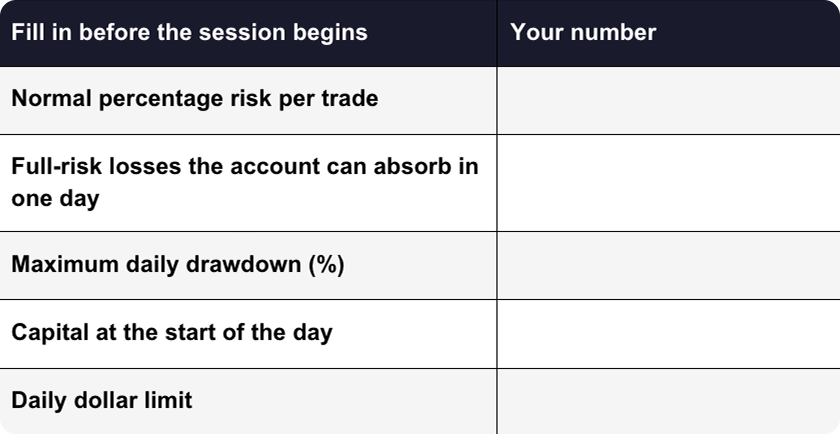
Your Circuit Breaker Worksheet
Frequently Asked Questions About Daily Loss Limits
What is a drawdown circuit breaker in trading?
A drawdown circuit breaker is a pre-set maximum loss for the day. Once the account is down by that amount from where it started the session, trading stops for the day. It is part of the trading plan, decided before the session begins.
What is the difference between a daily loss limit and a stop-loss?
A stop-loss applies to one trade and marks the point where that trade is no longer doing what you expected. A daily loss limit applies to the whole session and tells you when the account has absorbed enough risk for the day. You can respect every stop and still hit your daily limit.
Why do day traders need a daily loss limit?
Because every winning system has losing streaks, and a few losses in a row can create pressure to make the money back — taking setups you would normally pass on, taking more risk, or entering early. In day trading,a daily maximum loss is designed to stop a normal losing streak from doing excessive damage and turning into bad decisions.
How do I calculate my daily loss limit?
Determine your normal percentage risk per trade, decide how many full-risk losses the account can absorb in one day, and multiply. In Bob's example, four losses at 2% each give roughly an 8% maximum. Then convert that to a dollar figure based on your capital at the start of the day.
Is 8% the right daily loss limit?
Not necessarily. Bob is clear that 8% is not a number he recommends for every trader. The point is that the figure comes from a defined process: normal risk per trade multiplied by the number of full-risk losses you decide the account can absorb.
Why don't four 2% losses equal exactly 8%?
Because each successive 2% loss is calculated from a smaller balance. Four consecutive 2% losses reduce the account by about 7.76%, not 8%. Bob uses 8% as a simplification when building the example.
How likely is a losing streak with a 75% win rate?
In Bob's hypothetical example — a system that wins 75% of the time, with each trade independent — the chance of at least one three-trade losing streak over 100 trades is roughly 70%. Four in a row is about 25%, and five in a row about 7%. These are illustrations of probability, not a prediction of any real trading results.
Does a losing streak mean my trading system is broken?
Not necessarily. If a system has positive trade expectancy, losses are part of the deal and they can cluster together. A daily circuit breaker lets you stop without immediately concluding that something is broken — the losses may simply be part of the probabilities you accepted when you chose to trade the system.
What is positive trade expectancy?
It means that over a large enough sample of trades, a system should make money. A system with positive expectancy still has losing trades and losing streaks; they are the complementary probability to its winning trades.
Should I change the daily limit if a good setup appears?
No. Once the maximum is reached, trading stops for the day. You don't increase the limit because another setup looks good, and you don't reset it because you think you can make the money back. A stock scanner will keep surfacing new setups after the limit is hit, and the circuit breaker only works if those are left for the next session.
What capital should my daily loss limit be based on?
Calculate the dollar limit before the session begins, using the capital you have at the start of the day. That keeps the limit fixed for the session instead of shifting as trades open and close.
When is the best time to review my trading system?
Bob believes the best time to analyze your trading process is during a winning streak, not in the middle of a losing one. Retooling a profitable system to eliminate losing trades can easily eliminate even more future winners.
Does a daily circuit breaker apply to short selling?
Yes. The circuit breaker is based on percentage risk per trade and account drawdown, not on trade direction. If short selling is part of your approach, each short trade's risk is set by its stop in the same way, and those losses count toward the same daily maximum. Short positions can carry potentially unlimited losses, which is one reason defined limits matter.
Do fees count toward the daily loss limit?
Your daily maximum is measured by how far the account is down from where it started the session, so commissions and fees reduce the account alongside trading losses. For traders using a low cost brokerage, costs take a smaller share of each trade, but they still count toward the drawdown.
Do borrow costs affect the circuit breaker on short trades?
Any cost that reduces the account balance moves it closer to the daily maximum. When using hard to borrow locates, locate fees are part of that cost, so it is worth factoring them into the day's drawdown.
What should a day trader do after hitting the daily limit?
Stop trading, reset, and come back the next day. For a day trader, the halt is part of the trading plan, not a verdict on the system. Protect the capital, respect the limit set ahead of time, and don't let a normal losing streak convince you to fix something that may not be broken.
Related Reading From This Series
Disclosure
This Blog (hereafter referred to as the "Content") is produced by TradeZero. The Content may include the views and opinions of TradeZero and a third-party participant, Bob Iaccino. Bob Iaccino is compensated by TradeZero for participating in the Content. Mr. Iaccino's trading experiences and accomplishments are unique, and your trading results may vary substantially from his. TradeZero is not responsible for and neither affirms nor endorses any of Mr. Iaccino's views or opinions expressed in the Content. TradeZero makes no representations or warranties with respect to the accuracy of the Content or information available through any referenced or linked third party sites. The Content has been made available for informational and educational purposes only and should not be considered trading or investment advice or a recommendation as to any security. Nothing in this Content constitutes a personalized investment recommendation. Any securities discussed are referenced solely for illustrative and educational purposes.
Trading securities can involve high risk and potential loss of funds. Furthermore, trading on margin is for experienced investors and traders. Margin trading can result in losses that may be greater than your initial investment. Likewise, short selling as a securities trading strategy is extremely risky and can lead to potentially unlimited losses.
Options trading is not suitable for all investors as it can involve risk that may expose investors to significant losses. Please read the Characteristics and Risks of Standardized Options, also known as the options disclosure document (ODD) at OCC before deciding to engage in options trading.
TradeZero provides self-directed brokerage accounts to customers through its operating affiliates: TradeZero America, Inc. a United States broker dealer, registered with the Securities and Exchange Commission (SEC) and member of the Financial Industry Regulatory Authority (FINRA) and the Securities Investor Protection Corporation (SIPC); TradeZero, Inc., a Bahamian broker dealer, registered with the Securities Commission of the Bahamas; and TradeZero Canada Securities ULC, a Canadian broker dealer, member firm of the Canadian Investment Regulatory Organization (CIRO) and member of the Canadian Investor Protection Fund (CIPF); and TradeZero Europe B.V., a Dutch broker dealer, authorized and regulated by the Netherlands Authority for the Financial Markets (AFM) and subject to the regulatory framework of the European Securities and Markets Authority (ESMA) under MiFID II (collectively, the "TradeZero Broker Dealers").