A Welcome Rebound, but Confirmation Remains Elusive
November 17, 2026

Market Recap
Analyzing the markets with Richie Naso, a Wall Street veteran of over 40 years and former member of the NYSE.
Market close: Friday, November 13, 2026
Dow Jones Industrial Average
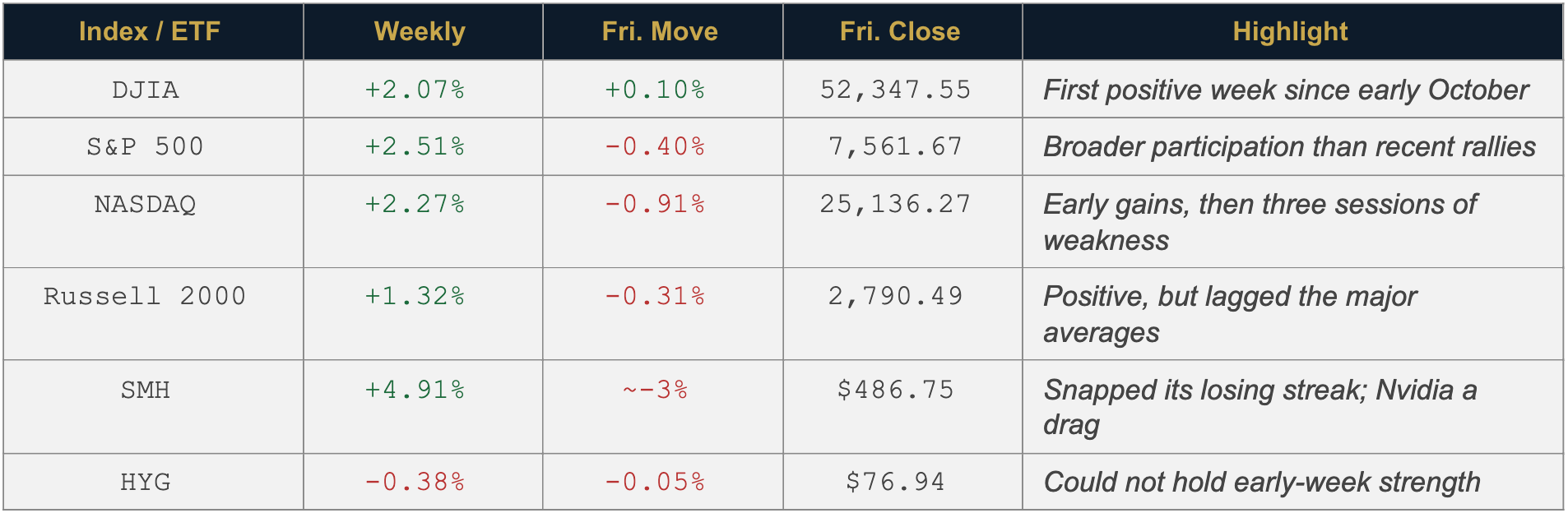
The Dow posted a strong weekly advance, gaining 1,061.82 points, or 2.07%, to close at 52,347.55 — its first positive week since early October. The performance was largely driven by Monday’s powerful 2.15% advance, which provided a cushion against selling pressure later in the week. (Source: AP News)
Richie’s take: The Dow demonstrated resilience this week, particularly considering the weakness in technology and the pressure coming from the bond market. However, I would be careful about interpreting the entire week’s advance as evidence of renewed buying conviction. A substantial portion of the gain came from Monday’s outsized move.
The participation of financials and industrials was encouraging, but the sustainability of this advance will depend on whether buying interest broadens and can withstand continued pressure from higher interest rates.
Richie’s bottom line: A constructive week for the Dow, but one that still requires confirmation. I would like to see broader participation and follow-through before becoming more confident in the durability of this rally.
S&P 500
The S&P 500 gained 184.81 points, or 2.51%, for the week, closing Friday at 7,561.67 after a 0.40% dip on the final session. (Source: AP News)
Important observations
The positive breadth was encouraging. Unlike a rally dependent entirely on a handful of mega-cap technology stocks, this week’s advance had considerably broader participation.
However, the divergence between Nvidia and the broader semiconductor group is worth watching. It suggests investors are becoming more selective within technology rather than indiscriminately buying the entire sector.
The rise in Treasury yields is another concern. A 10-year yield above 5% makes equity valuations more difficult to justify, particularly for higher-multiple growth stocks.
Richie’s take: The S&P delivered an encouraging recovery, with improving participation providing a positive underlying signal. Nevertheless, I remain cautious about declaring a sustainable change in market direction. The combination of rising yields, technology-sector rotation and continued uncertainty surrounding valuations warrants attention.
Richie’s bottom line: A strong week for the S&P, and improving breadth is a welcome development. But I would like to see whether this participation can be sustained while Treasury yields remain elevated. The quality of this rally will ultimately bedetermined by its ability to maintain broad participation rather than relying on short-term rotational buying.
Nasdaq Composite
The Nasdaq Composite gained 556.85 points, or 2.27%, for the week, closing at 25,136.27. Friday’s 0.91% decline was the third straight losing session after a strong start to the week. (Source: AP News)
Richie’s take: While the Nasdaq finished higher for the week, I am less impressed with the quality of the advance. The substantial gains early in the week were followed by three sessions of weakness, suggesting that buyers were not yet willing to commit aggressively at higher levels.
The weakness in Nvidia and other major technology names is particularly noteworthy. Given their considerable weighting in the index, continued deterioration among these leaders could undermine the broader market recovery. I would also pay close attention to the relationship between the Nasdaq and the semiconductor sector. Sustained weakness in technology leadership would be an unfavorable development.
Richie’s bottom line: The Nasdaq delivered a positive weekly performance, but the late-week deterioration leaves questions about the sustainability of the recovery. I remain cautious until technology leadership stabilizes and buying participation becomes more consistent.
SMH — Semiconductors
SMH posted a positive week, gaining $22.79, or approximately 4.9%, to close at $486.75 and breaking its recent losing streak. However, the headline gain masks considerable volatility and a significant divergence among semiconductor leaders. (Source: ETF.com)
What drove the week
- AMD: Advanced Micro Devices gained approximately 18.9%, providing substantial support.
- Broadcom: Advanced approximately 18.2%.
- Nvidia: Fell approximately 12.7%, creating a significant drag on SMH.
- Micron: Memory-chip optimism and expectations for higher DRAM prices helped support the sector.
- Friday weakness: Semiconductor stocks sold off sharply, giving back some of the week’s earlier gains.
An important divergence
SMH gained 4.9% for the week, considerably underperforming SOXX, the iShares Semiconductor ETF, which advanced approximately 9.4%. The primary reason was SMH’s heavier exposure to Nvidia. This is an important distinction because the broader semiconductor industry demonstrated considerably more strength than the performance of Nvidia alone would suggest. (Source: ETF.com)
Richie’s take: The semiconductor sector showed encouraging signs of recovery, particularly through AMD, Broadcom and memory-related stocks. However, Nvidia’s substantial weakness remains a concern given its influence on the sector and broader technology market. Friday’snearly 3% decline in SMH also deserves attention. It raises questions about whether this week’s advance represents the beginning of a sustainable recovery or simply a temporary rebound following an extended period of selling.
Richie’s bottom line: A positive week for semiconductors, but one that lacks confirmation from some of the sector’s most influential leaders. I would remain cautious until Nvidia stabilizes and SMH can demonstrate sustained buying interest rather than another short-lived recovery.
Russell 2000
The Russell 2000 gained 36.38 points, or 1.32%, for the week, closing at 2,790.49 after slipping 0.31% on Friday. (Source: AP News)
Richie’s take: The Russell’s performance remains a concern. Although the index finished higher for the week, its inability to maintain Monday’s advance suggests that buying conviction among small-cap investors remains limited. More importantly, the Russell underperformed the major averages, reinforcing the notion that this market recovery is not yet producing consistent participation across the broader equity universe.
I would continue watching the Russell as an important indicator of overall market health. Sustained strength in small caps would provide welcome confirmation that participation is broadening beyond the larger-cap stocks.
Richie’s bottom line: A positive week, but a relatively disappointing performance compared with the broader market. Until small caps demonstrate greater consistency and the Russell can hold its advances, I would remain cautious about declaring a meaningful improvement in overall market breadth.
HYG — High-Yield Credit
HYG finished the week at $76.94, down $0.29, or 0.38%, from the previous Friday’s close of $77.23. The ETF rose to $77.51 on Monday before giving back that gain and more over the remaining four sessions. (Source: StockAnalysis.com)
Richie’s take: HYG had previously been providing a degree of reassurance despite weakness in equities. This week, however, that support became less convincing. I would not characterize the modest decline as evidence of significant credit deterioration, but I would watch whether the weakness continues.
Richie’s bottom line: HYG’s inability to maintain its early-week strength is a yellow flag. Given its role as a credit-risk barometer, continued deterioration would be a concern for the broader equity market. A stabilization or recovery would help reinforce the possibility that the recent equity weakness is primarily a rotation rather than a deeper deterioration in market confidence.
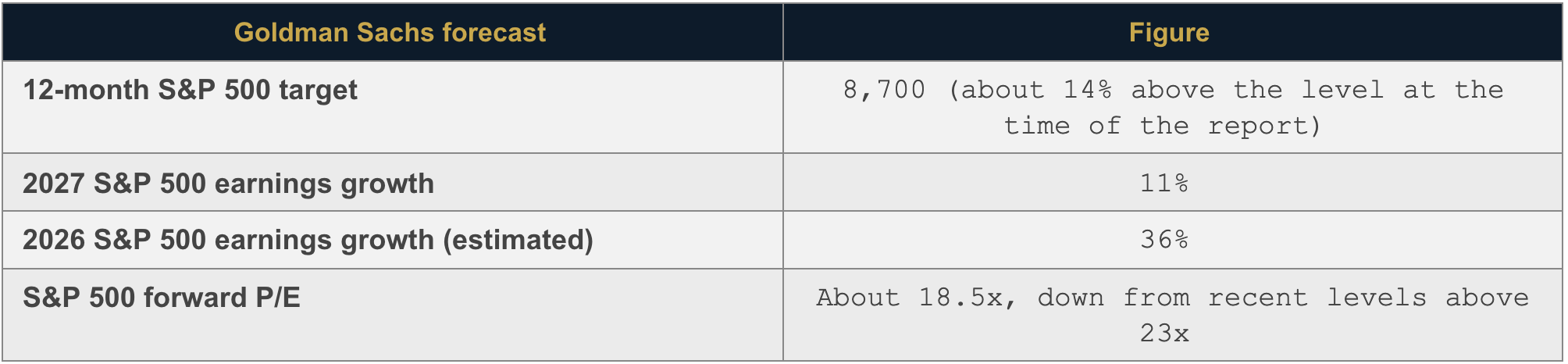
Strategies Watch: Goldman Sachs Sets a 12-Month S&P 500 Target of 8,700
The forecast below is Goldman Sachs’ view, as reported by Reuters on November 13, 2026, not TradeZero’s or Richard Naso’s. Forecasts are estimates, not guarantees, and may not be realized. This is for informational and educational purposes only and is not investment advice. (Source: Reuters)
Why Goldman is constructive
- Recent technology selling has made valuations more attractive.
- Corporate earnings should continue growing, although at a slower pace.
- Lower bond yields and easing inflation could support equity valuations.
- AI investment should continue contributing to economic growth, even as the rate of spending expansion slows.
This Week's Interesting Sector Piece: Nvidia: A CEO Transition, a Downgrade and an Earnings Report
The reporting summarized below is drawn from Yahoo Finance (Ines Ferré and Daniel Howley, November 13, 2026) and the outlets it cites. The analyst opinions and price targets are those of the firms named, not TradeZero or Richard Naso. Nothing here is a recommendation to buy or sell any security. (Source: Yahoo Finance)
What happened
Nvidia (NVDA) stock extended declines on Friday, the day after Jensen Huang resigned as CEO. On Thursday, the stock fell as much as 13% before buyers stepped in and shares pared losses to 4%. The company’s CFO, Colette Kress, will serve as interim head of the business until a permanent successor is named.
The leadership change followed a series of reports — including from The New York Times and Reuters — alleging personal relationships between Huang and a customer and company employees. Nvidia’s board met on Wednesday night and decided on the change at the top. The company has said an independent review is under way.
Who might succeed Huang
Wall Street is already speculating about who could take the permanent role. The names that have come up so far, according to Yahoo Finance:
- Rene Haas, Arm Holdings CEO. Arm (ARM) CEO Rene Haas is a potential successor, according to the Financial Times. Haas has led Arm since 2022 and previously ran Nvidia’s Computing Products Business Unit before leaving for Arm in 2013. “He ran a business unit there and reported right into Jensen and knows him well,” Patrick Moorhead of Moor Insights and Strategy told Yahoo Finance.
- Ian Buck, Nvidia VP of hyperscale and high-performance computing. Strategists have floated Nvidia insider Ian Buck, a 22-year company veteran who rose from systems engineer to head of its biggest businesses. Prediction markets Kalshi and Polymarket both put the odds of Buck taking over at roughly 40%, as of Friday.
- Chris Malachowsky, Nvidia co-founder. Co-founder Chris Malachowsky could also step in. An engineer with nearly 40 patents, he is an Nvidia fellow and senior technology executive who has overseen operations, engineering and the company’s research organization.
- Tim Cook, former Apple CEO. Shortly after the board announced Huang’s resignation, President Trump suggested former Apple (AAPL) CEO Tim Cook would be the best person for the job. On Friday, Polymarket bettors placed a 5% chance on Cook being selected.
The bear case: HSBC downgrades to Hold
Nvidia shares were downgraded to Hold at HSBC on Friday. The firm also cut its price target to $170 from $365. Analyst Frank Lee said investor confidence has been “shaken” because the company’s “leadership succession plan is unclear,” while the fundamentals remain intact and long-term uncertainty has increased.
“AI demand remains strong and NVIDIA has procured enough supply to achieve the 70% y-o-y revenue growth it outlined last quarter.” — Frank Lee, HSBC, via Yahoo Finance
Still, Lee said a new CEO could face challenges executing Nvidia’s existing roadmap and shaping its product strategy, as well as “maintaining the same pricing power with customers and the same bargaining power with suppliers.” Tightened export restrictions are another potential risk: “While the findings of the independent probe by NVIDIA and Congressional scrutiny remain to be seen, one possible outcome could be enhanced export restrictions,” Lee wrote. At least ten Wall Street analysts have downgraded the stock from Buy to Hold since the resignation.
The bull case: ‘Nothing has changed’
Wall Street hasn’t given up on Nvidia. While there has been a steady stream of price-target changes and a few downgrades, many analysts who cover the company are staying bullish. Their argument is captured in a note from Wedbush analyst Matthew Bryson: “Nothing has changed,” he wrote on Friday ahead of Nvidia’s earnings this week. “We again expect NVDA to exceed its forecast and to guide FQ4 above Street.” His rationale rests on three points:
“Management has tended to leave a fair bit [of] wiggle room in guidance, allowing for meaningful upside when reporting numbers and we expect NVDA will deliver another beat and raise quarter.”
“A strong hyperscaler spending backdrop augmented by increased spending at neoclouds and model builders (in particular xAI) is persisting into the out quarters as highlighted by results and guidance from Taiwan Semiconductor, AMD, SuperMicro, Foxconn, etc. as well as our own supply chain checks.”
“We believe NVDA has built a best in industry position with material and component suppliers through at least next year at a point where component and material access, not end demand, is defining shipments.”
On my Radar This Week: What I’ll Be Focused On This Week
The items below reflect Richard Naso’s personal areas of focus for the coming week and are provided for informational and educational purposes only. They do not constitute investment advice or a recommendation to trade any security.
WATCH LIST — WEEK OF NOVEMBER 17, 2026
Tuesday, November 17 — Nvidia (NVDA) fiscal Q3 earnings, after the close — This could be the week’s most consequential corporate event. Nvidia’s results and forward guidance will be scrutinized for evidence that AI spending remains strong and that the enormous capital commitments by hyperscalers are translating into sustainable demand. (Source: Stock Titan)
I will be looking at:
- Data-center revenue and forward guidance.
- Gross margins and profitability.
- Demand for next-generation AI chips.
- Capital expenditure plans from major technology customers.
- Whether semiconductor leadership can broaden beyond Nvidia.
The reaction to Nvidia’s guidance could have implications well beyond the semiconductor sector, particularly for the Nasdaq and SMH.
- Tuesday — Retail sales — Another indication of the consumer’s underlying strength.
- Wednesday — Fed minutes — The minutes of the last FOMC meeting will be examined for the Fed’s thinking on inflation and interest rates.
- Russell 2000, HYG, market breadth and Treasury yields — These should help determine whether last week’s advance is developing into a broader recovery or simply a temporary interruption in the recent weakness.
Final Thoughts: Richie’s Take
I am encouraged by the market’s ability to produce a positive week and break the recent losing streak. However, I am not prepared to declare that the correction risk has passed.
The advance in the major averages is a positive development, but the underlying evidence remains mixed. Technology leadership has shown signs of fatigue, small-cap participation remains less convincing, HYG has yet to provide the confirmation I would like to see, and rising Treasury yields present another challenge.
The market needs more than a handful of strong sessions to establish a sustainable change in direction. I want to see broader participation, renewed strength in technology, improved performance from the Russell 2000 and, importantly, confirmation from the credit markets.
For now, I remain cautious. The market has demonstrated that buyers are still willing to step in, but I need to see more convincing evidence that this advance has staying power. I would rather wait for confirmation than chase a rally that has yet to establish its durability.
The rebound is welcome, but the burden of proof remains with the bulls.
— Richie
Disclaimer
This content (“Content”) is produced by Richard Naso. The Content represents only the views and opinions of Mr. Naso who is compensated by TradeZero for producing it. Mr. Naso’s trading experiences and accomplishments are unique, and your trading results may vary substantially from his.
Mr. Naso is not acting as a securities analyst or investment adviser in providing this content, which is not intended to constitute professional investment research, individualized investment advice, or a recommendation to buy or sell any security.
TradeZero does not endorse the Content and makes no representations or warranties with respect to the accuracy of the Content or information available through any referenced or linked third party sites. The Content has been made available for informational and educational purposes only and should not be considered trading or investment advice or a recommendation as to any security. Trading securities can involve high risk and potential loss of funds. Furthermore, trading on margin is for experienced investors and traders only as the amount you may lose can be greater than your initial investment. Likewise, short selling as a securities trading strategy is extremely risky and can lead to potentially unlimited losses. Options trading is not suitable for all investors as it can involve risk that may expose investors to significant losses. Please read the Characteristics and Risks of Standardized Options, also known as the options disclosure document (ODD) at https://www.theocc.com/Company-Information/Documents-and-Archives/Options-Disclosure-Document before deciding to engage in options trading.
TradeZero provides self-directed brokerage accounts to customers through its operating affiliates: TradeZero America, Inc., a United States broker dealer, registered with the SEC and member of the Financial Industry Regulatory Authority (FINRA) and the Securities Investor Protection Corporation (SIPC); TradeZero, Inc., a Bahamian broker dealer, registered with the Securities Commission of the Bahamas; TradeZero Canada Securities ULC, a Canadian broker dealer, member firm of Canadian Investment Regulatory Organization (CIRO) and member of the Canadian Investor Protection Fund (CIPF); and TradeZero Europe B.V., a Dutch broker dealer, authorized and regulated by the Netherlands Authority for the Financial Markets (AFM) and subject to the regulatory framework of the European Securities and Markets Authority (ESMA) under MiFID II (collectively, the “TradeZero Broker Dealers”).