Your Win Rate Could Be Lying to You
August 10, 2026

Trading Strategies with Bob Iaccino
*Bob Iaccino, Chief Market Strategist and Co-Founder of Path Trading Partners, brings over 30 years of hands-on experience across equities, commodities, futures, and FX markets to his role as our Risk Management and Trading Strategies educator.
A high win rate can still lose money. A lower one can still make it. The edge was never how often you’re right.
Most traders, early on, pour their time into one question: what to buy and where to get in. Say you want to own Nvidia. Solid company. The stock can run for a long time on momentum. But you don’t want it here. Not until it pulls back to a level you’re willing to own it at. Waiting for your price is real discipline. It can keep you out of a lot of bad trades.
Once you get past selection and entry, almost every trader looks to the same number to judge whether they’re any good: their win rate. How often they’re right. It’s the scorecard a lot of people trust. It can also be one of the more misleading numbers in the whole process.
A 70% win rate can still be a losing system. A 40% win rate can still be a winning one. You can win seven out of ten trades and still bleed money. You can lose six out of ten and still come out ahead over time. Being right more often than being wrong doesn’t automatically tell you whether your account will grow over time, because win rate only counts how often you win. It says nothing about how much you make when you’re right versus how much you give back when you’re wrong.
The questions that matter most are the ones many people skip. When you trade the process correctly (the way you designed it), what’s your actual reward-to-risk ratio? Not on just the last couple of trades. Look at a full sample of trades since you locked in the process; how much do you make for every dollar you risk? And what’s the win rate that goes with that sample ratio? If you can’t answer both, then the single Nvidia trade you agonized over — the one where you waited for the pullback, put the stop where the price action said it should go, and took the target the setup offered — doesn’t tell you much by itself. One trade is just one data point. The only thing that matters is the pattern across many trades.
The two numbers that actually decide the outcome
Whether a process makes money over a meaningful sample tends to come down to two numbers and the relationship between them.
The first is your win rate, and many of you likely already know it: out of a large group of trades, how often you do close a trade in profit. Forty winners out of a hundred is 40%. Fifty-seven out of a hundred is 57%, and so on. The larger the data set, the more reliable the win rate.
The second is reward-to-risk. When you take a profit, how much do you make relative to what you lose when a trade goes south? For example, 2:1means every dollar you risk is set up to return two. At 0.75:1, that same dollar is only returning seventy-five cents.
Those two numbers are linked. Neither one means much on its own. A 40% win rate can look like a loser until you pair it with a big enough reward-to-risk and the math turns positive. An 80% win rate can look unbeatable until the payoff is so thin that winning most of the time still leaves you underwater.
So the real question is not “Do I make money on most of my trades?” It’s closer to this: given the reward-to-risk I’m actually working with, what win rate do I need to be profitable over time? Or the other way around — given the win rate I currently have, what reward-to-risk ratio do I need to use? Every trading process has a line in the sand it has to cross. Live on the wrong side of that line for long enough and the account can go the wrong way no matter how clean your stock picks look.
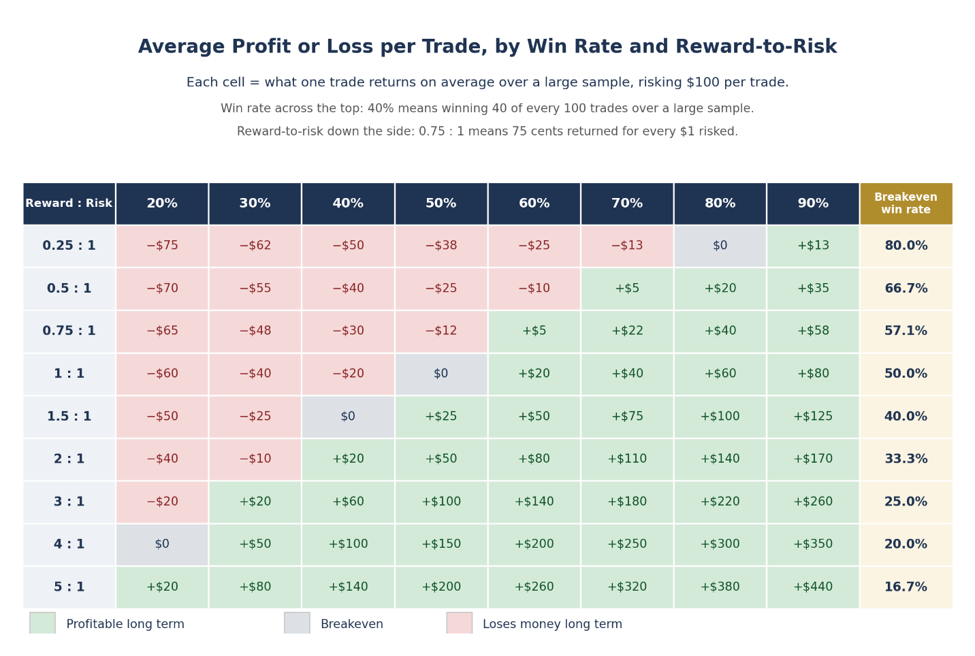
What you really want to focus on is “trade expectancy”. That simply means how much you can expect to make or lose, on average, per trade over a large number of trades. Say you risk $100 on every trade, make $200 when you win, and win 40% of the time. Over 100 trades, you would win 40 and lose 60, yet still make about $2,000 overall. That works out to an average profit of roughly $20 per trade. The important number isn’t just what you make when you’re right. It’s what the entire system produces after both the winners and losers are included. Positive expectancy is what you want.
The same math shows why a high win rate doesn’t always mean you’re making money. Say you win 70% of your trades, but your average winner is only one-quarter the size of your average loser. That can happen when you take profits too quickly but let losing trades run to your pre-planned stop level (or even further). Even though you’re right seven out of ten times, you can still lose money overall. Meanwhile, a system that only wins 40% of the time can still make money if the average winner is twice the size of the average loser. The win rate alone isn’t the edge. What matters is the balance between how much you make when you’re right and how much you lose when you’re wrong. See the table below:
The mistake that feels like discipline
This is where traders who already have a workable edge can still give it back. They build a process that works — say a 40% win rate with a 2:1 payoff — and then they flinch. A trade moves in their favor and is up $100, with a $200 profit target still in place, but the fear of giving that profit back takes over. So they close the trade early. It feels responsible. It feels like good risk management. But over time, consistently cutting winners short can be one of the most expensive habits a trader develops. There’s an old trader cliché: “No one ever lost money taking a profit.” On a single trade, maybe. But when you look at it over time, I’d argue that cliché is flat-out wrong.
Run the same hundred trades, but this time half the winners get cut at 1:1 instead of reaching 2:1. Twenty full winners at $200 bring in $4,000. Twenty clipped winners at $100 bring in $2,000. Sixty losers at $100 cost $6,000. Net: zero. You didn’t take any extra losses. The win rate didn’t change. You just cut twenty winners short, and the entire edge disappeared.
A planned loss costs what the process says it costs. That loss is already built into the math. When you take the stop your system called for, you’re following the process the way it was designed. But when you cut a winner short, you’re reducing the profits that are supposed to pay for those losses. At a 40% win rate, your winners have to do the heavy lifting. They have to be large enough compared with your losers for the math to work. Every time you cut one short, you’re not necessarily protecting the account. You may actually be weakening the edge.
A lot of traders have this backwards. They feel a loss hurts more than missing out on some additional profit, so they grab winners early and hold onto losers hoping they turn around. Human psychology says this is right, but the math says you should usually be doing the opposite. Take the planned loss when the process tells you to. Let the winner run to the target the setup gave you. That can feel uncomfortable in the moment, but it’s often exactly what keeps a lower win-rate system profitable.
Stop grading the process mainly on how often you’re right.
That number feels good, but it often means less than people think. Win rate is easy to track and easy to talk about. Expectancy is what the account actually cares about. Get the reward-to-risk right, keep your risk consistent, and stick to the process, and you can be wrong more often than you’re right and still make money over a large enough sample. Get those pieces wrong, and being right most of the time may not be enough to save you.
– Bob Iaccino
Disclaimer
This Blog (hereafter referred to as the "Content") is produced by TradeZero. The Content may include the views and opinions of TradeZero and a third-party participant, Bob Iaccino. Bob Iaccino is compensated by TradeZero for participating in the Content. Mr. Iaccino's trading experiences and accomplishments are unique, and your trading results may vary substantially from his. TradeZero is not responsible for and neither affirms nor endorses any of Mr. Iaccino's views or opinions expressed in the Content. TradeZero makes no representations or warranties with respect to the accuracy of the Content or information available through any referenced or linked third party sites. The Content has been made available for informational and educational purposes only and should not be considered trading or investment advice or a recommendation as to any security. Nothing in this Content constitutes a personalized investment recommendation. Any securities discussed are referenced solely for illustrative and educational purposes.
Trading securities can involve high risk and potential loss of funds. Furthermore, trading on margin is for experienced investors and traders. Margin trading can result in losses that may be greater than your initial investment. Likewise, short selling as a securities trading strategy is extremely risky and can lead to potentially unlimited losses.
Options trading is not suitable for all investors as it can involve risk that may expose investors to significant losses. Please read the Characteristics and Risks of Standardized Options, also known as the options disclosure document (ODD) at OCC before deciding to engage in options trading.
TradeZero provides self-directed brokerage accounts to customers through its operating affiliates: TradeZero America, Inc. a United States broker dealer, registered with the Securities and Exchange Commission (SEC) and member of the Financial Industry Regulatory Authority (FINRA) and the Securities Investor Protection Corporation (SIPC); TradeZero, Inc., a Bahamian broker dealer, registered with the Securities Commission of the Bahamas; and TradeZero Canada Securities ULC, a Canadian broker dealer, member firm of the Canadian Investment Regulatory Organization (CIRO) and member of the Canadian Investor Protection Fund (CIPF); and TradeZero Europe B.V., a Dutch broker dealer, authorized and regulated by the Netherlands Authority for the Financial Markets (AFM) and subject to the regulatory framework of the European Securities and Markets Authority (ESMA) under MiFID II (collectively, the "TradeZero Broker Dealers").