Rate Hike or No Rate Hike
September 14, 2026

Market Recap
Analyzing the markets with Richie Naso, a Wall Street veteran of over 40 years and former member of the NYSE.
a/o September 14th, 2026
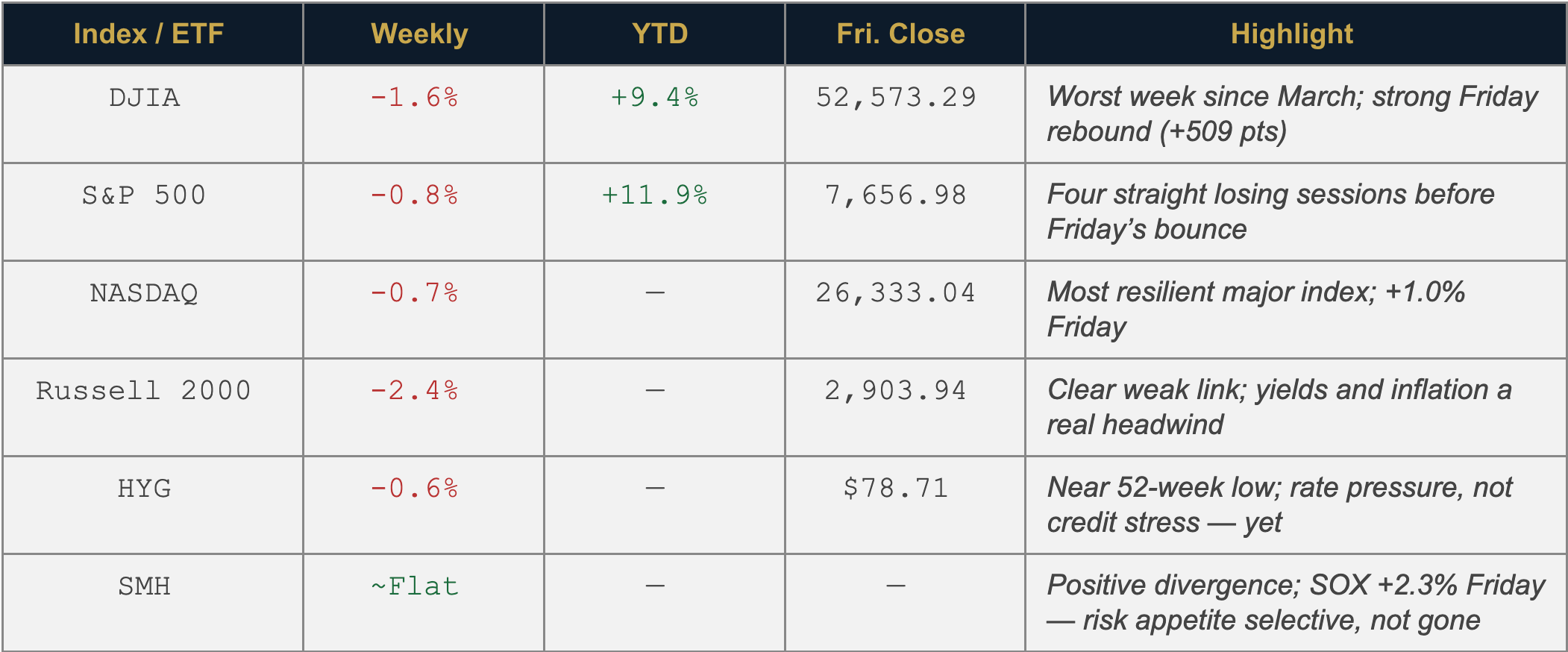
Last Week’s Main Indexes — Let’s Figure This Action Out
Dow Jones Industrial Average
The Dow had a difficult week, falling 840.96 points, or 1.6%, to 52,573.29. It was the Dow’s worst weekly performance since March, despite a strong rebound on Friday. (Source: Yahoo Finance)
- Friday: The Dow surged 509 points (+1.0%), breaking a four-session losing streak. The rebound was helped by easing oil prices and an August CPI report that was roughly in line with expectations. (Source: AP News)
- Friday breadth: The rebound was relatively broad — 26 of the Dow’s 30 components advanced, or about 87%. (Source: MarketWatch)
One positive point: the Dow remains up about 9.4% for the year, so this week’s decline is better viewed as a correction and consolidation within a still-positive 2026 trend rather than a confirmed bear-market signal.(Source: Yahoo Finance)
S&P 500
The S&P 500 had a volatile week, finishing down 0.8% at 7,656.98. The index suffered through four consecutive losing sessions before Friday’s strong rebound. Despite the pullback, the S&P remains up about 11.9% for the year, so this week’s decline still looks more like a correction than a change in the longer-term trend. (Source: AP News)
Richie’s bottom line: The S&P took a step backward this week, but it did not break the longer-term bullish structure. I view the current action as a warning to respect the September volatility — not yet a reason to abandon the broader bullish thesis.
Nasdaq
The Nasdaq had a relatively resilient week compared with the Dow and Russell 2000, but still finished lower. The Nasdaq Composite fell 0.7% for the week, closing Friday at 26,333.04 after gaining 1.0% on Friday. (Source: AP News)
Like the other major averages, the Nasdaq was pressured early and throughout most of the week by rising oil prices, higher Treasury yields, and renewed inflation concerns. (Source: MarketWatch)
Richie’s bottom line: The Nasdaq lost ground this week, but its relative strength remains encouraging. The technology/AI trade is still carrying a lot of the market’s leadership. The next test is whether that leadership can hold if the 10-year yield stays near 5% and the Fed delivers a rate increase next week.
Russell 2000
The Russell 2000 was the weakest of the major U.S. averages this week, falling 71.70 points, or 2.4%, to 2,903.94. That compares with declines of 1.6% for the Dow, 0.8% for the S&P 500, and 0.7% for the Nasdaq. Friday’s 0.4% bounce was not enough to erase the week’s losses.(Source: AP News)
Richie’s bottom line: The Russell 2000 was the clear weak link this week. Small caps are telling us that rising yields and inflation concerns are becoming a real headwind. I would watch the 50-day moving average closely — if the Russell cannot reclaim it, the September correction could have further room to run.
HYG — Junk Bond Watch
HYG had a weak week and finished near a 52-week low, reflecting the pressure that rising Treasury yields are putting on high-yield corporate bonds. HYG’s NAV ended Friday at $78.71, versus roughly $79.19 on Tuesday, putting the ETF down about 0.6% for the week. Its 52-week range is now $78.62–$81.18. (Source: BlackRock)
HYG weakened again this week as Treasury yields moved toward 5%, but the important takeaway is that high-yield credit spreads remainrelatively contained. For now, the bond market is signaling rate pressure rather than outright credit stress. I would become considerably more defensive if HYG continues to deteriorate while credit spreads begin to widen.
Richie’s bottom line: HYG is giving us a yellow light, not a red light.
SMH — Semiconductors
SMH was one of the stronger areas of the market this week. The VanEck Semiconductor ETF finished the week roughly flat to slightly positive, outperforming the major averages. More importantly, semiconductors showed relative strength on Friday, with the PHLX Semiconductor Index gaining 2.3%. (Source: MarketWatch)
Richie’s bottom line: SMH is a positive divergence. While the Russell and Dow are flashing caution, semiconductors are telling us that risk appetite has not disappeared — it’s becoming more selective.
On My Radar This Week
What I’ll Be Focused On This Week
The items below reflect Richard Naso’s personal areas of focus for the coming week and are provided for informational and educational purposes only. They do not constitute investment advice or a recommendation to trade any security.
WATCH LIST — WEEK OF SEPTEMBER 14, 2026
- Wednesday—FOMC Decision—The Fed is the primary catalyst for U.S. equities. Odds of a September rate hike touched almost 90%, according to the CME FedWatch tool. The market is increasingly pricing in a 25-basis-point hike, although meaningful disagreement remains among economists about whether the Fed actually moves. A hike that is already priced in could actually be constructive if the Fed signals it is a limited adjustment rather than the beginning of an aggressive tightening cycle.
- Friday—Bank of Japan—This could be the sleeper event of the week. The BOJ is widely expected to raise rates 25 basis points to 1.25%, the highest Japanese policy rate in decades. A more aggressive BOJ could strengthen the yen, which matters globally because of the enormous amount of yen-funded carry trades. If those positions begin to unwind, it could create selling pressure across risk assets—including U.S. equities. (Source: Reuters / MarketWatch)
What I’d watch:
Yen → Japanese bonds → carry trade → U.S. Treasury yields → Nasdaq/S&P
Final Thoughts: Richie’s Take
As we head into next week, I believe investors should take a more cautious approach. Friday’s sharp rebound was certainly encouraging, but I view much of that move as a short-covering rally following four consecutive losing sessions, rather than confirmation that the recent weakness has run its course. The major averages all finished higher Friday, but they still closed the week lower — with the Dow down 1.6%, the S&P 500 down 0.8%, the Nasdaq down 0.7%, and the Russell 2000 down 2.4%.
The September effect also deserves respect. September has historically been one of the market’s weakest months, and this year we are entering the month with several additional concerns: elevated oil prices, Treasury yields approaching 5%, inflation that remains sticky, and growing uncertainty over monetary policy. The Russell 2000 and HYG are particularly important to watch because both are showing more weakness than the Nasdaq and S&P.
Next week could be a major test. The FOMC meets Tuesday and Wednesday, with the policy decision and the Fed Chair’s press conference on Wednesday, and the market is heavily focused on whether the Fed delivers a 25-basis-point hike and, more importantly, what its guidance says about future policy.
Then we have the Bank of Japan meeting September 17–18. I believe this deserves more attention than it normally receives. Any indication that the BOJ is becoming more aggressive could strengthen the yen and potentially pressure global carry trades, creating another source of volatility for U.S. equities.
For me, the key indicators going forward are the 10-year Treasury yield, oil, HYG, the Russell 2000, and SMH. If yields stabilize, oil retreats, and technology leadership remains intact, the market could quickly regain its footing. But if yields push decisively through 5%, oil remains elevated, HYG continues to weaken, and the Russell cannot reclaim its 50-day moving average, I would become considerably more defensive.
My longer-term view remains constructive, but I am becoming more cautious in the near term. I don’t believe Friday’s rally is enough to declare the correction over. September has reminded us that markets do not move higher in a straight line, and the combination of the Fed, the BOJ, interest rates, and oil gives us plenty of reasons to expect continued volatility.
For now, I would respect the market, stay patient, and let the price action confirm the next move rather than chase Friday’s rally. If the market proves that the recent weakness was simply a correction, there will likely be opportunities to participate on the way back up.
- Richie
Disclaimer
This content (“Content”) is produced by Richard Naso. The Content represents only the views and opinions of Mr. Naso who is compensated by TradeZero for producing it. Mr. Naso’s trading experiences and accomplishments are unique, and your trading results may vary substantially from his. TradeZero does not endorse the Content and makes no representations or warranties with respect to the accuracy of the Content or information available through any referenced or linked third party sites. The Content has been made available for informational and educational purposes only and should not be considered trading or investment advice or a recommendation as to any security. Trading securities can involve high risk and potential loss of funds. Furthermore, trading on margin is for experienced investors and traders only as the amount you may lose can be greater than your initial investment. Likewise, short selling as a securities trading strategy is extremely risky and can lead to potentially unlimited losses. Options trading is not suitable for all investors as it can involve risk that may expose investors to significant losses. Please read the Characteristics and Risks of Standardized Options, also known as the options disclosure document (ODD) at theocc.com/Company-Information/Documents-and-Archives/Options-Disclosure-Document before deciding to engage in options trading.
TradeZero provides self-directed brokerage accounts to customers through its operating affiliates: TradeZero America, Inc., a United States broker dealer, registered with the SEC and member of the Financial Industry Regulatory Authority (FINRA) and the Securities Investor Protection Corporation (SIPC); TradeZero, Inc., a Bahamian broker dealer, registered with the Securities Commission of the Bahamas; TradeZero Canada Securities ULC, a Canadian broker dealer, member firm of Canadian Investment Regulatory Organization (CIRO) and member of the Canadian Investor Protection Fund (CIPF); and TradeZero Europe B.V., a Dutch broker dealer, authorized and regulated by the Netherlands Authority for the Financial Markets (AFM) and subject to the regulatory framework of the European Securities and Markets Authority (ESMA) under MiFID II (collectively, the “TradeZero Broker Dealers”).