Narrow Leadership, Rising Uncertainty and a Ray of Hope
November 9, 2026

Market Recap
Analyzing the markets with Richie Naso, a Wall Street veteran of over 40 years and former member of the NYSE.
Dow Jones Industrial Average
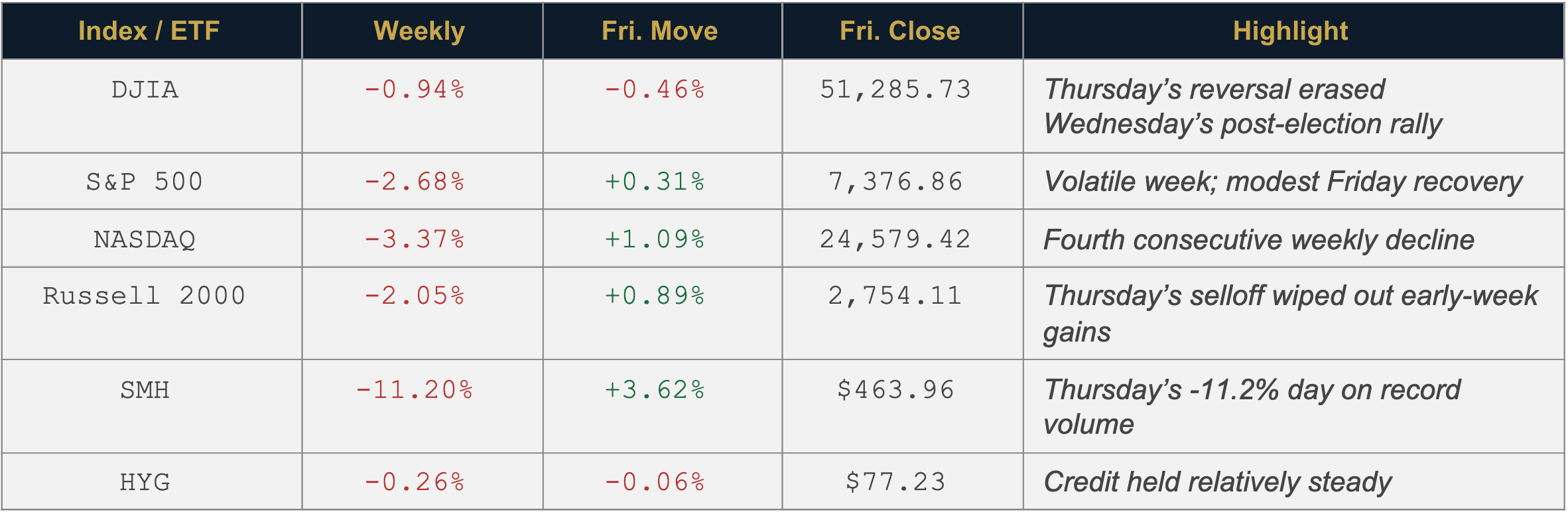
The Dow Jones Industrial Average finished the week lower, declining approximately 0.9% to close at 51,285.73. Although the index demonstrated some resilience early in the week, Thursday’s sharp reversal erased much of Wednesday’s strong post-election rally. (Source: AP News)
What stood out
The most significant development was the market’s inability to sustain Wednesday’s rally. Thursday’s aggressive selling demonstrated how quickly sentiment can change, particularly as concerns surrounding technology valuations, AI-related investments and economic uncertainty weighed on investors.
Friday brought some stabilization, but the Dow remained under pressure. The 10-year Treasury yield also remained elevated, adding another consideration for equity investors. (Source: AP News)
Richie’s take: The Dow showed relative strength compared with the Nasdaq, but I would not interpret that as evidence that the broader market has regained its footing. The sharp reversal on Thursday reinforces my concern that investor conviction is weakening.
S&P 500
The S&P 500 had a difficult week, declining approximately 2.7% to close at 7,376.86. The week’s trading was characterized by considerable volatility, highlighted by Wednesday’s strong rally followed by Thursday’s sharp reversal. Friday produced a modest recovery, but it did little to repair the damage. (Source: AP News)
Richie’s take: The S&P’s weekly performance reinforces my growing concern about the market’s near-term direction. Thursday’s aggressive selling, combined with weakness in technology and other growth-oriented areas, suggests that investors are becoming increasingly sensitive to valuations and economic uncertainty.
I am particularly concerned about whether the market can regain its footing without broader participation. Friday’s recovery was encouraging, but one positive session does not reverse the deterioration we’ve been witnessing.
Nasdaq Composite
The Nasdaq Composite suffered another difficult week, declining approximately 3.4% to close at 24,579.42. This marked the fourth consecutive weekly decline, reinforcing concerns about the technology sector and the sustainability of the AI-driven rally. (Source: AP News)
Richie’s take: The Nasdaq remains one of the weakest areas of the market, and I believe its performance deserves considerable attention. The concentration of selling in technology and semiconductors is particularly concerning because these stocks have been major contributors to the broader market’s advance.
Friday’s rebound may provide some temporary relief, but I would be reluctant to interpret it as a reversal in trend. The damage from Thursday’s selling cannot be dismissed simply because buyers returned for one session.
Until technology stocks stabilize, semiconductor leadership improves and market breadth begins to recover, I would remain defensive. The possibility of further downside has to be taken seriously.
SMH — Semiconductors
The VanEck Semiconductor ETF (SMH) suffered an exceptionally difficult week, declining 11.2% to close at $463.96. The semiconductor sector was among the hardest-hit areas of the market, with Thursday’s extraordinary selloff — an 11.21% single-day drop on roughly 29 million shares — standing out as the defining event of the week. (Source: StockAnalysis.com)
SMH daily moves, November 2–6, 2026.
| Mon | Tue | Wed | Thu | Fri |
| -2.71% | +2.01% | -2.75% | -11.21% | +3.62% |
Richie’s take: SMH’s performance is particularly troubling because semiconductors have been one of the primary engines behind this market’s advance. A decline of this magnitude, especially on such heavy volume, raises serious questions about whether technology leadership is breaking down.
Friday’s bounce may represent some short covering and bargain hunting, but I would be careful about assigning too much significance to one recovery session following such an aggressive selloff.
Russell 2000
The Russell 2000 declined approximately 2.1% for the week, closing Friday at 2,754.11. Small-cap stocks experienced considerable volatility, with Thursday’s sharp selloff more than offsetting the gains accumulated earlier in the week. (Source: AP News)
Richie’s take: The Russell 2000 continues to raise concerns about the underlying health of this market. Small-cap stocks are an important barometer of investor confidence and economic expectations. Their inability to sustain rallies, particularly during periods of weakness in technology and the broader market, is not encouraging.
I am particularly concerned about the lack of consistent participation outside the larger-cap stocks. Friday’s recovery does little to change that assessment. Until the Russell can establish some stability and demonstrate sustained relative strength, I would view rallies cautiously.
HYG — High-Yield Credit
The iShares High Yield Corporate Bond ETF (HYG) was relatively stable during an otherwise difficult week for equities. HYG finished Friday at $77.23, compared with $77.43 the previous Friday, a decline of approximately 0.26% for the week. (Source: StockAnalysis.com)
Richie’s take: HYG’s relative stability is one of the few encouraging developments in an otherwise troubling market environment. While equities experienced significant selling pressure, the high-yield credit market has not yet confirmed a broader deterioration in risk appetite.
However, I would not become complacent. Credit markets often provide an important early warning when investors begin demanding greater compensation for taking risk. A sustained breakdown in HYG would add another layer of concern to an already deteriorating technical picture.
Earnings Check: Nearly 90% of the S&P 500 Has Reported
Nearly 90% of S&P 500 companies have reported third-quarter results, and year-over-year earnings growth is running at about 29% so far. That is a slight deceleration from the second quarter’s 33% jump — and apparently not enough for investors, as the S&P 500 is down 3.6% since the beginning of October.
What Analysis are Sayin: Notable Comments From Last Week’s Market Coverage
The comments below are the views of the firms and individuals named, not TradeZero or Richard Naso, and are included for informational and educational purposes only. They do not constitute investment advice or a recommendation to buy or sell any security.
Charles Schwab — November 6 (bearish)
Schwab describes the current environment as a “stealth bear market,” citing deteriorating technology leadership and a rotation toward defensive sectors. The firm’s technical assessment: (Source: Charles Schwab)
- The S&P 500 and Nasdaq-100 have broken important support levels.
- The Russell 2000 has weakened considerably.
- Semiconductors are approximately 15% below their 200-day moving average.
- Defensive sectors are attracting capital while technology is losing leadership.
Morgan Stanley — Michael Wilson, November 2 (more constructive)
Wilson believes the correction that began in June is in its “final innings.” He sees opportunities developing in quality cyclical stocks as investors look toward 2027, but also warns that investors are becoming less forgiving of companies with weak free cash flow. (Source: Morgan Stanley)
BlackRock Investment Institute — November 2026 (cautious)
BlackRock makes an important observation about technology valuations: “Investors now want evidence that spending can deliver returns.” The firm has moved U.S. equities to neutral, citing rising AI capital expenditures and pressure on free cash flow, while remaining constructive on the long-term AI opportunity. (Source: BlackRock)
Reuters market commentary — November 6
The technology selloff has raised questions about the sustainability of the AI trade. Reuters reported that the Nasdaq suffered its fourth consecutive weekly decline despite Friday’s technology rebound. The central concern is whether investors are beginning to question the enormous capital expenditures required to sustain the AI investment cycle. (Source: Reuters)
Andra Markets — November 6
This one speaks directly to my emphasis on breadth. “The headline tape says risk-on. The internals say something narrower.” Andra points out that Friday’s S&P and Nasdaq gains were driven by a handful of large technology stocks, while decliners outnumbered advancers 17 to 8. It also noted that HYG and other credit-market indicators were not confirming the equity rebound. (Source: Andra Markets)
This Week's Interesting Sector Piece: Everything Is Going Wrong for Chip Stocks. 5 Names at Fire-Sale Prices.
The article summarized below is from Barron’s. The stocks named, the valuations cited and the views expressed are those of Barron’s and the analysts it quotes, not TradeZero or Richard Naso. It is included for informational and educational purposes only and does not constitute investment advice or a recommendation to buy or sell any security. Past performance is not indicative of future results. (Source: Barron’s)
Chip stocks have tumbled on the midterm election results, lackluster earnings, and struggles in the phone and PC markets. If your portfolio is flush with semiconductor stocks, Barron’s suggests you sit down before looking at your returns: everything that could have gone wrong for chip makers has gone wrong, seemingly all at once.
The iShares Semiconductor ETF, better known by its ticker SOXX, tumbled 12% on Thursday, its fifth decline in six sessions. It drove the S&P 500 to a 4.4% drop and the tech-heavy Nasdaq Composite to an even more painful 5.5% pullback on the day.
The indexes managed to claw back a portion of those losses on Friday, but not nearly enough to make investors whole or calm their nerves. Barron’s expects it will likely take weeks, not days, for the worst performers to recover.
When the semiconductor trade was booming in May, Barron’s warned that “nothing lasts forever” for chip stocks. The publication now argues that the selloff has created a more attractive entry point for investors who choose individual names carefully — a view, not a guarantee.
SOXX has dropped 28% since the start of October and is down 38% from its all-time closing high on June 22. No one in the semiconductor space has been spared.
The personal computer market is in shambles, making life difficult for Intel, which makes about half of its money from PC chips. Intel shares have plummeted 38% since the company reported a third-quarter contraction in its PC business.
Fundamentals and valuations
The silver lining, according to Barron’s, is that the sector’s fundamentals still look attractive even as the chip mania that kicked off 2026 has died down. Analysts polled by FactSet predict the iShares Semiconductor ETF’s earnings will surge 51% to $10.39 a share next year, from an estimated $6.89 in 2026. Sales are projected to grow 38%, and margins are still creeping higher. Forecasts are estimates and may not be realized.
Valuations, meanwhile, have come back to earth. In June, SOXX traded as high as 33 times projected 12-month earnings. As of Thursday’s close it traded at 14 times, its lowest point since late 2022. Valuations in the sector were already hitting new lows before the election, strategists at UBS pointed out.
“The slowdown is a negative for semis and AI infrastructure, but a lot is already priced into semis.” — UBS strategists, on a potential data-center deceleration, via Barron’s
UBS also noted that investors had already cut their semiconductor positions heavily. In Barron’s reading, current chip-stock prices already reflect the worst of investors’ fears.
The five names Barron’s highlights
Does that mean jump in head first? Barron’s says maybe not. In May, the publication highlighted five names — Nvidia, AMD, Broadcom, Micron and Taiwan Semiconductor — when chip stocks were rising and a selloff looked likely. With a stock free-fall now under way, Barron’s argues that quintet still has a strong case.
To start, AI remains the No. 1 growth driver (and Nos. 2, 3 and 4) in semiconductors, and those stocks have been AI winners. Chips for PCs, smartphones and even cars don’t have nearly the same potential. Remember that brutal Intel report? In the same quarter, Intel’s data-center and AI segment revenue surged 78% year over year.
Fears of a total AI investment collapse might also be overblown. States are eager for jobs and tax revenue, and will welcome data centers if companies make appropriate environmental provisions and pay for their own power, argues JoAnne Feeney, a portfolio manager at Advisors Capital.
“We see the possible delays in data center buildouts as behind the selloff, but view those as just that: delays at worst. Some valuations have become particularly attractive, and we see Broadcom and Nvidia as among those.” — JoAnne Feeney, Advisors Capital, to Barron’s
Nvidia, the world’s second-largest company by market value, came into Thursday trading at just 13 times forward earnings, 30% lower than the S&P 500’s multiple. The stock bounced back about 3% on Friday. Broadcom, which helps make custom chips for partners like Alphabet and OpenAI, was at less than 16 times earnings.
Valuations can always fall further, Barron’s cautions, and that is before accounting for the nearly $900 billion in supply commitments from Anthropic, around which so much of the AI industry is orbiting. If Anthropic can’t follow through on its commitments, its suppliers will see a chunk of demand evaporate.
But the moves over the past week have little to do with any new information from Anthropic. Barron’s conclusion: unless you think a total collapse of the AI trade is imminent, if not already under way, chip stocks that looked expensive just a few months ago now appear far cheaper. Whether that proves to be an opportunity is a judgment each investor has to make for themselves.
On my Radar This Week: What I’ll Be Focused On This Week
The items below reflect Richard Naso’s personal areas of focus for the coming week and are provided for informational and educational purposes only. They do not constitute investment advice or a recommendation to trade any security.
WATCH LIST — WEEK OF NOVEMBER 9, 2026
- Technology and the AI trade — Can the Nasdaq stabilize after entering correction territory? I’ll be watching semiconductors (SMH) closely.
- Market breadth — This remains one of my biggest concerns.
- Tuesday — October CPI — This inflation report could be particularly important.
- Credit markets — HYG.
- Small caps — Russell 2000.
Final Thoughts: Richie's Take
I remain cautious about the market’s near-term prospects. While Friday’s rebound provided some temporary relief, I don’t believe it has done enough to reverse the deterioration we’vewitnessed in recent sessions. The weakness in technology and semiconductors, coupled with increasingly narrow market leadership, raises questions about the underlying health of this rally.
What concerns me most is the lack of broad participation. The major averages can give a misleading impression of market strength when leadership is concentrated in a relatively small number of stocks. I continue to believe that market breadth, rather than the headline performance of the S&P 500 and Nasdaq, will be one of the more important indicators to watch.
There is, however, a ray of light worth acknowledging. HYG has demonstrated a degree of resilience in the face of the recent equity market weakness. While high-yield credit has not been immune to some pressure, we have not yet seen the kind of widespread credit deterioration that would suggest investors are anticipating a more serious economic or financial disruption. I view this as an encouraging sign and one worth monitoring closely. Credit markets often provide an important window into institutional risk appetite.
The Russell 2000 and the semiconductor sector remain areas of concern, and I would like to see improvement in both before becoming more constructive. This week’s inflation data and corporate guidance should provide additional clues as to where the market is headed.
My position remains one of caution, but not outright pessimism. The technical deterioration, narrowing leadership and lack of broad participation warrant respect. At the same time, HYG’s relative resilience suggests that the weakness has not yet spread uniformly across the financial markets.
I am not prepared to declare that the longer-term trend has reversed, but neither am I willing to assume that Friday’s rebound marks the beginning of a sustained recovery. I would rather remain patient, protect capital and let the market demonstrate that its footing has improved before becoming more aggressive.
— Richie
Disclaimer
This content (“Content”) is produced by Richard Naso. The Content represents only the views and opinions of Mr. Naso who is compensated by TradeZero for producing it. Mr. Naso’s trading experiences and accomplishments are unique, and your trading results may vary substantially from his.
Mr. Naso is not acting as a securities analyst or investment adviser in providing this content, which is not intended to constitute professional investment research, individualized investment advice, or a recommendation to buy or sell any security.
TradeZero does not endorse the Content and makes no representations or warranties with respect to the accuracy of the Content or information available through any referenced or linked third party sites. The Content has been made available for informational and educational purposes only and should not be considered trading or investment advice or a recommendation as to any security. Trading securities can involve high risk and potential loss of funds. Furthermore, trading on margin is for experienced investors and traders only as the amount you may lose can be greater than your initial investment. Likewise, short selling as a securities trading strategy is extremely risky and can lead to potentially unlimited losses. Options trading is not suitable for all investors as it can involve risk that may expose investors to significant losses. Please read the Characteristics and Risks of Standardized Options, also known as the options disclosure document (ODD) at https://www.theocc.com/Company-Information/Documents-and-Archives/Options-Disclosure-Document before deciding to engage in options trading.
TradeZero provides self-directed brokerage accounts to customers through its operating affiliates: TradeZero America, Inc., a United States broker dealer, registered with the SEC and member of the Financial Industry Regulatory Authority (FINRA) and the Securities Investor Protection Corporation (SIPC); TradeZero, Inc., a Bahamian broker dealer, registered with the Securities Commission of the Bahamas; TradeZero Canada Securities ULC, a Canadian broker dealer, member firm of Canadian Investment Regulatory Organization (CIRO) and member of the Canadian Investor Protection Fund (CIPF); and TradeZero Europe B.V., a Dutch broker dealer, authorized and regulated by the Netherlands Authority for the Financial Markets (AFM) and subject to the regulatory framework of the European Securities and Markets Authority (ESMA) under MiFID II (collectively, the “TradeZero Broker Dealers”).