Jobs Report VS. Interest Rates
September 8, 2026

Market Recap
Analyzing the markets with Richie Naso, a Wall Street veteran of over 40 years and former member of the NYSE.
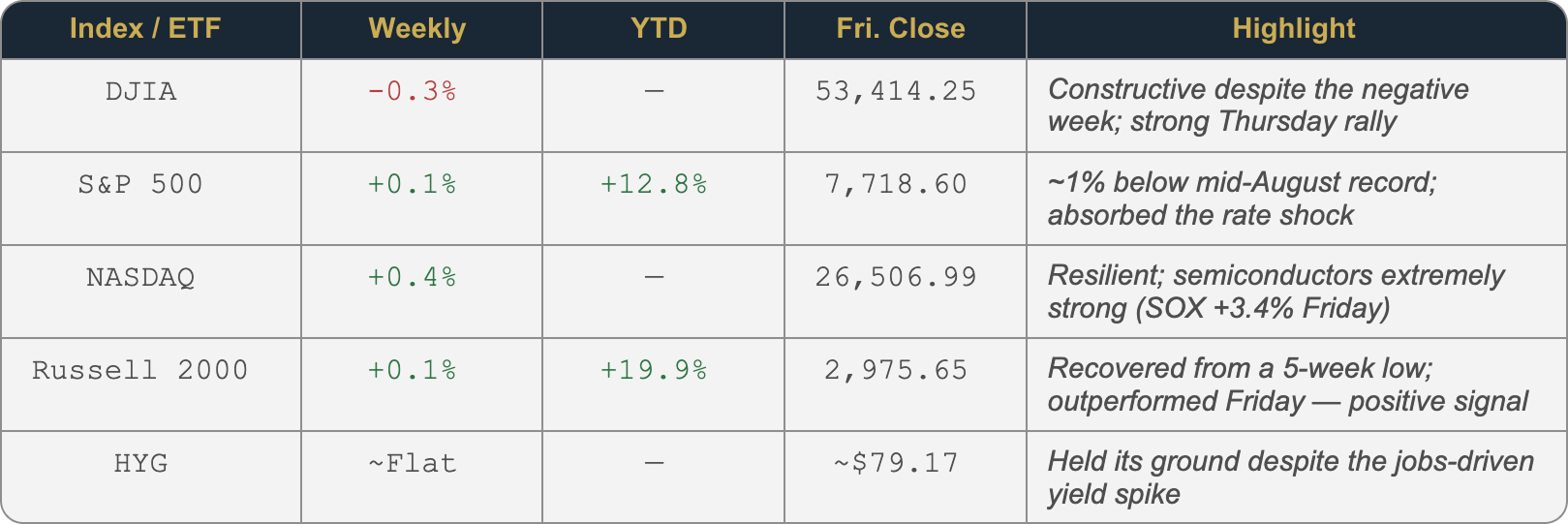
a/o September 4th, 2026
Last Week’s Main Indexes — Let’s Figure This Action Out
Dow Jones Industrial Average
The Dow had a slightly negative week, finishing at 53,414.25 — down 0.51% on Friday and about 0.3% for the week. (Source: AP News)
The big story was interest rates. The week started with some weakness, followed by a strong Thursday rally as Fed Governor Christopher Waller suggested rates could potentially be held steady if inflation continues to ease. The Dow gained 1.18% Thursday, closing at 53,686.11. (Source: Upstox)
Richie’s read: The Dow’s behavior is actually fairly constructive despite the negative week.
S&P 500
The S&P 500 finished the week essentially flat, up about 0.1%, closing Friday at 7,718.60. Friday’s 0.4% decline gave back much of the week’s earlier strength. The index remains about 1% below its mid-August record high and is up roughly 12.8% year-to-date. (Source: Reuters)
Richie’s read: The S&P’s ability to finish slightly positive despite the rate shock is actually encouraging.
Nasdaq
The Nasdaq Composite had a relatively good week, gaining about 0.4% despite Friday’s selloff. It finished Friday at 26,506.99, down 0.29% on the day. For comparison, the S&P 500 gained about 0.1% for the week while the Dow lost about 0.3%. (Source: AP News)
Richie’s read: The Nasdaq fell only 0.3% Friday, which I view as relatively resilient given the move higher in Treasury yields.
Semiconductors were extremely strong
The Philadelphia Semiconductor Index jumped roughly 3.4% Friday, even while the Nasdaq Composite was down. Memory stocks were particularly strong, with the memory ETF gaining about 4.6%. That is important because it suggests investors haven’t abandoned the AI/semiconductor trade despite higher rates. (Source: Barron’s)
Russell 2000
The Russell 2000 was one of the more interesting parts of the market this week. It finished Friday at 2,975.65, gaining 0.2% on the day, and eked out approximately a 0.1% gain for the week. Year-to-date, it remains the strongest major U.S. index, up roughly 19.9%. (Source: AP News)
- The 2-year Treasury yield rose to about 4.37%, while the 10-year reached roughly 4.78%. That’s normally a difficult environment for small caps because of their greater sensitivity to financing costs. (Source: Reuters)
Why I think this is important
This is actually a positive technical signal. The Russell had closed at a five-week low earlier in the week yet managed to recover and finish slightly positive. On Friday, when rates jumped following the jobs report, it outperformed the major averages. (Source: MarketWatch)
HYG — Junk Bond Watch
HYG was essentially flat for the week, closing Friday at about $79.16–$79.19. The week was quiet on the surface, but the underlying message from high-yield credit was more important: credit markets remain relatively stable despite rising Treasury yields and renewed Fed-rate concerns. (Source: StockAnalysis.com)
Richie’s read: The Friday action is the most interesting.
The August payroll report came in at 162,000, well above expectations, pushing the 2-year Treasury yield to around 4.37% and the 10-year toward 4.78%. Yet HYG held its ground.
Economic Data: The August Jobs Report Was Stronger Than Expected
- Jobs added: 162,000 vs. roughly 55,000 expected.
- Unemployment: stayed at 4.1%.
- Wages: up 3.1% year over year — relatively moderate.
- Revisions: July was revised higher, from an initial loss to a gain of 21,000.
What it means for the market
Good news for the economy, but potentially challenging news for stocks in the short term. The report reduces fears that the economy is heading toward a recession, but it also gives the Fed less reason to cut rates — and potentially more reason to raise them. Markets increased the probability of a September Fed hike to around 60%.
Bottom line: The economy looks stronger than expected, but that strength could keep interest rates higher for longer.
This Week’s Interesting Sector Piece: Why ‘buy The Dip’ Is Bad Advice
Source: Barron’s, summarising a recent academic paper by Javier Estrada (available on SSRN). Included for informational and educational purposes only. Not investment advice.
Key Points
- A recent academic paper by Javier Estrada argues that the popular “buy the dip” retail investing strategy is flawed.
- Estrada says buying the dip requires quick reactions, risks holding performance-dragging cash, and fails to enhance risk-adjusted returns.
- After a month in which the S&P 500 has fallen, it has returned an average of 9.1% over the following year, below the average return of 11%. (Source: SSRN)
“Buy the dip” is a hugely popular strategy, even supplanting “buy low, sell high” to become what investment consultant Larry Swedroe calls “perhaps the most repeated piece of advice in retail investing.” And according to a recent academic paper by Javier Estrada, it has serious flaws.
Estrada ticks through four main things that can go wrong when you buy a stock that’s just fallen 10%. Buying the dip requires a quick reaction, often not giving investors a chance to determine if something truly changed about the company or the macro environment it operates in. It also contradicts one of the other popular rules of investing — that markets exhibit momentum, with rising stocks continuing to rise and falling stocks continuing to fall, probably because investors initially underreact to news.
“Implementing a BTD strategy may be akin to catching a falling knife, particularly in the short-term.”
— Javier Estrada, academic paper via Barron’s
There are other issues. To buy a dip requires selling something else or holding cash and waiting for tumbles to create opportunity. There’s a risk to both: the asset you’re selling might end up performing better, or the extra cash you’re holding becomes a drag on performance. Neither is a great outcome.
Then there’s the time factor. Even if the stock does eventually rebound, it may take ages to play out. If a price drop is the beginning of a long drawdown — longer than the investor’s holding period — the dip-buyer is investing more capital in an asset whose price will keep dropping during the holding period, Estrada writes.
And even if all these things work out and dip buying produces a winner, there’s the question of how much risk you should take on to do so. The article makes this point rhetorically: if an investor likes a stock enough to buy it, why not buy twice as much on margin? Why not buy a triple-levered ETF? The answer, of course, is risk — which is where the idea of risk-adjusted returns comes in.
A good strategy is one that increases the chances of a positive return more than the odds of a loss. A strategy that increases both equally isn’t a good strategy — and indeed, Estrada finds that buy-the-dip strategies can improve the performance of some buy-and-hold-and-rebalance strategies, but they increase risk as well, meaning they “fail to enhance risk-adjusted return.”
Interestingly, he also finds that dips are far from the opportunities they may appear. After a month in which the S&P 500 has fallen, it has returned an average of 9.1% over the following year, below the average return of 11%. Past performance is not indicative of future results.
“This article does not suggest that investors should not buy on dips,” Estrada is careful to say. His point, instead, is that dip-buying comes with broader portfolio implications that investors need to consider.
To quote a bumper sticker: “Nothing worth believing in fits on a bumper sticker.” Nor does any strategy worth investing in. (Source: Barron’s)
What I’ll Be Focused On This Week
The items below reflect Richard Naso’s personal areas of focus for the coming week and are provided for informational and educational purposes only. They do not constitute investment advice or a recommendation to trade any security.
Watch List — Week Of September 7, 2026
- CPI — The Big Event — Friday, September 11. Critical in determining whether the recent rise in yields continues.
- PPI — Thursday. Producer prices as a leading read on inflation pressure.
- Risk-Appetite Checklist — What I’d want to see: IWM/Russell higher, HYG stable or higher, and Treasury yields stable. That combination would signal risk appetite remains healthy.
What I’ll Be Focused On This Week
The items below reflect Richard Naso’s personal areas of focus for the coming week and are provided for informational and educational purposes only. They do not constitute investment advice or a recommendation to trade any security.
Watch List — Week Of September 7, 2026
- CPI — The Big Event — Friday, September 11. Critical in determining whether the recent rise in yields continues.
- PPI — Thursday. Producer prices as a leading read on inflation pressure.
- Risk-Appetite Checklist — What I’d want to see: IWM/Russell higher, HYG stable or higher, and Treasury yields stable. That combination would signal risk appetite remains healthy.
Final Thoughts: Richie’s Take
I remain constructive on the longer-term outlook, but I believe we should be particularly cautious as we move through September. September has historically been one of the weakest months for the stock market, and with equities near record highs after a substantial advance, the risk of a meaningful correction should not be dismissed.
The stronger-than-expected jobs report has added another layer of uncertainty. A stronger economy is positive, but it also gives the Fed less reason to ease policy and could keep interest rates higher for longer. Next week’s inflation data, particularly Friday’s CPI report, will be critical in determining whether the recent rise in yields continues.
I would not underestimate the possibility of a September correction. Markets can remain strong for a long time, but when valuations are elevated and interest-rate expectations are shifting, a relatively small catalyst can produce a much larger move. I will be watching the 10-year Treasury yield, the Russell 2000, and HYG closely. If small caps and high-yield bonds begin breaking down together, that would be an important warning that risk appetite is deteriorating.
For now, my stance remains cautious near term but constructive longer term. I am not calling for a bear market, but I would not chase strength at these levels. September is a month to respect risk, protect gains, and let the market come to us. If we get a meaningful pullback without deterioration in the economy or credit markets, it could ultimately create a potential opportunity to add to positions for the longer term.
– Richie
Disclaimer
This content (“Content”) is produced by Richard Naso. The Content represents only the views and opinions of Mr. Naso who is compensated by TradeZero for producing it. Mr. Naso’s trading experiences and accomplishments are unique, and your trading results may vary substantially from his. TradeZero does not endorse the Content and makes no representations or warranties with respect to the accuracy of the Content or information available through any referenced or linked third party sites. The Content has been made available for informational and educational purposes only and should not be considered trading or investment advice or a recommendation as to any security. Trading securities can involve high risk and potential loss of funds. Furthermore, trading on margin is for experienced investors and traders only as the amount you may lose can be greater than your initial investment. Likewise, short selling as a securities trading strategy is extremely risky and can lead to potentially unlimited losses. Options trading is not suitable for all investors as it can involve risk that may expose investors to significant losses. Please read the Characteristics and Risks of Standardized Options, also known as the options disclosure document (ODD) at theocc.com/Company-Information/Documents-and-Archives/Options-Disclosure-Document before deciding to engage in options trading.
TradeZero provides self-directed brokerage accounts to customers through its operating affiliates: TradeZero America, Inc., a United States broker dealer, registered with the SEC and member of the Financial Industry Regulatory Authority (FINRA) and the Securities Investor Protection Corporation (SIPC); TradeZero, Inc., a Bahamian broker dealer, registered with the Securities Commission of the Bahamas; TradeZero Canada Securities ULC, a Canadian broker dealer, member firm of Canadian Investment Regulatory Organization (CIRO) and member of the Canadian Investor Protection Fund (CIPF); and TradeZero Europe B.V., a Dutch broker dealer, authorized and regulated by the Netherlands Authority for the Financial Markets (AFM) and subject to the regulatory framework of the European Securities and Markets Authority (ESMA) under MiFID II (collectively, the “TradeZero Broker Dealers”).