Vertical Spread: Learn How Options Traders Can Approach Risk, Cost, and Directional Exposure with Two-Leg Strategies
May 26, 2026

By Shane Neagle
Traders looking to move beyond single-leg options trading strategies may want to get acquainted with the vertical spread. This accessible approach is structured to allow traders to get exposure to directional moves while maintaining visibility of both the potential gain as well as the maximum potential loss of the trade.
This approach seeks to collect premiums in tandem with purchasing an option, which can potentially reduce the net outlay of the trade. This benefit can potentially help with managing exposure, and, at the same time, the setup’s structure allows for a clear overview of potential losses and gains, which can help traders with finding entry and exit points.
Vertical spreads offer an approachable entry point into multi-leg options trading. These strategies can potentially be a good fit for active traders in search of strategic, risk-controlled setups, but understanding how they work, as well as both their advantages and disadvantages, is essential.
Here, we’ll break down the role that vertical spreads play, some key variations, as well as the factors that have made the approach a mainstay among options traders.
What is a Vertical Spread?
The vertical spread is a two-leg options trading strategy; in other words, it uses two options contracts. One of those is purchased (long) while the other is sold (short).
With a vertical spread, both legs of the trade use the same type of options contract, so either a call or a put. In addition, the two legs have the same expiration date. Where the two legs differ, however, is the strike price.
Since the contracts have the same expiration, the value of the trade depends exclusively on the price of the underlying asset at that time.
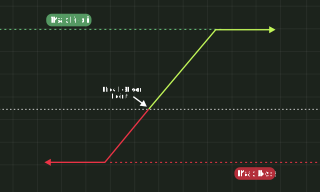
The difference between the strike prices and the net debit or credit define both the potential gain and potential loss.
In a debit spread, the trader’s potential risk is limited to the initial net debit, while the maximum potential gain equals the width of the strike spread minus that debit. In a credit spread, on the other hand, the potential risk is limited to the strike width minus the net credit received, while the maximum potential gain equals the net credit itself.
Types of Vertical Spreads
Broadly speaking, vertical spreads are divided into two main categories: bull call spreads and bear put spreads. While the core structure remains the same, directional intent and, potentially, premium flow, are what separate the two.
Let’s begin with the bull call spread, a setup that is structured to fit moderately bullish outlooks on an underlying asset. Here, a trader purchases a call option at a lower strike price, while at the same time selling another call option at a higher strike price.
In this case, the call option that is sold can help offset the cost of the purchased call option, which may lead to a low net debit requirement for opening the position. The maximum potential gain is reached if the underlying finishes at or above the higher strike, whereas the maximum potential loss, equal to the net debit, occurs if the underlying finishes below the lower strike.
On the other hand, to construct a bear put spread, traders purchase a put option with a higher strike price, and simultaneously sell a put option with a lower strike price. This is the inverse of the bull call spread, as it is structured to potentially benefit from a moderate decline in an underlying asset’s price.
In this case also, it is the short leg of the trade, the sold put, which can offset the overall cost of the setup, while also helping to maintain visibility in terms of maximum potential losses. Here, maximum potential gains are achieved if the underlying falls to or below the lower strike at expiration, while the maximum potential loss is equal to the net premium paid.
In short, Bull Call Spreads aim to capture measured upside with limited cost, while Bear Put Spreads try to capitalize on moderate declines with built-in protection.
How Vertical Spreads Work
Like most multi-leg strategies, the mechanics of vertical spreads are best understood through the use of a simple example.
First, let’s tackle the bull call spread. Let’s assume that a hypothetical stock is trading at $100. Our trader buys a $100 call for the price of $5, and sells a $105 call for $2, thus creating a net debit of $3. In this case, that $3 represents the maximum potential loss of the trade.
If the stock rises to $105 or higher by expiration, the spread reaches its full $5 width. At that point, the long call’s gains are entirely offset by the short call’s obligation, so potential gains are capped at $2, which is derived from the $5 spread minus the $3 debit.
The breakeven sits at $103, and is calculated by adding the debit to the lower strike. Any close below $100 results in the total loss of the premium paid, this is the maximum potential loss we mentioned, and amounts to $3.
Since the first example was a debit spread, we’ll use a credit spread for the second one. Let’s say that we’re once again dealing with a stock trading at $100.
To construct a bear call credit spread, a trader could sell a $100 call to collect a $5 premium, and purchase a $105 call for $2, which would leave a net credit of $3. In this case, that $3 is equal to the maximum potential gain of the trade. The maximum gain potential is reached if the stock remains below $100 at the time of expiration.
On the other hand, the maximum loss is equal to the $5 width of the spread minus the $3 credit, so in this case, $2, and this happens if the underlying asset’s price climbs above $105 at the time of expiration. Finally, to get the breakeven point, we add the credit to the short strike, so in this case, we add $3 to $100, for a breakeven at $103.
The reason why these setups might appeal to cost-conscious traders is that entering debit spreads can be more affordable compared to straight-up purchasing a single option. In addition, they could appeal to the risk-conscious on account of the fact that both the worst-case scenario and the best-case scenario are known at the outset of the trade.
Advantages of Vertical Spreads
One of the key advantages of vertical spreads is that they can lead to capital efficiency. Compared to buying a single long call or put, a vertical spread lowers the upfront cost, as the sold leg of the trade leads to a collected premium.
This allows traders to maintain a desired directional exposure, while potentially having to put up less capital than if they opted to purchase a single options contract.
As we mentioned, with vertical spreads, both the maximum potential gain and maximum potential loss are visible at the outset of the trade, which can make it easier to size positions and manage portfolio risk.
Flexibility is another point in favor of vertical spreads. Debit spreads might be a good choice for capturing directional momentum, whether bullish or bearish, whereas credit spreads can potentially benefit from conditions in which price action stalls.
Vertical spreads can also help traders manage exposure in volatile markets. Since both legs of the trade respond to changes in implied volatility, large swings in option prices can potentially offset each other to some degree, which can reduce the impact of sudden volatility spikes when compared to holding a single long or short option.
Common Mistakes to Avoid
Even though vertical spreads offer visibility in terms of potential gains and losses, traders might still run the risk of running into problems if they overlook key practical details. One of the most common mistakes is entering positions too close to expiration. When there’s little time remaining, there’s often not enough premium left to justify the risk, and small price movements can quickly wipe out potential gains.
Another frequent pitfall may come in the form of misjudging implied volatility. Traders who opt for debit spreads in conditions with high volatility could see their position lose value as volatility contracts, even if the underlying asset’s price moves in the right direction. On a similar note, selling credit spreads in scenarios where volatility is too low could reduce the premium collected and, in turn, this could weaken the trade’s reward-to-risk ratio.
Strike selection is an important part of putting a vertical spread into play. In instances where a spread is too narrow, it could offer little potential reward relative to the potential risk. On the other hand, with spreads that are too wide, more capital is required, which could reduce the trade’s capital efficiency.
Another layer of potential risk lies in liquidity. Using multi-leg strategies with illiquid options contracts might expose traders to risks on account of wide bid-ask spreads, which, in turn, can potentially lead to poor fills or higher exit costs.
What are the risks associated with a vertical spread?
A vertical spread carries defined but still meaningful risks that traders should understand before entering the position.
- Although both debit and credit vertical spreads cap maximum loss, traders can still lose the entire premium paid in a debit spread or face the full defined loss in a credit spread if the underlying asset moves beyond the strike prices.
- Vertical spreads are also sensitive to time decay and changes in implied volatility, which can work for or against the position depending on the spread type.
- Early adverse price moves can reduce the ability to manage or adjust the trade, and wide bid-ask spreads may increase the cost of entering or exiting.
- When the spread contains a short American-style option, there is also potential early-assignment risk.
Because vertical spreads require the underlying to move - or not move - in a specific way before expiration, traders should account for market volatility, liquidity conditions, and clear risk-management parameters before using the strategy.
Conclusion
Vertical spreads are structured in a way that is meant to help traders participate in directional market moves while maintaining defined risk parameters. Because both the maximum potential gain and maximum potential loss are established at entry, traders may be able to plan positions with greater clarity and manage exposure in a disciplined way.
These setups may also offer improved capital efficiency, as the short leg can help offset the cost of the long leg. Whether applied in trending or range-bound conditions, vertical spreads are structured to help traders and provide a balanced framework for seeking a strategic, cost-conscious approach to options trading.
Disclaimer
This content (“Content”) is produced by Tokenist Media LLC. The Content represents only the views and opinions of Tokenist Media LLC.Tokenist Media LLC’s trading experiences and accomplishments are unique, and your trading results may vary substantially. Tokenist Media LLC is a paid marketing partner of TradeZero that receives compensation from TradeZero for broadcasting, displaying, and/or presenting marketing and sponsorship materials that promote TradeZero. TradeZero does not endorse the Content and makes no representations or warranties with respect to the accuracy of the Content or information available through any referenced or linked third party sites. The Content has been made available for informational and educational purposes only and should not be considered trading or investment advice or a recommendation as to any security.
Trading securities can involve high risk and potential loss of funds. Furthermore, trading on margin is for experienced investors and traders only as the amount you may lose can be greater than your initial investment. Likewise, short selling as a securities trading strategy is extremely risky and can lead to potentially unlimited losses.
Options trading is not suitable for all investors as it can involve risk that may expose investors to significant losses. Please read the Characteristics and Risk of Standardized Options, also known as the options disclosure document (ODD) at https://www.theocc.com/Company-Information/Documents-and-Archives/Options-Disclosure-Document before deciding to engage in options trading. Please also see the Options Trading Disclosure. You must be approved to trade multi-leg options strategies. You may lose all of your principal. Executing multi-leg options orders may result in increased transaction fees compared to single-leg options orders. Multi-leg strategies may exhibit risks such as illiquidity and increased sensitivity to market unpredictability.
TradeZero provides self-directed brokerage accounts to customers through its operating affiliates: TradeZero America, Inc., a United States broker dealer, registered with the Securities and Exchange Commission (SEC) and member of the Financial Industry Regulatory Authority (FINRA) and the Securities Investor Protection Corporation (SIPC); TradeZero, Inc., a Bahamian broker dealer, registered with the Securities Commission of the Bahamas;TradeZero Canada Securities ULC, a Canadian broker dealer, member firm of the Canadian Industry Regulatory Organization (CIRO) and member of the Canadian Investor Protection Fund (CIPF) and TradeZero Europe B.V., a Dutch broker dealer, authorized and regulated by the Dutch Authority for the Financial Markets (AFM) (collectively, the “TradeZero Broker Dealers”).