Correction Ahead — Or Another Buy-The-Dip Rally?
May 19, 2026

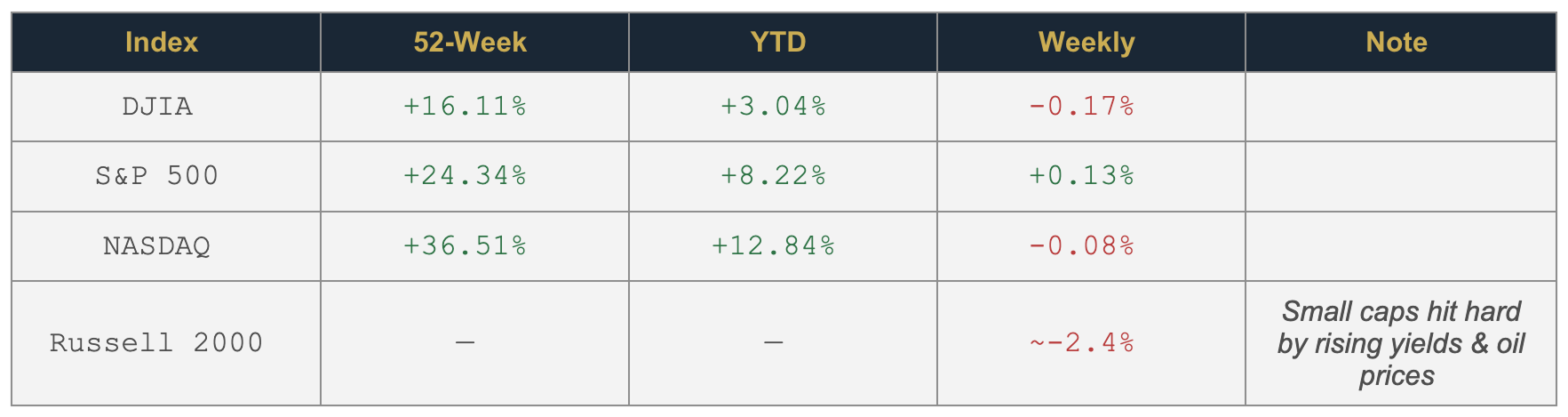
(Market Close 15th May 2026)
HYG — Junk Bond Watch
HYG — one of Wall Street’s most closely watched high-yield bond ETFs, tracking below-investment-grade corporate bonds and used as a real-time gauge of credit risk, liquidity, and market risk appetite — was relatively stable on the week. It traded in the $79.80–$80.20 range before softening late Friday as Treasury yields pushed higher.
Source: BlackRock
Market Commentary: Wall Street Retreats as Treasury Yields and Tech Pressure Mount
Wall Street pulled back on Friday as investors reacted to rising U.S. Treasury yields and renewed pressure on technology stocks following the conclusion of the latest U.S.–China summit.
The technology-heavy Nasdaq Composite led declines, falling 1.5%, while the benchmark S&P 500 lost 1.2%. The blue-chip Dow Jones Industrial Average finished down 1.0%.
“Rising Treasury yields are a problem for the system — just not yet a problem for equities.” — Alex King, Cestrian Capital Research / Seeking Alpha, May 15, 2026
Seeking Alpha analyst Alex King of Cestrian Capital Research noted that the 30-year Treasury yield recently climbed to 5.1% while the 10-year continued moving higher, calling climbing bond yields an increasingly important factor for investors as inflation concerns remain elevated.
King also highlighted the conflicting forces shaping markets, describing the tension between the inflationary impulse from the Gulf region and the deflationary impact of AI as a key dynamic currently unfolding across the global economy. Despite recent resilience in equities, he said the current backdrop favours careful risk management in stocks as investors navigate heightened volatility and shifting macroeconomic conditions.
Valuation: Stocks Approaching Dot-Com Peak on Shiller Valuation Gauge
The U.S. stock market’s cyclically adjusted valuation is approaching its most expensive level on record. The Shiller price-to-earnings (CAPE) ratio recently stood at 42.32 — less than 5% below the peak reached during the dot-com bubble, according to data shared by Barchart.
A move above that prior high would mark the richest valuation reading in market history by this measure, which compares stock prices with inflation-adjusted average earnings over the past decade.
Equity indices have continued hitting records despite elevated interest rates, persistent inflation concerns, and ongoing debate over whether artificial intelligence optimism has pushed investors too far. Offsetting those headwinds, the most recent corporate earnings season has been robust.
Federal Reserve: Will Markets Test New Fed Chair Kevin Warsh? History Suggests Yes.
As Kevin Warsh prepares to take the helm at the Federal Reserve, Wall Street veterans are revisiting an old market maxim: “The market always tests new Fed chairs.”
According to Dario Perkins, global macro strategist at TS Lombard, the historical record largely supports this view. Research from Barclays indicates that new Fed chairs have historically seen an average maximum stock market drawdown of approximately 5% in their first month, rising to around 13% by month three — larger than typical annual movements.
Bond markets present similar challenges. Perkins found that Treasury yields have typically risen during the first six months of a new chair’s term, with only Arthur Burns avoiding this pattern.
“It is not the market that tests the chair, but the chair that tests the market.” — Dario Perkins, TS Lombard / Seeking Alpha, May 15, 2026
Perkins argues that most incoming chairs are eager to establish hawkish credentials early on — a dynamic that traces back decades. He recalled how Paul Volcker congratulated Alan Greenspan after his first rate hike: “Welcome to the club. You are now a real central banker.”
Warsh takes over having been viewed as aligned with President Trump’s preference for lower rates. However, markets are now leaning in the opposite direction as inflation fears accelerate, with futures currently pricing above a 60% probability that the Fed hikes rates before year-end.
Sector Spotlight: Quantum Computing: From Theoretical Curiosity to Market Phenomenon
Quantum computing has graduated from a theoretical curiosity to a stock market phenomenon. Sector shares routinely post some of the biggest moves in the market — up and down — as investors place their bets on the future of computing.
Quantum computers, rooted in the principles of quantum mechanics, can explore multiple solutions simultaneously and promise the kind of processing power that could transform fields such as medicine and materials science. However, pure-play quantum stocks currently trade mostly on sentiment, as none have yet turned a profit. Most are actively burning cash as they develop products.
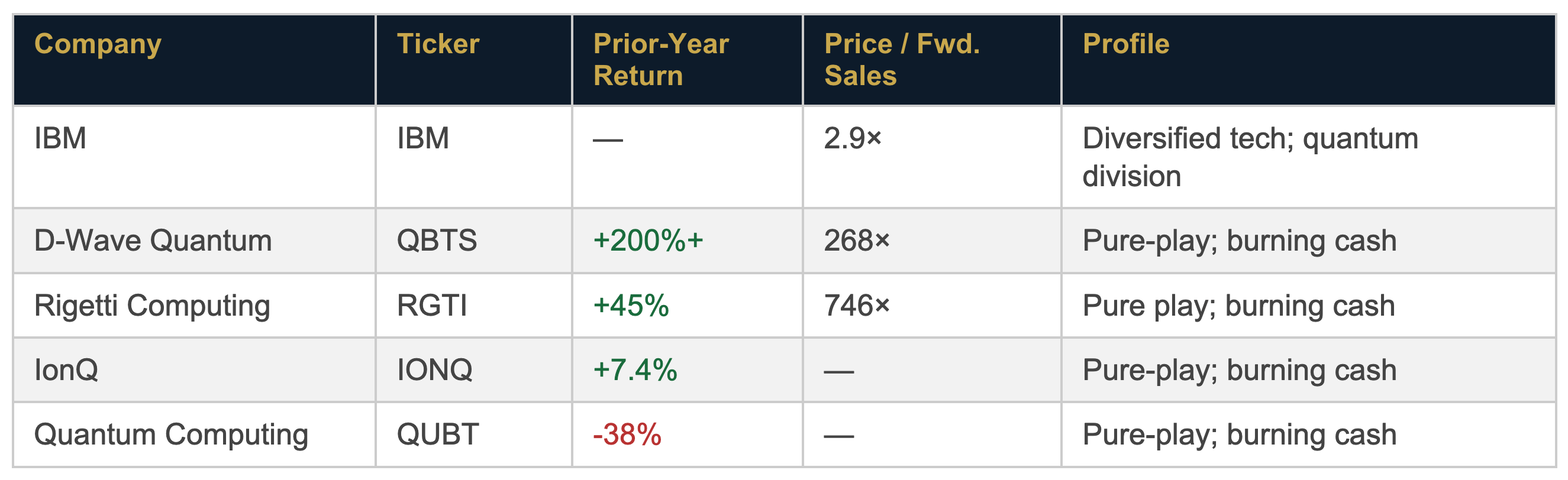
Performance among these stocks has been highly varied. D-Wave Quantum (QBTS) more than tripled last year, and Rigetti Computing (RGTI) rose 45% — handily outstripping a 20% gain for the Nasdaq 100. IonQ (IONQ) rose 7.4%, while Quantum Computing (QUBT) lost 38%. Such divergence suggests that company-specific narratives, rather than broad sector tides, are driving winners and losers.
Past performance figures are historical and are not indicative of future results.
The following section summarises reporting from Barron’s (print edition, p. 11, May 18, 2026, by Mackenzie Tatananni). Stock names and tickers are drawn from that article and included for informational and educational purposes only. Nothing in this section constitutes a recommendation or solicitation to buy or sell any security.
Valuations tell a tale of two worlds. IBM trades at a measured 2.9 times forward sales, while Rigetti and D-Wave have been pushed to price-to-sales ratios of 746× and 268×, respectively — levels that reflect speculative sentiment rather than current fundamentals.
Despite those stretched valuations, many analysts believe the sector is approaching an inflection point. Barclays projects that quantum systems could achieve a definitive performance edge over traditional computers by 2027, provided their capabilities hold up under technical scrutiny. McKinsey estimates the market could grow to between $43 billion and $72 billion by 2035.
For Barron’s’ full analysis of the individual quantum stocks referenced in this summary, see the print edition, p. 11, May 18, 2026.
On My Radar This Week: Key Events and Data Points to Monitor
The items below reflect Richard Naso’s personal areas of focus for the coming week and are provided for informational and educational purposes only. They do not constitute investment advice or a recommendation to trade any security.
WATCH LIST — WEEK OF MAY 18, 2026
- Treasury Yields — The #1 Issue Right Now: 10-year toward 4.6% · 30-year above 5% · Equity pressure building (Source: WSJ)
- NVIDIA Earnings (NVDA): Widely cited as the single most consequential earnings event for broader market direction (Source: Reuters)
- Retail Earnings / Consumer Health: Walmart · Target · Home Depot · TJX Companies
Sources
[1] Barron’s, print edition, p. 29 — “Market Dashboard” — Teresa Rivas, May 18, 2026. (Market performance data)
[2] Market recap for the week of May 11–15, 2026 — AI-generated research summary. (Weekly index recap)
[3] Seeking Alpha — “SA Analyst Warns That Rising Treasury Yields Are Becoming a Market Threat” — Jason Capul, May 15, 2026 / “Stocks Near Dot-Com Peak on Shiller Valuation Gauge” — Max Gottlieb, May 13, 2026.
[4] Seeking Alpha — “Will Markets Test New Fed Chief Kevin Warsh? History Suggests Yes.” — Max Gottlieb, May 15, 2026.
[5] Barron’s, print edition, p. 11 — “IonQ and 5 More Stocks to Play Quantum Fever” — Mackenzie Tatananni, May 18, 2026. (Quantum sector summary)
[6] Final Thoughts — Richard Naso’s personal opinion and market commentary.
Disclaimer
This content (“Content”) is produced by Richard Naso. The Content represents only the views and opinions of Mr. Naso who is compensated by TradeZero for producing it. Mr. Naso’s trading experiences and accomplishments are unique, and your trading results may vary substantially from his. TradeZero does not endorse the Content and makes no representations or warranties with respect to the accuracy of the Content or information available through any referenced or linked third party sites. The Content has been made available for informational and educational purposes only and should not be considered trading or investment advice or a recommendation as to any security.
Past performance referenced in this Content is not indicative of future results.
Trading securities can involve high risk and potential loss of funds. Furthermore, trading on margin is for experienced investors and traders only as the amount you may lose can be greater than your initial investment. Likewise, short selling as a securities trading strategy is extremely risky and can lead to potentially unlimited losses. Options trading is not suitable for all investors as it can involve risk that may expose investors to significant losses. Please read the Characteristics and Risk of Standardized Options, also known as the options disclosure document (ODD) at
https://www.theocc.com/Company-Information/Documents-and-Archives/Options-Disclosure-Document before deciding to engage in options trading.
TradeZero provides self-directed brokerage accounts to customers through its operating affiliates: TradeZero America, Inc., a United States broker dealer, registered with the SEC and member of the Financial Industry Regulatory Authority (FINRA) and the Securities Investor Protection Corporation (SIPC); TradeZero, Inc., a Bahamian broker dealer, registered with the Securities Commission of the Bahamas; TradeZero Canada Securities ULC, a Canadian broker dealer, member firm of Canadian Investment Regulatory Organization (CIRO) and member of the Canadian Investor Protection Fund (CIPF); and TradeZero Europe B.V., a Dutch broker dealer, authorized and regulated by the Netherlands Authority for the Financial Markets (AFM) and subject to the regulatory framework of the European Securities and Markets Authority (ESMA) under MiFID II (collectively, the “TradeZero Broker Dealers”).