Multi-Leg Options: How Traders Combine Contracts to Adapt to Market Conditions
May 26, 2026

By Shane Neagle
Multi-leg options trades combine two (or more) options contracts to form a single position. Each leg of this larger trade can be a call or a put, with different strike prices and expiration dates to boot.
The most obvious advantage of this approach is also its greatest drawback: complexity. While multi-leg options strategies are highly diverse and may be applied in a variety of market conditions, they also require quite a bit of knowledge to execute effectively.
Some of the most popular multi-option setups include spreads, straddles, and condors. Each of these approaches can potentially be used within a variety of market conditions. These strategies
are structured to help traders potentially manage risk, capture gains, or position for moves in price, volatility, or time decay - but they’re not a guarantee of success, so making the most of them will require a rock-solid understanding of how they work, their potential benefits, and their
drawbacks.
This blog is meant to serve as a foundational guide for traders looking to use TradeZero’s new multi-leg options feature; we’re going to break down what these trades are, how they work, how these strategies are structured, and how traders commonly apply them in different market conditions.
What Are Multi-Leg Options?
With a single-leg options trade, you buy (or sell) either a put or a call on an underlying asset.
With multi-leg options, a trader places two or more options contracts on the same underlying asset. The expiration dates and strike prices on those contracts can differ, depending on the strategy in question. If you’re a tiny bit confused, don’t worry, as we’ll explain everything in depth later on.
When entered together, the legs create a combined position with a specific risk-reward profile structured to align with a market objective. In a single-leg setup, potential gain and loss depend on a single market outcome, usually a directional move. With multi-leg trading, the interaction between legs can define risk, set profit targets, or neutralize certain market factors, such as
volatility ortime decay.
All legs are executed as one order, which means the entry is coordinated. This helps reduce the risk of partial fills or missed prices that could happen if each leg were placed separately.
Coordinated entry is especially important for strategies where timing and strike relationships are key to maintaining the intended payoff structure.
Multi-leg setups can take many forms; vertical spreads, for example, use two options of the same type (call or put) and expiration but different strike prices to help define risk and reward, while straddles combine a call anda putat the same strike and expiration to offer exposure to large moves in either direction. Then, we have condors, which add more legs to create defined
profit zones and multiple break-even points, just to use a limited set of examples.
Each approach uses the relationship between legs to control exposure. For example, selling one option to offset the cost of buying another can potentially lower the net premium paid, while still offering potential upside.
Others are structured to collect premium income by selling options at certain strikes while managing exposure with additional legs.
Key Benefits of Multi-Leg Options
Multi-leg options offer a set of advantages that single-leg trades can’t match. By combining contracts, traders can shape the trade’s risk, reward, and exposure to different market forces. We’ll go through some of the most pronounced benefits of this approach here.
Defined Risk
Many multi-leg strategies, chiefly debit spreads, credit spreads, and iron condors, have a built-in maximum loss. In each case, one leg of the trade offsets the risk of the other leg. In stark contrast with the reputation that options have of being risky financial instruments, these strategies can potentially allow traders to define maximum potential losses and manage risk.
Flexibility in Market Views
Multi-leg setups are quite adaptable; whether you have a bullish, bearish, or neutral outlook regarding an asset, there’s a multi-leg strategy that’s a natural fit. Moreover, multi-leg strategies also allow options traders to build positions that, for example, seek to benefit from volatility changes or time decay, even if the actual price movement in the underlying asset is minimal. To use two simple examples, an iron condor can potentially benefit from price stability, while a long straddle may perform better during sharp moves in either
direction.
Simply put, multi-leg options strategies allow traders to both adapt to a variety of market conditions and expand their horizon beyond just directional opportunities.
Income Generation
By leveraging credit-based strategies such as short vertical spreads, options traders may collect option premiums by selling one leg of the trade.
Income-focused multi-leg options setups may be appealing in low-volatility periods, as they are structured to collect option premiums. However, outcomes vary and depend on risk management and market behavior.
Hedging Capabilities
Options are renowned for their ability to hedge other positions, and multi-leg options setups are no different in this regard. Some strategies, such as protective collars, are structured in ways that are meant to limit the downside risk on an existing stock position. This also limits upside potential, but in a lot of situations, the tradeoff is more than worth it. Moves like these may potentially be quite prudent in uncertain market conditions, say, ahead of an earnings report or another major announcement.
Common Multi-Leg Strategies
There are many ways to structure multi-leg options. Having an understanding of some of the most common approaches (upon which other, more complex strategies are based) is a good starting point.
Vertical Spreads
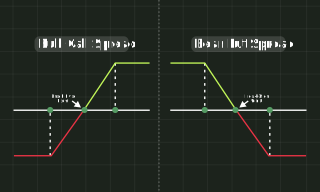
In a vertical spread, you both buy and sell options of the same type. Either both of these options are calls or both of them are puts.
The expiration date on the options is the same; however, the strike prices are different. The option that you sell helps offset the cost of the setup through the premium that you collect.
These setups may work well when a trader has a defined directional bias but wants to maintain clear visibility of both the potential gains and losses of the trade. Bull call spreads are commonly used when traders anticipate upward moves, while bear put spreads are often applied when traders expect potential declines.
Iron Condors
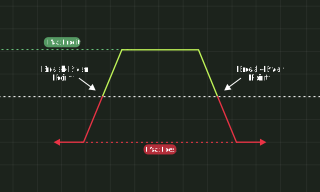
The iron condor is a strategy that consists of a short call spread and a short put spread. This setup can potentially benefit if the underlying asset’s price stays within a certain range.
This is a neutral strategy that may perform better in low-volatility environments. The two spreads are placed far enough apart to give the trade room, but close enough to potentially collect a premium.
Since both spreads are credit positions, time decay can work in the trader’s favor, and risk is limited to the width of the widest spread minus the net credit received.
Butterflies
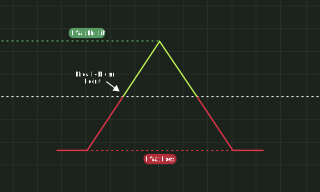
A butterfly spread uses three strike prices to create a position that has one peak profit zone. The trader buys one option at a low strike, sells two at a middle strike, and buys one at a high strike, all calls or all puts, with the same expiration.
This strategy is structured to perform best if the price converges near the middle strike at expiration, though actual results depend on market movement. It can potentially be useful when a trader expects minimal movement and aims to target a specific price level while keeping the maximum potential loss of the trade clearly defined.
Straddles
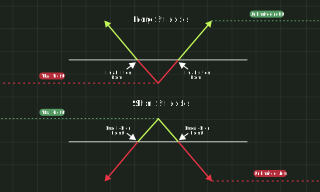
A long straddle combines a call and a put at the same strike and expiration, and can be used by traders who expect significant price swings in either direction, such as around earnings or major news.
The main challenge is that both legs lose value if the underlying remains flat. For the trade to capture gains, the post-event move would need to be large enough to cover the combined premium paid.
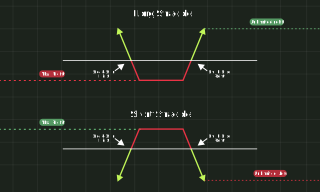
Strangles
Similar to a straddle, a strangle involves buying a call and a put at different, out-of-the-money strike prices. This lowers the upfront cost but requires a larger move in the underlying to cover the combined premium paid.
It’s often chosen when a trader anticipates a sharp move but is less certain about the direction and aims to reduce the upfront premium.
How Multi-Leg Orders Work in Practice
In practice, multi-leg options are placed as a single, unified order, which allows all legs of the trade to be executed together and at once. A coordinated entry like this ensures that the intended structure of the trade remains intact and that issues like partial fills or mismatched prices, which could change the setup’s risk and reward profile, are avoided.
The process starts with building the position in the order ticket. Each leg is added with its strike and expiration based on the strategy’s design. For example, a bull call spread might pair a purchased call near the current price with a sold call at a higher strike to offset cost. Once the order is sent, it’s routed as a package; either all legs fill or none do.
Strike selection and expiration alignment are important for maintaining the payoff structure. Most multi-leg trades can use the same expiration for all legs, but more advanced strategies may mix expirations to manage exposure to time decay in specific ways. Regardless of the setup, matching the legs to the market outlook is key.
Margin requirements depend on the type of strategy. Defined-risk positions like vertical spreads generally need less margin because the maximum loss is capped. Undefined-risk combinations, which leave one or more legs uncovered, can require more collateral.
Risk and Reward in Multi-Leg Options
Every multi-leg strategy has a defined relationship between potential gains, maximum loss, and break-even points. Understanding these numbers before entering is essential, as they determine whether the trade aligns with your market outlook and risk tolerance.
Maximum potential gains are often capped in strategies like vertical spreads, condors, or butterflies. This cap is set by the distance between strike prices, minus any net premium paid or plus any premium received. In return for this limit, traders may gain the benefit of predefined risk and the potential for a higher probability of capturing gains compared to outright long options.
Maximum loss is equally important. In defined-risk trades, it’s limited to the net premium paid or the difference between strikes minus the credit received. In undefined-risk trades, such as uncovered legs, losses can be significantly larger, making them unsuitable for many traders without sufficient margin and risk controls.
Break-even points mark the price level or levels the underlying must reach for the position to begin offsetting the combined premium paid. These vary by strategy, and some have more than one break-even, as in iron condors or strangles. Knowing these points helps set realistic expectations and plan exits.
Volatility plays a major role in how these trades perform. Long volatility positions like straddles can benefit from sharp moves, while short volatility positions like credit spreads thrive in quiet markets where prices remain stable. A change in implied volatility after entry can shift the trade’s value even without significant price action.
Time decay, or theta, can also work for or against a position. Strategies that sell options can potentially benefit from time decay, as the value of the sold legs erodes. Conversely, long multi-leg setups may see value decline if the expected move doesn’t happen quickly enough.
Position sizing ties it all together. Even a well-structured trade can lead to outsized losses if too much capital is committed. Limiting position size to a set percentage of available capital ensures no single trade can cause significant damage.
Selecting the Right Strategy for Market Conditions
Matching the strategy to the market environment is what makes multi-leg options effective. The same setup can perform well in one scenario and poorly in another, so it starts with a clear market outlook.
In bullish conditions, traders may favor debit spreads like bull call spreads, which define risk while allowing for upside participation. Bearish markets can call for bear put spreads or bearish credit spreads that can benefit if prices move lower. For sideways or range-bound markets, neutral strategies such as iron condors or butterflies can generate returns as long as the underlying stays within a set range.
Volatility levels are another factor. High implied volatility makes buying options expensive, so traders might lean toward selling premium through credit spreads or condors to take advantage of inflated prices. Low implied volatility can make long premium strategies more attractive, as the cost of entry is lower and there’s more room for volatility to expand.
Specific events also influence strategy selection. Earnings announcements, economic reports, or major news can create short-term volatility spikes. Straddles and strangles can be used when large moves are expected, but direction is uncertain. For traders who expect the event to pass without major disruption, credit spreads can capture premium while defining risk.
Broader market sentiment plays a role as well. In strong uptrends, pullbacks may present opportunities for bullish spreads at more favorable prices. In uncertain or choppy conditions, neutral positions that rely on time decay can reduce directional exposure.
Ultimately, the best fit comes from aligning the trade’s structure, strikes, expirations, and risk profile with both the expected price movement and the volatility backdrop. Aligning a strategy with the market environment may improve its effectiveness, though results can vary widely depending on timing and execution.
Mistakes to Avoid in Multi-Leg Trading
One of the most common mistakes is entering a position without fully understanding how each leg contributes to the overall trade. Every leg affects risk, reward, and sensitivity to market factors like volatility and time decay. Without a clear grasp of these relationships, traders may be caught off guard by how the position behaves after entry.
Overcomplicating the setup is another pitfall. While multi-leg strategies can be powerful, adding too many legs without a clear purpose can make the trade harder to manage and increase transaction costs. Sticking to well-defined structures keeps execution simpler and monitoring more straightforward.
Liquidity is often overlooked. Placing a trade in options with wide bid-ask spreads can lead to poor fills and unnecessary slippage, especially when trying to exit quickly. Focusing on liquid contracts with tight spreads can improve execution and reduce cost.
Poor exit planning is also a risk. Entering a trade without defined profit targets or stop levels can lead to hesitation and missed opportunities. Having a clear plan before placing the order, including when to cut losses, ensures decisions aren’t made under pressure.
Avoiding these mistakes starts with preparation: knowing the purpose of each leg, keeping strategies manageable, choosing liquid contracts, and setting clear exit rules. Doing so helps preserve the advantages of multi-leg trading while reducing avoidable risks.
Taking Multi-Leg Options to the Next Level
Once you’ve gotten a good handle on the basics, the next logical step is to refine your approach to attain a greater degree of precision and adaptability.
The most straightforward way to do this is by combining strategies to tailor them to current market conditions. To use an example, a trader might pair a debit spread with a calendar spread to target both a directional move and favorable time decay conditions.
This is the stage in the journey in which technical analysis plays the largest role. To advance beyond a certain level, using chart patterns, charting support and resistance levels, and utilizing technical indicators such as moving averages (MAs) to fine-tune your approach becomes mandatory.
Platform features also start playing a much more important role at this stage. Having access to advanced order routing can help users secure better fills on their traders, while advanced charting tools go a long way in making technical analysis easier to do.
It’s impossible to cover (at least succinctly) all the ways in which the choice of a platform has an effect on the trading experience. Some traders might prioritize monitoring tools that track individual leg performance, while others could place a higher priority on low trading fees.
Finally, we have the ever-important topic of risk management. Remember, even advanced structures like these can fail if volatility shifts sharply or if the market moves faster than expected. Limiting the number of open complex trades, keeping the size of your positions reasonable, and having predefined exit rules that are followed to the letter can protect your capital in the long run while still allowing for strategic experimentation.
What are the risks involved with Multi-Leg Options?
Multi-leg options strategies carry several risks that traders should evaluate carefully, even though they often provide defined risk and structured payoffs.
- Because these strategies involve multiple contracts, traders face higher transaction costs and wider bid-ask spreads, which can impact profitability or make adjustments more expensive.
- Complex positions are also sensitive to changes in implied volatility, time decay, and directional movement, and each leg may react differently, creating outcomes that can be difficult to predict without experience.
When the structure includes short American-style options, traders may face early-assignment risk, especially around dividends or expiration.
Multi-leg strategies can also be affected by liquidity constraints, slippage, and sudden volatility spikes, which may push the position toward its maximum loss more quickly than expected.
Since many multi-leg spreads require the underlying asset to stay within specific price ranges, accelerate in a certain direction, or reach defined targets, traders should ensure they understand how the legs interact and use disciplined position sizing and risk management.
Conclusion
Multi-leg options bring a lot to the table, giving traders the ability to define risk, shape reward, and align trades with current market conditions. Through combining calls and puts into a single, structured position, enterprising traders can benefit not just from price movement, but volatility changes and time decay, sometimes, all at once.
The key to success lies in having an understanding of how each leg of a setup contributes to the overall structure. With that in mind, traders can select the right strategy for the current market environment and have a clear understanding of what the rules for entering and exiting a trade are.
You shouldn’t take multi-leg strategies lightly, as embarking on this journey requires a solid understanding of how options trading works, as well as a decent amount of experience with single-leg strategies. However, if you meet those criteria, expanding into multi-leg options allows traders to access a wide variety of strategies that provide more control over risk and reward in different market scenarios. While these approaches can be useful, they require careful study and risk management.
Disclaimer
This content (“Content”) is produced by Tokenist Media LLC. The Content represents only the views and opinions of Tokenist Media LLC.Tokenist Media LLC’s trading experiences and accomplishments are unique, and your trading results may vary substantially. Tokenist Media LLC is a paid marketing partner of TradeZero that receives compensation from TradeZero for broadcasting, displaying, and/or presenting marketing and sponsorship materials that promote TradeZero. TradeZero does not endorse the Content and makes no representations or warranties with respect to the accuracy of the Content or information available through any referenced or linked third party sites. The Content has been made available for informational and educational purposes only and should not be considered trading or investment advice or a recommendation as to any security.
Trading securities can involve high risk and potential loss of funds. Furthermore, trading on margin is for experienced investors and traders only as the amount you may lose can be greater than your initial investment. Likewise, short selling as a securities trading strategy is extremely risky and can lead to potentially unlimited losses.
Options trading is not suitable for all investors as it can involve risk that may expose investors to significant losses. Please read the Characteristics and Risk of Standardized Options, also known as the options disclosure document (ODD) at https://www.theocc.com/Company-Information/Documents-and-Archives/Options-Disclosure-Document before deciding to engage in options trading. Please also see the Options Trading Disclosure. You must be approved to trade multi-leg options strategies. You may lose all of your principal. Executing multi-leg options orders may result in increased transaction fees compared to single-leg options orders. Multi-leg strategies may exhibit risks such as illiquidity and increased sensitivity to market unpredictability.
TradeZero provides self-directed brokerage accounts to customers through its operating affiliates: TradeZero America, Inc., a United States broker dealer, registered with the Securities and Exchange Commission (SEC) and member of the Financial Industry Regulatory Authority (FINRA) and the Securities Investor Protection Corporation (SIPC); TradeZero, Inc., a Bahamian broker dealer, registered with the Securities Commission of the Bahamas;TradeZero Canada Securities ULC, a Canadian broker dealer, member firm of the Canadian Industry Regulatory Organization (CIRO) and member of the Canadian Investor Protection Fund (CIPF) and TradeZero Europe B.V., a Dutch broker dealer, authorized and regulated by the Dutch Authority for the Financial Markets (AFM) (collectively, the “TradeZero Broker Dealers”).