Are We Consolidating for New All-Time Highs?
May 26, 2026

HYG — Junk Bond Watch
HYG had a relatively weak week as rising Treasury yields and renewed inflation concerns pressured the credit markets.
Why it matters for stocks:
- When HYG is strong, it suggests investors are comfortable taking risk and credit markets remain supportive for equities.
- When HYG weakens, it often signals growing concern about economic growth, rising default risk, tighter financial conditions, or declining liquidity.
Bond Yields Are Nearing the Danger Zone
Attribution: The following section summarises reporting from Barron’s. Included for informational and educational purposes only. Not investment advice. Please verify the exact article title, author, and date before publication.
Key Points
- U.S. Treasury yields surged, with the 30-year hitting 5.20% and the 10-year topping 4.68%, driven by rising oil prices.
- Sustained yield increases stem from pandemic-era borrowing, persistent deficits, and elevated inflation. U.S. federal debt exceeds 100% of GDP.
- Higher yields pressure equity valuations and corporate borrowing. 62% of fund managers in Bank of America’s most recent survey expect the 30-year yield to exceed 6% within 12 months.
Bond yields rose this month to levels that are setting off alarm bells across financial markets. The 30-year U.S. Treasury bond yield hit 5.20% on May 19 — its highest level since mid-2007, just before the 2008–09 financial crisis. The 10-year yield topped 4.68% the same day before retreating, but remains above 4.50%.
The trend is global: yields on U.K. gilts, German Bunds, and Japanese government bonds have also been climbing, in tandem with a rise in crude oil prices since the Iran war began in late February. West Texas Intermediate, the U.S. benchmark crude, nearly doubled to just under $113 a barrel on April 7 from about $67 a barrel on February 27, the day before the war began. Crude prices have since retreated to the low-$100s, but even at those levels they are creating inflationary pressures that may not dissipate soon.
Robin Brooks, senior fellow at the Brookings Institution and former chief economist at the Institute for International Finance, cites three reasons for the sustained rise in yields since the 10-year bottomed near 0.50% in 2020: governments almost everywhere went on an emergency borrowing binge to counter the economic impact of the pandemic; there has been no meaningful reduction in deficits since then; and inflation has remained higher and more volatile than in the years preceding COVID-19.
Total U.S. federal debt held by the public topped 100% of GDP in this year’s first quarter, approaching the post–World War II record of 106%. The Congressional Budget Office estimates the budget deficit will total 5.8% of GDP in 2026 and will average 6.1% annually over the decade through 2036 — far above the 3.8% average of the past 50 years.
A fraught geopolitical environment is pushing up military spending globally. The Trump administration is seeking a 44% increase in military expenditure for fiscal 2027, to a record $1.5 trillion. U.S. interest expense is now running at more than $1 trillion annually, exceeding current military outlays.
“For years, foreign investors, starved for yield at home, exported capital into U.S. Treasuries. As domestic yields abroad rise, that incentive weakens. The U.S. government must compete for buyers of its debt on its own merits in a world of high government deficits and rising inflation.”
— Yardeni Research
The futures market now sees a 70% probability of a Federal Reserve rate hike of at least one-quarter percentage point by December, according to the CME FedWatch tool — a notable shift from prior expectations of more than two quarter-point cuts by year-end.
Reflecting these trends, 62% of respondents to Bank of America’s most recent fund manager survey indicated they anticipate the 30-year Treasury yield will top 6% in the next 12 months. That sort of surge would place significant pressure on equities.
This Week’s Sector Piece: AI Chip Stocks
1. Micron Technology (MU)
Micron ranks highly among quantitative screens, supported by strengthening tailwinds and rapidly improving pricing dynamics. Citi recently raised its price target significantly, pointing to aggressive DRAM price hikes and a potential multiyear upcycle that analysts suggest could extend through 2027. Assessed across quantitative metrics, Micron’s story remains compelling, with strong growth indicators across multiple categories. Past performance is not indicative of future results.
2. Sandisk Corporation (SNDK)
Sandisk stands out in the NAND storage space, with demand and pricing both supported by AI workloads. Citi also raised its price target by more than 50%, citing strong storage demand, a favorable pricing backdrop, and long-term agreements that support gross margins. Sandisk reported Q3 revenue growth of more than 250% year over year, with adjusted gross margin reaching 78% — earning an ‘A+’ Profitability grade in Seeking Alpha’s quantitative framework, with a net income margin more than four times the sector median. Past performance is not indicative of future results.
3. Ichor Holdings, Ltd. (ICHR)
While Ichor is not a pure-play semiconductor company, it is a key upstream supplier in the chip stack, designing specialized fluid delivery systems for semiconductor fabs. Key highlights from Ichor’s Q1 results included revenue of $256 million and an adjusted EPS beat of $0.02. Management guided Q2 revenue to $290–$310 million with further margin expansion.
“Demand across our core markets has further strengthened since our last earnings call. Our visibility now extends deeper into 2026. Within this very robust demand environment, we expect Ichor to be a top performer, both in terms of growth and earnings leverage. Our Q2 forecast now reflects unconstrained demand exceeding $300 million. This is one of the steepest ramps witnessed in Ichor’s history, representing growth well over 30% in just two quarters.” — Philip Barros, CEO, Ichor Holdings — Q1 2026 Earnings Call. Forward-looking statements represent management’s views and are not a guarantee of future performance.
Key Events and Data Points to Monitor
The items below reflect Richard Naso’s personal areas of focus for the coming week and are provided for informational and educational purposes only. They do not constitute investment advice or a recommendation to trade any security.
WATCH LIST — WEEK OF MAY 26, 2026
- PCE Report — The Fed’s Preferred Inflation Gauge
Could heavily influence the Fed’s rate path and near-term market direction
- Treasury Yields — Still the Biggest Macro Driver
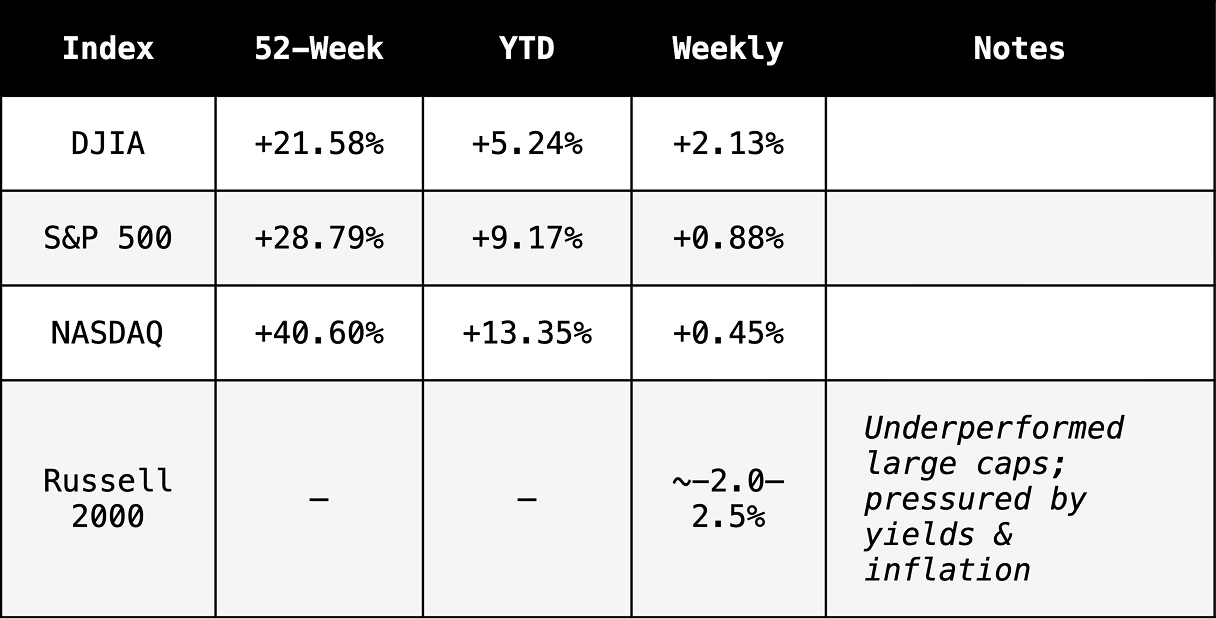
Continued strength in the 10-year could pressure high-valuation growth stocks and small caps
- Oil Prices
Sustained strength increases inflation concerns and reduces the likelihood of aggressive Fed rate cuts
- Market Breadth
Monitor whether weakness spreads beyond small caps into the broader market
- Russell 2000 and HYG — Risk Appetite Indicators
Continued weakness in either would signal tightening financial conditions and growing investor caution
Richie’s Take
The tape feels more defensive right now. This is no longer a market where investors can ignore macro risks. The bond market is beginning to matter again, and next week could become an important test of whether this remains a healthy consolidation — or the early stages of a broader correction.
— Richie
Sources
[1] Market performance data — DJIA, S&P 500, NASDAQ, Russell 2000, HYG. (Please confirm primary source.)
[2] Bond Yields Are Nearing the Danger Zone — Barron’s. (Please confirm author, full date, and page number before publication.)
[3] AI Chip Stocks analysis — Seeking Alpha. (Please confirm author and full date before publication.)
[4] Ichor Holdings Q1 2026 Earnings Call Transcript — Philip Barros, CEO.
[5] Final Thoughts — Richard Naso’s personal opinion and market commentary.
Disclaimer
This content (“Content”) is produced by Richard Naso. The Content represents only the views and opinions of Mr. Naso, who is compensated by TradeZero for producing it. Mr. Naso’s trading experiences and accomplishments are unique, and your trading results may vary substantially from his. TradeZero does not endorse the Content and makes no representations or warranties with respect to the accuracy of the Content or information available through any referenced or linked third-party sites. The Content has been made available for informational and educational purposes only and should not be considered trading or investment advice or a recommendation as to any security.
Past performance referenced in this Content is not indicative of future results. Any trading strategies discussed are for educational purposes only and should not be construed as investment advice or a recommendation.
Trading securities can involve high risk and the potential loss of funds. Trading on margin is for experienced investors and traders only, as the amount you may lose can be greater than your initial investment. Short selling as a securities trading strategy is extremely risky and can lead to potentially unlimited losses. Options trading is not suitable for all investors as it can involve risk that may expose investors to significant losses. Please read the Characteristics and Risks of Standardized Options (the Options Disclosure Document, or ODD) at theocc.com/Company-Information/Documents-and-Archives/Options-Disclosure-Document before deciding to engage in options trading.
TradeZero provides self-directed brokerage accounts to customers through its operating affiliates: TradeZero America, Inc., a United States broker-dealer, registered with the SEC and member of FINRA and SIPC; TradeZero, Inc., a Bahamian broker-dealer registered with the Securities Commission of the Bahamas; TradeZero Canada Securities ULC, a Canadian broker-dealer, member of CIRO and CIPF; and TradeZero Europe B.V., a Dutch broker-dealer authorized and regulated by the AFM under MiFID II (collectively, the “TradeZero Broker Dealers”).