Triple Top Pattern: How Short Sellers Use This Bearish Signal to Capitalize on Fading Momentum
March 16, 2026

Triple Top Pattern
By: Shane Neagle
The triple top is one of the most distinctive chart patterns. It forms when a stock attempts to break through the same resistance level three separate times — and fails on each attempt.
This repeated rejection often signals that sellers are beginning to regain control and that an asset has reached a top.
Triple tops typically emerge after an extended uptrend — what follows, in many cases, is a breakdown below support — and this shift opens the door for aggressive short sellers to take advantage of the reversal.
Although some mistake the third peak for renewed strength, traders familiar with the structure know better. Once confirmation appears in the form of a support break, the pattern may provide traders with a visual reference for defining risk when evaluating potential entries.
With TradeZero’s real time short-locate tools, commission-free trading (on all order types via NASDAQ, NYSE, and AMEX above $1 from 7am-8pm ET), and access to hard-to-borrow names, traders can access resources designed to support participation in setups as they develop.
What Is the Triple Top Pattern?
A triple top is a bearish reversal pattern defined by three distinct peaks that form near the same price level, with two pullbacks in between. The pullbacks are commonly referred to as troughs or valleys.
These peaks reflect repeated attempts to break through resistance — and in the case of the Triple Top pattern, each one fails to generate follow-through as buying pressure diminishes.
The pattern begins to take shape after a sustained uptrend, when a stock approaches a key resistance area. The first rejection may appear routine, but as price returns to test the same level a second and third time — only to fail again — it signals that demand is weakening.
This inability to make new highs suggests that bullish momentum is beginning to lose steam, and that the bears are beginning to step in more aggressively.
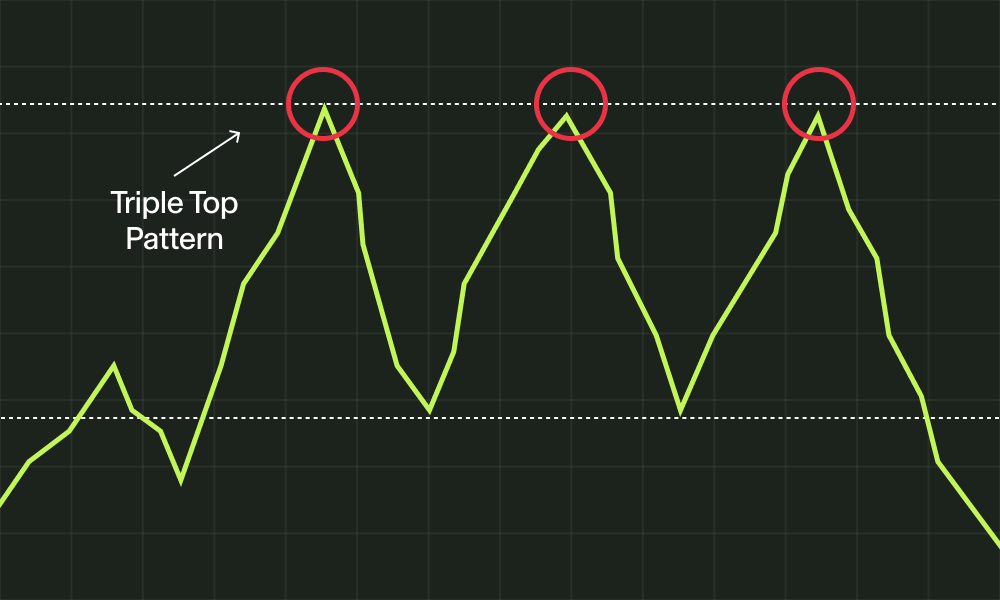
Compared to other common and easily recognizable bearish reversal stock chart patterns like the head and shoulders or double top, the triple top stands out for its horizontal structure and visual clarity.
The resistance zone typically remains flat, offering a clean level for traders to monitor — but that simplicity can oftentimes be deceptive. It’s common for the third peak to trigger a breakout attempt, which traps the buyers who expect continuation.
These failed breakouts often add momentum to the eventual breakdown as stop-losses trigger and long positions unwind. By recognizing the difference between a valid breakout and a reversal trap, short sellers can use the third peak as an early signal to prepare.
The defining moment, however, comes when price breaks below the horizontal support formed by the two intervening lows. That breakdown confirms the shift from accumulation to distribution — and often accelerates as trapped longs begin to exit and short sellers enter with conviction.
Triple tops reflect a structural transition in control — they mark the moment when optimism stalls, resistance holds firm, and a bearish trend starts to unfold.
How to Identify a Valid Triple Top
The structure of the Triple Top is simple — but if recognizing basic shapes was all that was required, everyone would be a successful stock trader. Identifying a valid triple top requires more than spotting three peaks on a chart — traders also need to assess price action, structure, volume, and look for confirmation before taking action.
The three peaks of the pattern should be relatively equal in height or price. While these peaks don’t need to be 100% identical, they should still be close enough in height to suggest a clear ceiling beyond which buying pressure fades.
Between each peak, the stock typically pulls back to a similar support level — creating two reaction lows that form a horizontal baseline. This support line is used as the key reference point for confirming the validity of the Triple Top chart pattern.
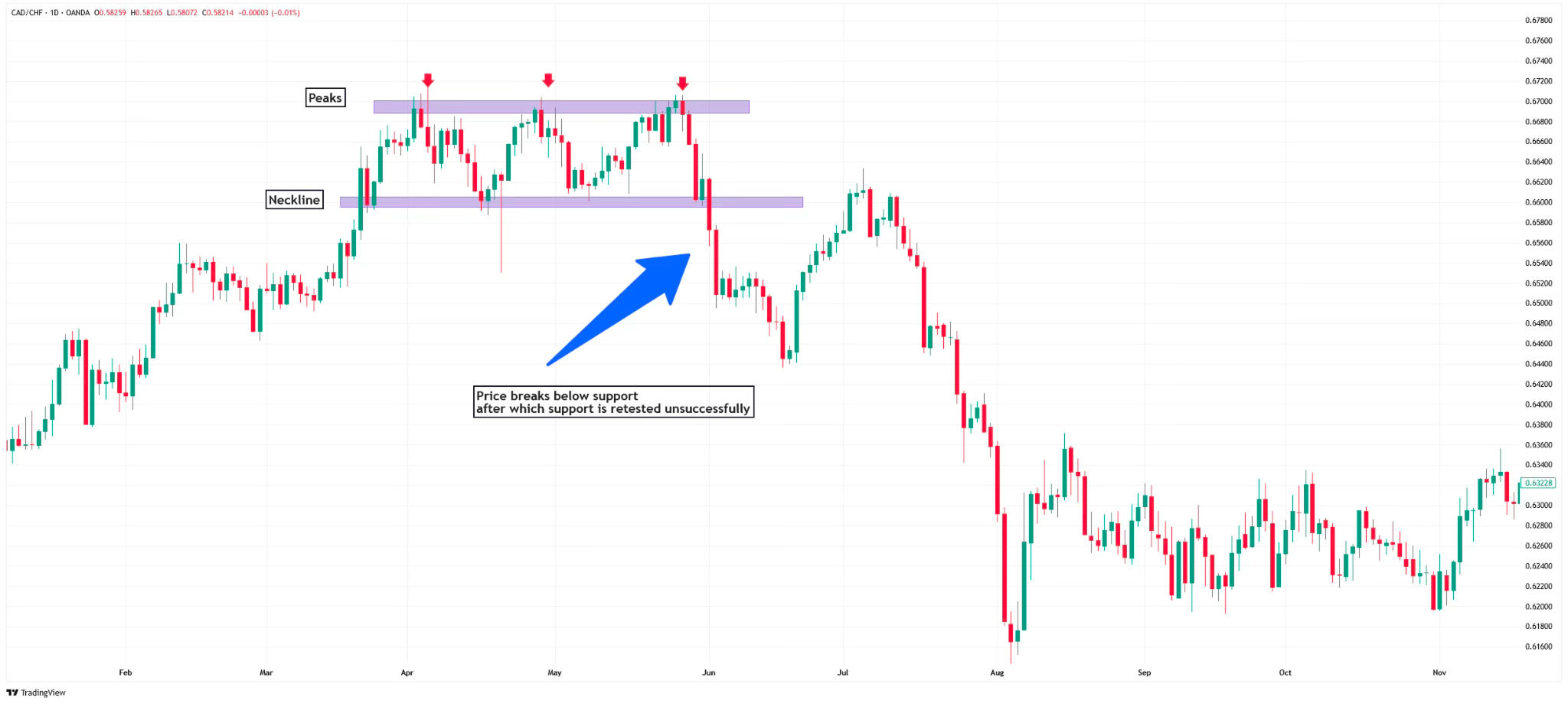
Moreover, short sellers should also pay heed to the pattern’s duration. The length of time in question plays a key role in validating the pattern.
Triple tops that form over multiple sessions — or better yet, across several weeks — suggest more meaningful distribution. Quick, intraday versions may still work, but they’re much more likely to be invalidated and fizzle out.
Savvy traders also tend to seek confluence from other signals: a Relative Strength Index (RSI) that prints a lower high at the third peak, moving averages acting as dynamic resistance, or price stalling under volume-weighted average price (VWAP) can all strengthen the case.
Rather than relying solely on shape, experienced traders combine structure with context — ensuring the setup has weight before stepping in.
Finally, we have yet another key component of technical analysis — volume. With Triple Tops, the peaks often form on declining or moderate volume — which reflects diminishing buying interest. When the pattern completes, a valid breakdown occurs when price closes below support on strong volume, which gives a clear signal that sellers have taken control.
Acting too early — especially at the third peak — exposes traders to the risk of a failed breakdown or squeeze. Until a decisive close through support happens, the pattern remains incomplete. While getting in early does provide the potential for greater returns, it also leads to more failed setups.
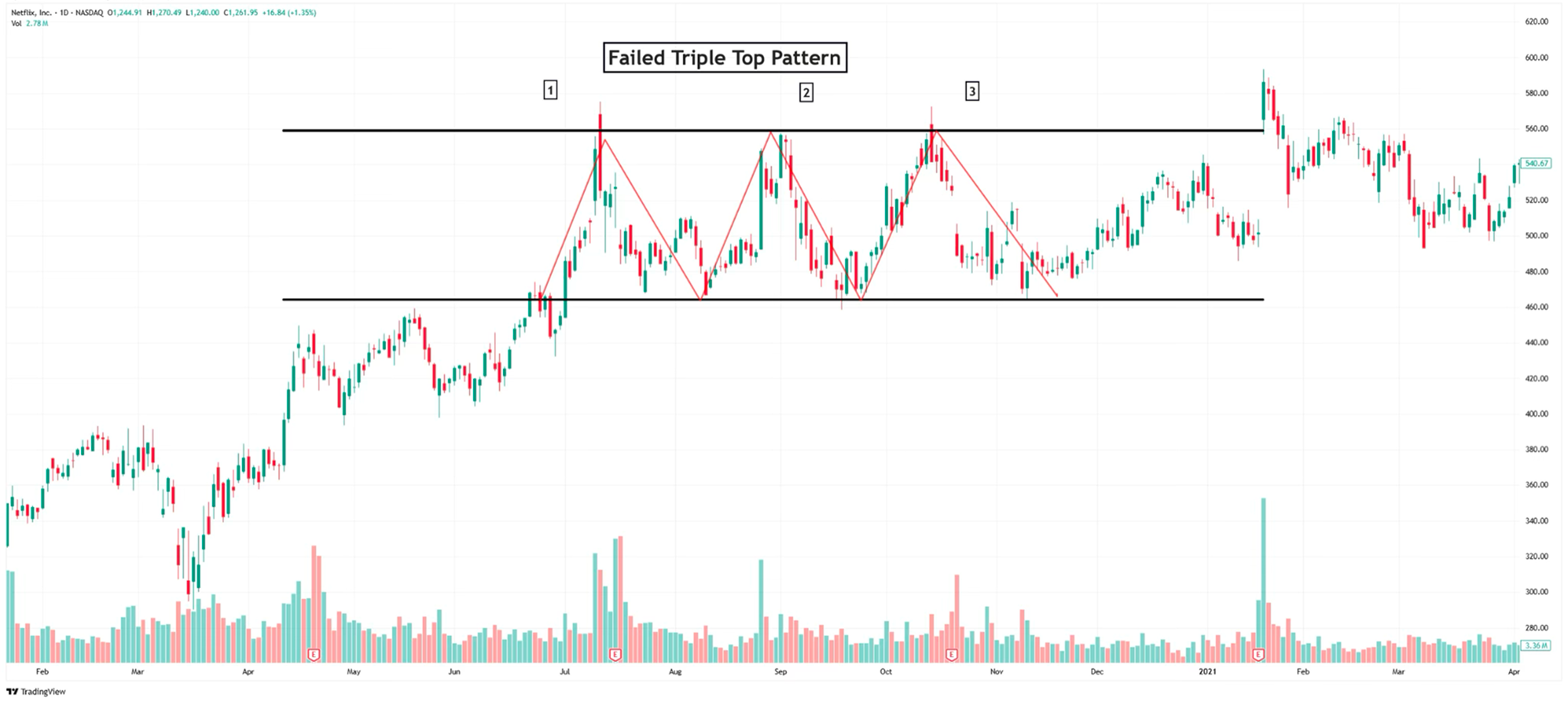
Why Triple Tops Matter for Short Sellers
Beyond being a structural setup, Triple also offers insight into crowd behavior at key turning points. For short sellers, the pattern reveals exhaustion, hesitation, and the early signs of a shift in momentum.
Each failed breakout attempt that occurs chips away at and diminishes buyer confidence. The first rejection might be shrugged off. The second starts to raise some questions. By the time the third peak rolls around, many traders start to recognize that resistance won’t be breaking — it is, at this point, in fact, holding.
That third attempt often becomes the trigger. For long-biased traders, it’s a cue to either tighten stops or trim exposure. For short sellers, the third peak marks the moment where one should begin to prepare for a potential reversal.
Once support finally gives out, prices tend to move quickly. A breakdown below support is often interpreted by some traders as a sign of weakening buyer control, which may lead to increased selling pressure.. In high-volume or crowded names, this can even trigger short squeezes and forced liquidations — making execution speed and risk control essential.
Ultimately, triple tops are monitored by short sellers as one possible way to identify weakening momentum near resistance — not by chasing highs, but by waiting for momentum to break down.
Key Risk Management Tips When Trading Triple Tops
Trading triple tops without a clear risk plan can quickly backfire — especially in volatile names or crowded setups. While the pattern can be appealing to some traders, it also requires discipline and careful risk management at each stage of evaluation.
The most common mistake is shorting too early — assuming the third peak will hold without waiting for confirmation. A better approach is to treat the third top as a warning, not an entry. Only once the stock breaks through support with volume should a short position be considered.
Protective stops are critical. Traders often place them just above the most recent high — typically the third peak — to limit losses in case of a failed breakdown or squeeze.
Profit targets are usually mapped out using the height of the pattern. Measuring the distance between resistance and support — in this case, the height between the peaks and support, gives a rough projection for downside, helping traders stay objective as the move unfolds.
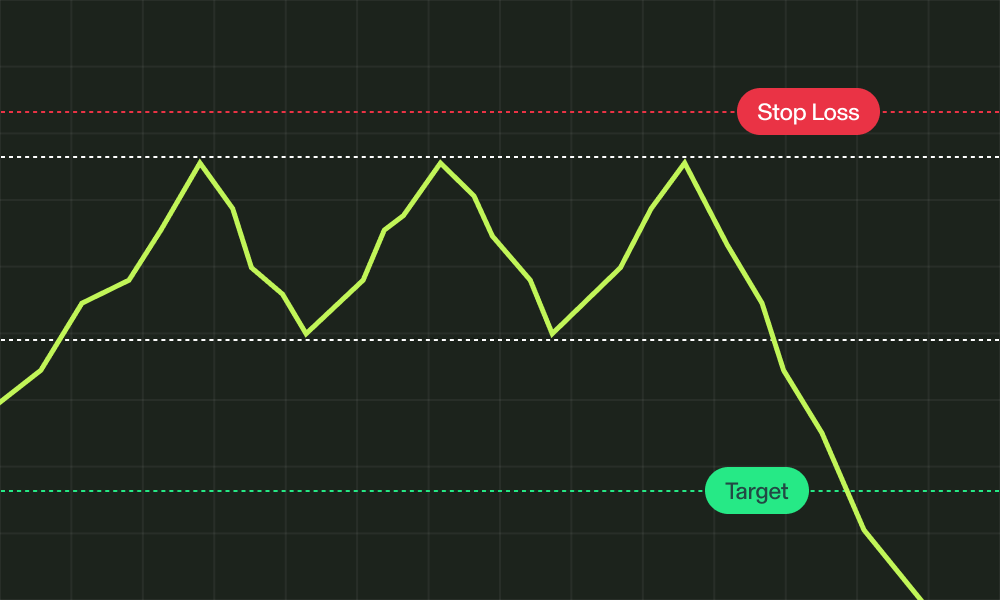
Accurate position sizing can make or break a trade — especially in fast-moving names. Some traders choose to scale in — starting small at the breakdown and adding size only after continued weakness confirms the move.
This allows for risk control early while still building exposure into momentum. Equally important is the use of invalidation signals. A reclaim of the former support zone, a strong intraday trend shift, or a bullish engulfing candle near the stop level may indicate the pattern has failed.
In high-volatility or low-float names, sizing becomes even more important. Reducing exposure helps absorb noise and avoid outsized losses in names that can move quickly or unpredictably.
Clear confirmation, defined stops, and adjusted sizing — those are the pillars of risk management when trading triple tops. Without them, even strong setups can become costly lessons.
Why the Triple Top Pattern Works Well for TradeZero Traders
Triple tops often develop in fast-moving small caps — the kind of stocks that attract heavy speculation, sharp reversals, and sudden breakdowns. For short sellers trading these setups, timing and access are everything.
TradeZero’s real-time short-locate tool allows traders to request shares in advance of potential setups, which some find useful in fast-moving markets. Once support gives out, hesitation can mean missing the move — but with the right tools, traders can position themselves ahead of the crowd.
The platform’s commission-free structure also supports tactical execution. Whether scaling into a position near resistance or trimming into weakness after confirmation, traders have the flexibility to manage risk without overthinking costs.
When a breakdown unfolds, access is often the difference-maker. TradeZero provides tools to help traders locate and short hard-to-borrow stocks, supporting participation in setups such as the triple top with structure and speed.
Conclusion
Triple tops are often viewed as a recognizable chart pattern that traders watch when assessing potential fading strength. When resistance holds firm through multiple attempts, and momentum stalls out, the setup becomes a prime opportunity for short sellers who wait for confirmation.
The pattern shows up often in small-cap names and hype-driven moves — but it only becomes actionable when structure breaks and sellers take control. For traders who come prepared with a plan, the triple top offers clearly defined risk, strong reward potential, and a repeatable edge in momentum-driven markets
Disclaimer
This content (“Content”) is produced by Tokenist Media LLC. The Content represents only the views and opinions of Tokenist Media LLC.Tokenist Media LLC’s trading experiences and accomplishments are unique, and your trading results may vary substantially. Tokenist Media LLC is a paid marketing partner of TradeZero that receives compensation from TradeZero for broadcasting, displaying, and/or presenting marketing and sponsorship materials that promote TradeZero. TradeZero does not endorse the Content and makes no representations or warranties with respect to the accuracy of the Content or information available through any referenced or linked third party sites. The Content has been made available for informational and educational purposes only and should not be considered trading or investment advice or a recommendation as to any security.
Trading securities can involve high risk and potential loss of funds. Furthermore, trading on margin is for experienced investors and traders only as the amount you may lose can be greater than your initial investment. Likewise, short selling as a securities trading strategy is extremely risky and can lead to potentially unlimited losses. Options trading is not suitable for all investors as it can involve risk that may expose investors to significant losses. Please read the Characteristics and Risks of Standardized Options, also known as the options disclosure document (ODD) at OCC before deciding to engage in options trading.
TradeZero provides self-directed brokerage accounts to customers through its operating affiliates: TradeZero America, Inc., a United States broker dealer, registered with the Securities and Exchange Commission (SEC) and member of the Financial Industry Regulatory Authority (FINRA) and the Securities Investor Protection Corporation (SIPC); TradeZero, Inc., a Bahamian broker dealer, registered with the Securities Commission of the Bahamas; and TradeZero Canada Securities ULC, a Canadian broker dealer, member firm of the Canadian Industry Regulatory Organization (CIRO) and member of the Canadian Investor Protection Fund (CIPF).