Bearish Engulfing Pattern: How Short Sellers Spot and Trade Momentum Reversals
March 16, 2026

Bearish Engulfing Pattern
By: Shane Neagle
The bearish engulfing pattern represents a clear shift in momentum from buyers to sellers and signals that bullish control is ending. Visually, it consists of two high conviction candles - a smaller green candle followed by a larger red one that completely engulfs the previous day’s body.
For short sellers, this pattern is often studied because of its simple and clear visual structure, which may suggest potential areas for entries and exits.
In general, short sellers trade in volatile situations with sharp price movements, which coincides with the bearish engulfing pattern. Short sellers using the pattern require easily available stocks to borrow, which can be acquired through platforms such as TradeZero, aligning perfectly with bearish strategies focused on timing clean reversals and managing risk.
What Is the Bearish Engulfing Pattern?
The bearish engulfing pattern is a two-candle formation that signals a potential reversal after a bullish move. On the chart, the pattern is confirmed when a large red (bearish) candlestick completely engulfs the prior green (bullish) candlestick. If the second one does not fully engulf the first one, the pattern is not confirmed.
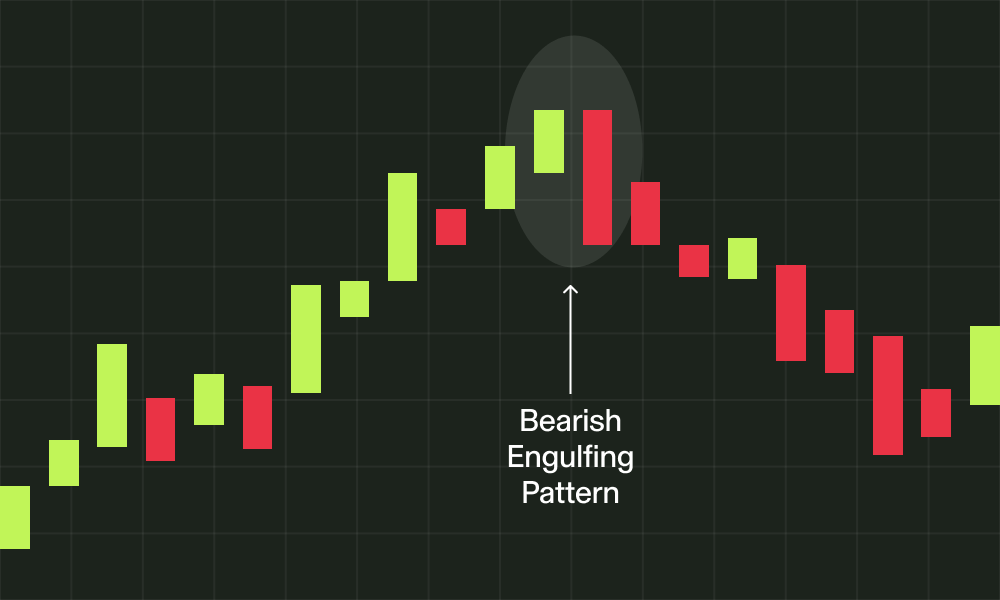
At its core, this pattern shows that a stock that had been steadily climbing has now reversed, and may begin trending lower. The first candle reflects bullish continuation. The second candle opens higher, but sellers take over and drive the price below the previous session’s low.
This reversal can happen for several reasons. It may follow a negative news catalyst, such as weak earnings, guidance cuts, analyst downgrades, or sector-wide pressure. But often, no news is needed. The pattern also forms due to technical exhaustion, where buying slows at key resistance or in overbought conditions, triggering a shift in sentiment.
Psychology Behind the Pattern
The bearing engulfing pattern occurs when the stock seems to be in a state of stable growth. Late buyers are coming in raising the volume, however an unexpected event occurs that involves sellers. Whether it is just traders looking to sell to make profits or some negative financial report or detrimental news, but buyers are caught off guard.
The open pushes higher, validating bullish assumptions, yet sellers step in aggressively. That rejection isn’t random. It often comes from profit-taking by early longs, institutional selling, or smart money fading euphoric moves. The sharp reversal catches new buyers off guard, flipping confidence into confusion.
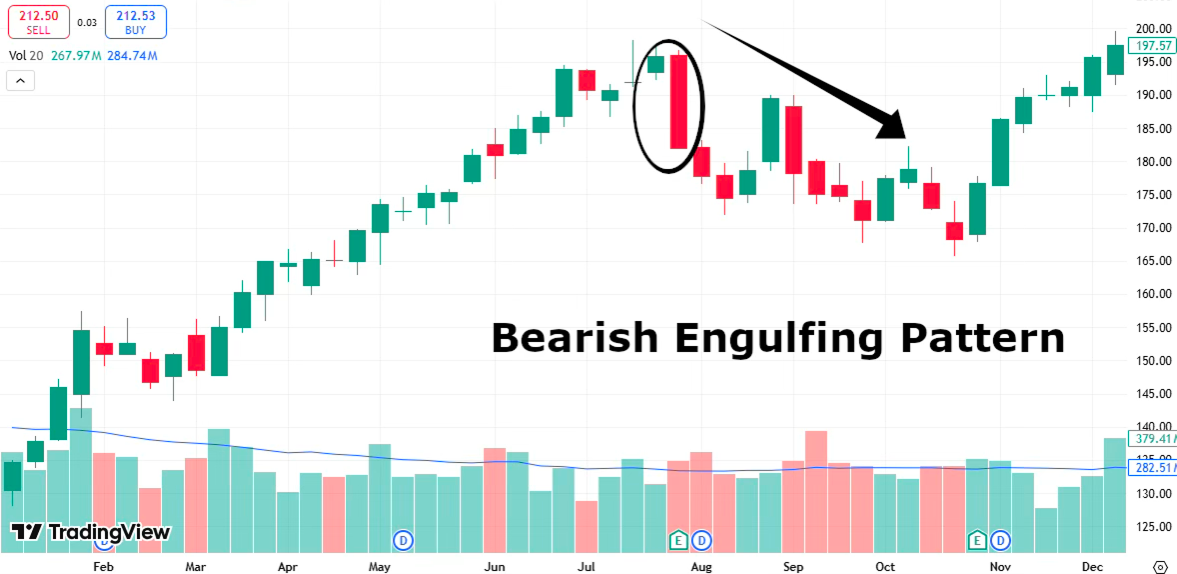
Once the close undercuts the previous day’s range, trapped longs begin to react. Some traders quickly cut losses, while others hesitate, hoping for a rebound. Indecisive traders are what makes this pattern come to fruition, eventually forcing them to reassess.
While the first wave was mostly profit-oriented, the second wave of selling is often psychological. On top of technical traders, it is also disappointed buyers exiting and former bulls flipping short. The emotional feedback loop builds: failed breakout, panic, lower prices, more exits.
What began as a routine push higher becomes a shift in tone. The psychology flips from conviction to vulnerability. The engulfing pattern doesn’t just show that the market turned, but rather it reveals that sentiment cracked, and that crack is what gives the move traction.
How to Confirm and Trade the Bearish Engulfing Pattern
Traders who want to use the bearish engulfing pattern must take into account other factors. Active traders who analyze previous highs, extended technical levels, or sustained uptrends may find the pattern easier to interpret in context.
Most importantly, traders who are looking for confirmation will have the highest chances of success. The volume spike suggests conviction behind the reversal and indicates that selling pressure is broad-based, not just isolated profit-taking. Another useful confirmation tool is the Relative Strength Index (RSI). If the stock was overbought before the reversal, the signal becomes more credible. A break of a rising trendline or close below a short-term moving average can further reinforce the bearish shift.
No trading strategy is complete without risk management and timing. Some traders view a move below the low of the engulfing candle as a possible confirmation point when evaluating this pattern. This reduces the risk of a failed setup. Short sellers usually place a stop-loss order just above the high of the engulfing candle for an extra layer of risk management.
Traders looking to trade the pattern should also define realistic downside targets. These may include the next support level, a prior consolidation zone, or an unfilled gap. Avoiding arbitrary profit targets helps align the trade with the price structure, making the move more predictable and grounded in technical context.
Finally, the bearish engulfing pattern is rarely a standalone signal. It works best when paired with supporting indicators, price context, and volume confirmation that align with a potential reversal.
Common Mistakes Traders Make
Even though the bearish engulfing pattern appears quite straightforward, traders can still make mistakes. The most common mistake involves timing, or rather, traders being too impatient or too hesitant.
Traders who are trying to jump ahead of the curve by not waiting for confirmation open themselves to unnecessary losses. If the second candle does not engulf the body of the first, the pattern is insignificant because it lacks momentum.
On the other side, traders should not be driven by FOMO and enter technical setups such as this pattern late. If entered late, the trade may already be crowded or losing steam.
In both cases, too early or too late, ignoring timing and structure undermines the pattern’s reliability.
Another frequent mistake is trading the pattern in low-volume or sideways markets. Without strong participation or directional context, the pattern becomes unreliable. Sideways price action tends to produce more false signals, and low volume suggests a lack of conviction from either side.
Finally, ignoring the broader trend or market sentiment can skew results. If the overall market is strong, a bearish pattern on an individual stock may have less impact.
Why the Bearish Engulfing Pattern Appeals to Short Sellers
The bearish engulfing pattern appeals to some short sellers because it suggests established entry and exit points. Access to borrowable shares through platforms such as TradeZero can support those looking to apply short-selling strategies, though outcomes will vary based on market conditions and risk management.
Some traders approach the bearish engulfing pattern by monitoring price action below the low of the engulfing candle and considering stop levels near recent highs, but strategies differ depending on individual style and risk tolerance. Finally, short sellers are looking to cover their positions, depending on their strategy, but most optimally when the stock hits a key downside target or when the momentum stalls or reverses.
The pattern provides clear targets for entry and exit, which attracts many traders using short-selling strategies.
Additionally, this pattern is known to appear in hard-to-borrow stocks, where shorting access becomes a real challenge.TradeZero provides real-time short locate tools including, Single Use Locates, Pre-Borrows, and industry standard Locates. These tools provide users with access to short locates in hard-to-borrow stocks, helping facilitate trades in names that might otherwise be difficult to access.
Conclusion
The bearish engulfing pattern is one of the simplest technical patterns. It provides short sellers with visual reference points for entries and exits, while platforms like TradeZero can help facilitate access to borrowable shares, including those that may be harder to source.
Whether triggered by news or pure technical exhaustion, the pattern reflects a clear sentiment change that can lead to meaningful reversals. However, traders rushing in without context risk mistaking noise for signal. Meaning that traders must look for supporting indicators such as RSI or trendline breaks in order to find the best setup.
Disclaimer
This content (“Content”) is produced by Tokenist Media LLC. The Content represents only the views and opinions of Tokenist Media LLC.Tokenist Media LLC’s trading experiences and accomplishments are unique, and your trading results may vary substantially. Tokenist Media LLC is a paid marketing partner of TradeZero that receives compensation from TradeZero for broadcasting, displaying, and/or presenting marketing and sponsorship materials that promote TradeZero. TradeZero does not endorse the Content and makes no representations or warranties with respect to the accuracy of the Content or information available through any referenced or linked third party sites. The Content has been made available for informational and educational purposes only and should not be considered trading or investment advice or a recommendation as to any security.
Trading securities can involve high risk and potential loss of funds. Furthermore, trading on margin is for experienced investors and traders only as the amount you may lose can be greater than your initial investment. Likewise, short selling as a securities trading strategy is extremely risky and can lead to potentially unlimited losses. Options trading is not suitable for all investors as it can involve risk that may expose investors to significant losses. Please read the Characteristics and Risks of Standardized Options, also known as the options disclosure document (ODD) at OCC before deciding to engage in options trading.
TradeZero provides self-directed brokerage accounts to customers through its operating affiliates: TradeZero America, Inc., a United States broker dealer, registered with the Securities and Exchange Commission (SEC) and member of the Financial Industry Regulatory Authority (FINRA) and the Securities Investor Protection Corporation (SIPC); TradeZero, Inc., a Bahamian broker dealer, registered with the Securities Commission of the Bahamas; and TradeZero Canada Securities ULC, a Canadian broker dealer, member firm of the Canadian Industry Regulatory Organization (CIRO) and member of the Canadian Investor Protection Fund (CIPF).